
Submission success!
Download white paper
Submission success!

We’ve all been there: sitting down for a meal and feeling like something is missing. It’s not that the meal itself is bad (unless you’re eating plain salad with no dressing or toppings, that’s objectively bad—don’t @ us), it could just be missing something. Maybe it’s a seasoning of some kind? Or a little sauce for dipping? Or maybe it’s somebody special you’d like to have with you while you participate in that most common of human experiences: sharing a delicious meal?
Whatever the case may be, we’re willing to bet you know the feeling of something missing—and the feeling when something is truly better when paired with something else. That “better together” feeling, like a delicious peanut butter and jelly sandwich or a soft blanket and your favourite show, is a thing of beauty.
As HR leaders, or a people leader of any kind, you know there are things in your daily work that would be so much more effective and would save you oodles of time if they simply worked together. Indeed, too many of the tools you use as an HR leader are scattered across too many different platforms, and it’s costing you valuable time and effort.
A study by Harvard Business Review recently revealed that by some counts every worker in a corporate environment toggles between apps approximately 1,200 times a day. That equates to “about four hours each week of reorienting after switching apps, and it doesn’t even include the time taken to log in.” Let that sink in for a second. With four extra hours a week, what could you accomplish? How would that impact your life?
Here’s the real point we’re getting at: too many of the tools you use are separated, and they don’t work in tandem to produce something beautiful (like a cold glass of milk and a warm cookie, if you know what we mean). And while we could go on and on and create a big list, we’re going to focus on two aspects of your work that deserve your attention, indeed two things that are infinitely better together:
Employee recognition and employee feedback.
Let’s make sure we’re on the same page. You likely already know employee recognition is great. And you already understand that employee feedback is essential. But you struggle to connect them in a way that drives action, culture, and ROI. And maybe, if we may be so bold, you haven’t yet considered that they should be joined together.
Maybe you, like the people leader of days of yore, consider that employee recognition is what paycheques are for and employee feedback is a suggestion box in a dusty corner nobody pays attention to. (By the way if you’re like that, may we direct your attention to the nearest payphone, where the 80s are calling and they want their recognition programs back)
But we digress.
You know recognition is important, but it’s not tied to feedback, and lacks strategic direction.
And you have employee surveys, but don’t or can’t act on the feedback you receive.
And what happens as a result?
Employees feel invisible. Trust is eroded because feedback never leads to action. And recognition, if it happens, is piecemeal and reserved for “when we get to it.”
And let’s be clear: that’s not a knock on you as a people leader. But it absolutely IS a knock on the fact that you know what you need to do but the systems you have at your disposal restrict your ability to do it.
And that, friends, is what we mean when we say employee feedback, reinforced by recognition, is better together. Because when it’s all in one platform, and both aspects reinforce each other, it’s the missing piece of your people strategy. It will unlock the culture, ROI, and indeed the system of action that closes the loop between listening to your employees and doing something about it. And it’ll do it all while saving you time, effort, and headaches.
Let’s dive in.
If employee recognition is the peanut butter…
As mentioned before, you likely already know the benefits of recognition. But bear with us, because like a toddler with sticky hands, we sometimes can’t help but spread the delicious jam of knowledge as we delightedly run about.
The general benefits of employee recognition are well known. But what’s even more interesting is recent research by Awardco’s Center of Excellence that reveals new insights on recognition. Here’s the long and short of it.
Employees who feel meaningfully recognized are:
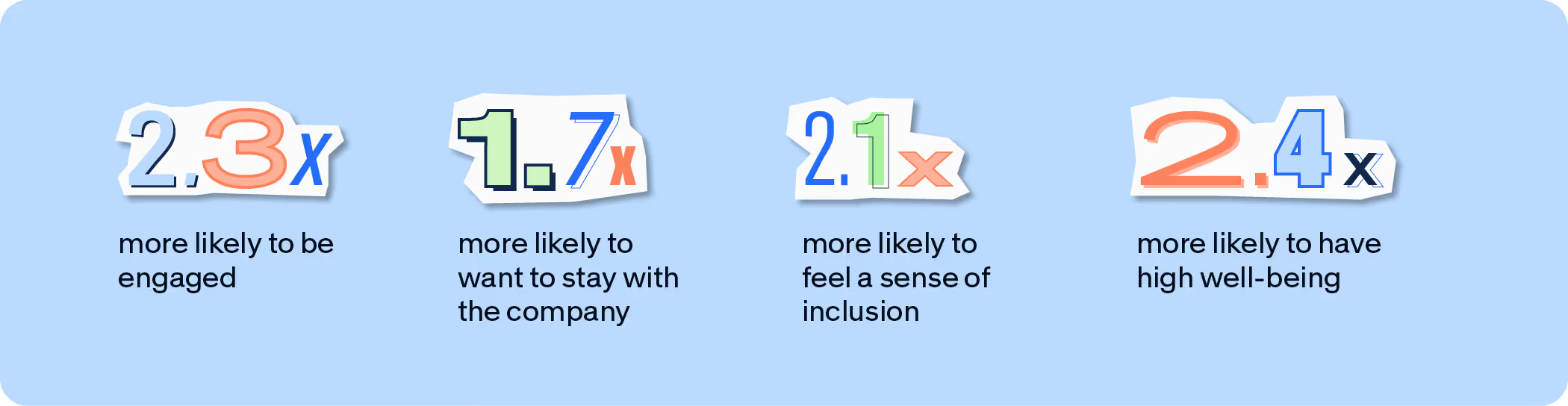
That’s not just fluffy, feel-good data. That’s the kind of data you can take to any leader and say, “Hello. I’ve been talking about recognition for a long time, but now I have something I think you’ll appreciate as much as a nice glass of wine and a delicious cheese, or… you know, business ROI and the bottom line.”
No leader in their right mind would say they don’t want more engaged, loyal, healthy employees. It’s a no-brainer. Those things translate directly to actual, bottom-line ROI. How do they do that? It’s simple. Engaged employees are 17% more productive, generate 23% more profitability, and are less likely to leave (Gallup).
That means engaged employees (i.e., recognized employees) generate more long-term ROI. And a fun bonus? Engaged employees can even help lower healthcare premiums for organizations because they’re healthier.
Turns out appreciating people on a regular basis has a lot of benefits. Pretty wild, right?
The bottom line (see what we did there?) is this: employee recognition cannot be dismissed out of hand. It is a powerful, oft-overlooked, and frequently under-funded lever that leaders can pull to activate real ROI, a stronger organizational culture, and happier employees. Period.
But you knew that. And we know we’re preaching to the choir. What we really wanted to do here is give you some real firepower to show exactly what strategic employee recognition does for the organizations that use it.
In that respect, maybe it’s a little like sunscreen. Everybody knows it’s good and it protects you from harmful UV rays. It’s not like a sunburn will kill you right away. So maybe if you get a little burned here, a little red there, no big deal, right? Until it is a big deal, and there was something all along that could have prevented the problem before it even started.
That’s what we’re talking about here: a strategic, preventative, active thing you can do now that will have an immediate impact now AND in the future.
Slather on that recognition sunscreen. You can thank us later.
And employee feedback is the real deal…
Similar to leaders knowing in a general, vague way that employee recognition is good for their organizations, many leaders also tend to agree that employee feedback is important, necessary, and can lead to good outcomes. That’s why so many organizations have the seemingly required “employee engagement survey” they send out once a year.
But like a bottle of vitamins on a shelf, employee feedback is only actually beneficial if you do something with it. There’s one crucial thing about employee feedback that most people tend to shove under the rug and ignore, hoping it’ll go away:
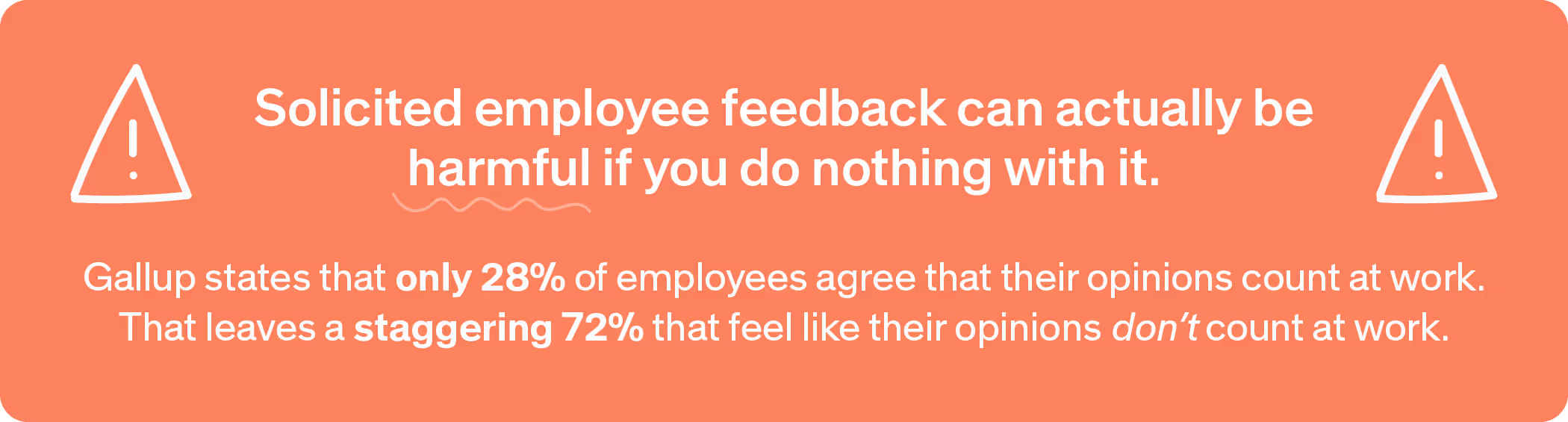
Let’s paint a picture.
If everyone was okay with a 28% score, that would mean students would be okay with failing every class in school, or that people were cool with seeing only 28% of a movie. Or maybe a little closer to home: that would mean organizations were okay with 28% productivity from their employees.
If organizations are constantly expecting more from employees, why can’t employees expect more from their workplaces or their leaders? And that expectation doesn’t have to be huge. It can be something as simple as asking for employee feedback regularly and then acting on that feedback as much as possible.
You may have heard of a philosophy called “Kaizen” at some point in your life. If you’re in manufacturing, or if you’ve read a few business articles, or if you’ve sat in a senior leadership meeting, we’re willing to bet you’ve heard it more than a few times.
Kaizen originated in Japan and means “continuous improvement,” focusing on small, incremental changes to enhance productivity, safety, and effectiveness. It tends to involve everyone, from workers to managers, and is deeply dependent on employee feedback.
Here’s an example: Toyota used to be a no-name brand that built okay vehicles for a massive market. Plagued with problems, Toyota had difficulty competing until they implemented the Kaizen method in the 1950s and soon rocketed to the top of the car manufacturing world. Why? Because their employees who built the cars daily saw potential improvements and were given the power to bring them up.
TL;DR: Employee listening and implementing that feedback is what made Toyota the absolute juggernaut it is today. How’s that for a takeaway?
And if cars aren’t your thing, consider this: when was the last time you gave feedback and it was listened to, and then something changed for the better as a result? How did that feel? Now think of that on an organizational scale. The possibilities, dear reader, are endless.
So while you might not be building cars—you are building something. It might be software. It might be a better culture. It might be logistics. It might be a better career for yourself. And gathering feedback (and acting on it) is a major key to your success.
…then together they create a beautiful alchemy
So employee recognition and employee feedback are essential strategic tools to build culture and see real ROI. But the tools are often separated, living in silos, and unable to communicate with each other. That’s a little like having chocolate in one hand and hot water in the other. One tastes great, and the other is fantastic for so many reasons (cleaning, cooking, comfort when you’ve had a DAY and you need a good soak…need we go on?), and who would think to put them together, right?
But that’s the beautiful alchemy of hot chocolate, friends. Put them together and they form an incredible symphony of taste and comfort. And if hot chocolate isn’t your thing, swap that out for coffee and you’ll see what we mean.
The point is this:
Employee recognition + employee feedback = a perfect system
With both tied together in the same tool, you too can have that beautiful alchemy in your workplace. You can solve the problems plaguing you when you struggle to act on employee feedback. You can close the loop and turn insights from feedback into meaningful, visible action that helps employees feel seen and heard.
How does that work? In the simplest terms it works like this:
When you connect feedback from employees and tie it to recognition programs at your disposal that creates a unique system of action, it eliminates the gap between listening and doing. And Awardco (there it is, you knew it was coming, didn’t you?) does it better than anyone.
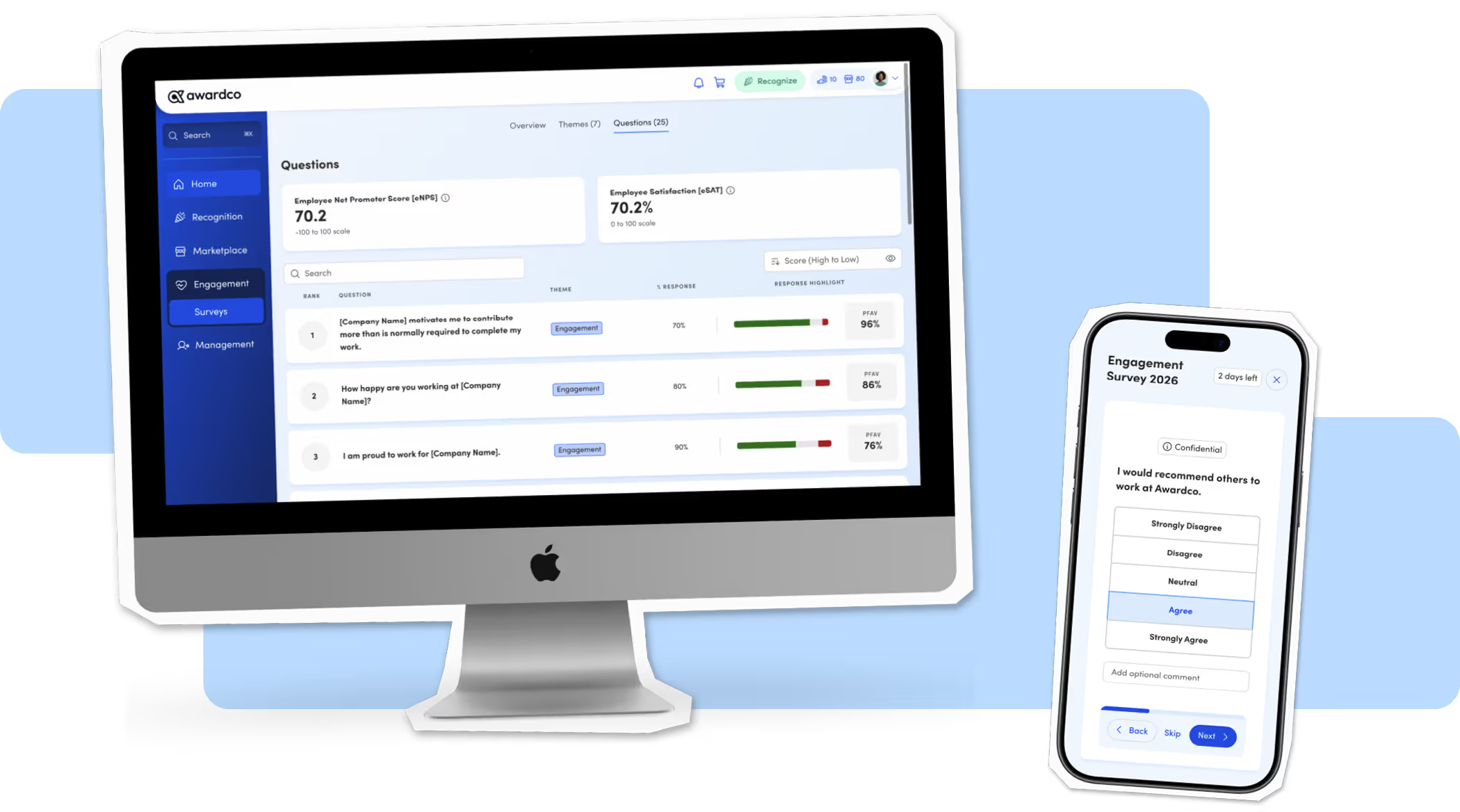
And this isn’t just hyperbole—it’s data-backed, action-based, and it truly works. The recognition and engagement tools live together. You can easily collect employee feedback, have insights served up to you in powerful dashboards, and then spin up recognition programs within minutes that address those very same insights.
In practice, let’s say you ran your annual employee engagement survey through Awardco Engage™ (yep, the ™ is real and makes it super official). With our survey tool informed and built hand-in-hand with behavioral scientists in our Center of Excellence, we know how to give you the exact measuring stick with which to collect feedback.
Now you’ve got that feedback, but it’s only half the story. A slice of bread with some peanut butter on it. Tasty, for sure, but it needs something else. You need more, and that’s where recognition programs come in to save the day with another slice of bread and a nice layer of your favorite jelly or jam or hey, even bananas. We don’t judge.
Back to our example. You’ve gotten some data, and you can drill down and see all sorts of insights. You can even use Awardco Intelligence™ (another ™—we know, we know, you’re impressed) to use AI to help you surface even more insights without having to spend hours digging through the data yourself.
And with those insights, you discover that your Seattle branch is struggling with productivity compared to your Paris branch. It looks like Seattle’s morale is low due to a low manager approval rating. And before you ask, yes, you can get that specific with Awardco Engage™. Neat, right? (PS this can work with any kind of metadata, not just location)
So you’ve got that insight, you know the issue because you’re listening to your employees…now what do you do?
What you do is stay right on the platform and kick up a few recognition programs tailored for, and only visible to, the Seattle branch. Some could be about boosting morale, say using a non-monetary peer-to-peer recognition program that helps employees support each other publicly (and privately, if you want that, too). Or maybe you put together a training program and incentivize your managers in Seattle to take it, and reward them through the recognition program you built in Awardco.
And then? Sit back and see what happens. Wait for a bit, then survey your teams again to gather more data and prove the ROI of the strategy you just put together.
And that is the power of employee feedback coupled with employee recognition. That’s the magic of what we mean when we say better together. It’s a system that no longer restricts your capabilities, but enhances them because it’s purposefully built to work in concert. It’s made specifically for you as a leader of people to close the loop, reduce your workload, and enhance your abilities to do your job.
Need we say more?
We’re better together
We’ve talked quite a bit about the many benefits of recognition, engagement, and how they work together. We know this all sounds great in theory. But we also know you haven’t had a tool that could truly unlock the potential of each. You’ve likely used a survey tool before, and you may even have a recognition program in place—big or small.
What we’re saying is that there’s an opportunity to close the loop. There’s a way to bridge that gap and win the daily battle of building a better culture in your organization. You can do it with data, insights, and most importantly, the increasingly vital “human element” that makes everything worth doing.
You’re a leader for a reason. You know how to develop systems and people into something that not only builds a successful business but helps people live better lives outside of work. To be honest, that’s what we’re about. We want to empower you to do your job better, take care of your people more effectively, and avoid adding to your already overloaded system of programs.
So when you’re ready, we’ll be the dressing to your salad. The peanut butter to your jam. The Ross to your Rachel. And with us, we’ll never go on a break.

