
Most organizations can tell whether recognition is happening. A recognition program can look healthy from a distance: the overall numbers are up, the budget is being used, and the dashboard is full of green arrows. Look closer, though, and you may find that some teams are participating constantly while others barely appear.
The harder questions are whether recognition is happening often enough, evenly enough, or well enough, and how those patterns relate to engagement, retention, and performance.
As someone who has spent much of my career in people analytics, I love a good dashboard. But a dashboard only matters if it helps a leader decide what to do next. This guide covers what recognition analytics should measure, what a useful reporting dashboard includes, and what to ask vendors before you buy.
What are recognition analytics?
Recognition analytics are the metrics, reports, and dashboards organizations use to measure how recognition programs are being used and what impact they’re having. Strong recognition analytics go beyond counting awards. They track budgets, redemptions, participation, recognition trends, program performance, and engagement-related signals so leaders can make faster, better decisions.
That last part matters. A report that says 4,000 recognitions were sent last quarter tells you something happened. It doesn’t tell you who was left out, whether your budget is being used well, or whether any of it connects to the outcomes your executives care about.
Why recognition reporting matters more than ever
Leaders need more than anecdotes to evaluate whether recognition is worth the investment. Finance wants spend visibility. HR wants to know if the program is reaching everyone. Executives want to see how recognition relates to program, culture, and other business outcomes.
The research gives us good reasons to measure carefully. Awardco’s State of Recognition 2027 report surveyed 4,792 employees across 21 countries and 11 industries, all at organizations with 250 or more employees. Employees who hadn’t been recognized in the past three months had an average engagement score of 30%. For employees recognized through one channel, the score was 58%. Two channels brought it to 70%, and three or more reached 77%.
That tells me a yearly total isn’t enough. Leaders need to see how often recognition is happening, through how many channels, and which employees have been missed, while there’s still time to do something about it.
The same research also found a difference in recognition coverage between organizations with and without a dedicated recognition platform. In companies without a dedicated recognition platform, 15% of employees said they hadn’t been recognized at all in the past three months. In companies with a platform, that number was only 3%.
Which employee recognition metrics matter most?
I like to group employee recognition metrics into four categories. A strong program looks at all four together. Before comparing the numbers, define the population, time period, and calculation. Decide who counts as eligible, what “recent” means, whether archived employees are included, and whether the comparison uses the same program rules and employee groups. Without those definitions, a precise-looking metric can still produce a misleading comparison. Once those definitions are clear, look beyond the overall average. Segment relevant metrics by groups such as team, location, role, tenure, or manager to see where patterns differ. These comparisons can surface questions to investigate, but interpret them in context and use appropriate access controls, especially for small or sensitive groups.
Participation metrics
These show whether recognition is part of how people work.
- Recognition frequency (how often recognition is given, per employee and per team)
- Login rates
- Recognition sent
- Recognition received
- Employees with no recognition in the past three months
- Manager participation and time since each manager last recognized their team
- Team-level adoption
- Location-level adoption
Source matters too. In Awardco’s 2027 research, employees who said their manager recognizes them scored 37 points higher on engagement and 47 points higher on feeling their performance is evaluated fairly.
Senior leader recognition was the least common, but its strongest effect was on how employees feel about company values, a 32-point jump. Employees who only received recognition from peers were slightly less satisfied with their pay. A report that breaks recognition out by who is giving it can show you where those gaps are. Use these views to identify coaching and program opportunities, not to rank managers or turn recognition into a compliance score.
Redemption/reward metrics
These show how budget and rewards are being used.
- Redemptions and reward-category usage
- Budget utilization
- Unused balances
- Distribution of reward amounts
That last one is worth tracking, with an important distinction: this finding is about rewards intended to make a particular contribution or achievement feel significant, not a minimum value for everyday recognition or every points award. The report asked employees to think about a reward or gift they had received for something like completing a project or reaching a milestone, then rate how significant the amount felt. In that context, rewards below $25 were less likely to feel significant, regardless of salary band. Perceived significance increased up to about $250, then the gains began to level off; $100 to $250 was the study’s sweet spot for balancing cost and impact. The right amount depends on what the reward is for and how significant that moment is meant to feel. Everyday recognition can still be frequent, specific, and non-monetary. When points are used, evaluate their value in context rather than applying the $25 benchmark to every recognition.
Program metrics
These show whether the program is operating as intended and delivering consistent, meaningful experiences.
- Milestone fulfillment and on-time coverage, especially service anniversaries
- Nomination flow and conversion
- Values or behaviour alignment
- Recognition type and occasion mix
- Earn program participation and completion, where applicable
- Recognition experience feedback
Anniversary coverage deserves attention. Employees who received service anniversary recognition scored 30 points higher on how they perceive their rewards and 24 points higher on their view of the company’s vision and strategy. Do not measure this only by counting anniversary awards. Look at the percentage of eligible employees recognized within the expected window, how long fulfillment takes, and whether coverage is consistent across teams, locations, and employee groups.
Outcome metrics
These connect recognition to culture and business outcomes.
- Engagement
- Retention and turnover
- Productivity
- Absenteeism
- Safety, where relevant
Program data tells you what’s happening inside the recognition program. Outcome data gives that activity context. You need both.
Evaluating the business value of recognition
A recognition ROI dashboard puts recognition activity next to the outcomes leaders already track. The most common ones are:
- Turnover
- Engagement
- Productivity
- Absenteeism
- Safety
The goal is to show how those outcomes change over time as recognition changes, rather than to report activity for its own sake.
Turnover is often the easiest place to start because the cost is so visible. SHRM’s 2026 benchmarking data puts the median cost-per-hire at $15,000 for executive positions and $1,300 for non-executive positions. Those figures cover hiring costs only. They leave out lost productivity, ramp-up time, and the effect on the team left behind.
Finance leaders will also want to know how recognition relates to pay. In Awardco’s research, pay satisfaction explained 21% of the variance in engagement. Adding recognition to the model explained an additional 9%, beyond pay alone. The effect of pay perception on engagement also weakened slightly as recognition frequency increased. In other words, recognition appears to work alongside compensation, which is a useful point when reward budgets are under review.
A word of caution from the analytics side. Recognition data shows related signals, not automatic proof of cause. Workload, compensation, leadership changes, and seasonality all influence the same outcomes. The goal is triangulation. When recognition trends, engagement results, and retention data point in the same direction, you have a much stronger basis for decisions. If you want to estimate the financial side, the Awardco ROI Calculator is a good place to start.
Recognition analytics and engagement data work better together
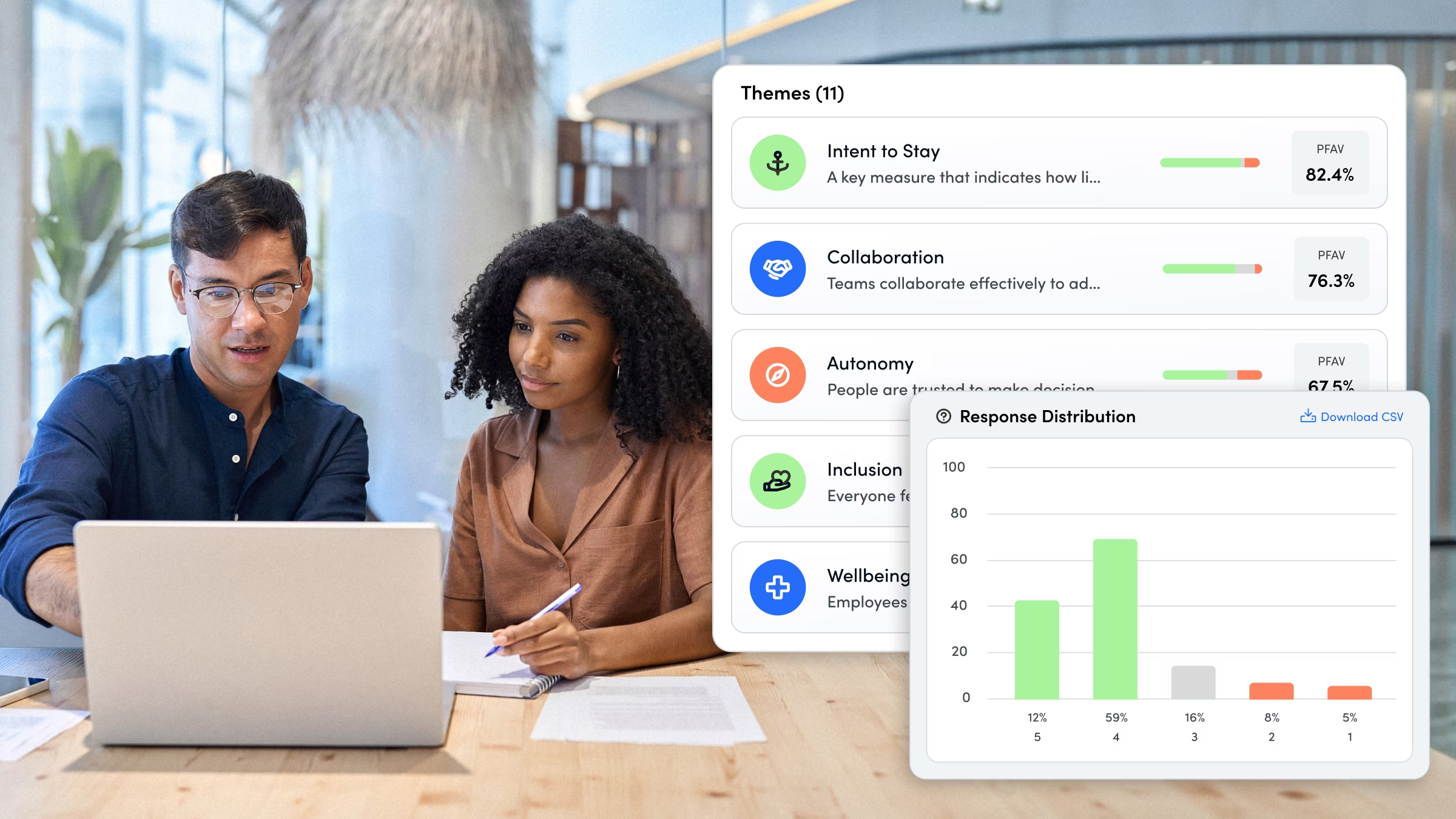
Recognition data gets far more useful when it sits next to engagement and survey data.
Here’s an example. Say a team’s survey comments show people feel undervalued, and that same team has low recognition activity. Now you have a hypothesis worth investigating. You can look at manager habits, access to recognition, the channels being used, and whether recognition is reaching different roles and locations.
It also works in the other direction. If leaders respond to survey feedback specifically related to recognition, such as employees saying they feel overlooked, under-recognized, or want more meaningful recognition, analytics can show whether that response is actually reaching the intended teams. In this case, the value is in connecting the recognition-related feedback to the action taken in response and seeing whether that action reached the people it was intended to support.
This is where Awardco takes a different approach. Recognition, rewards, surveys, and analytics share one data layer, so Awardco Engage and recognition data aren’t living in separate tools. Recognition intelligence connects recognition, engagement, and operational signals so leaders can see what’s happening and why in one place. That makes it easier to move from surface-level reporting to a clearer view of what is happening across teams, budgets, and employee groups.
For more on how recognition shows up in HR metrics, see our blueprint on how employee recognition transforms HR metrics.
What to ask vendors about recognition analytics and reporting
If you’re evaluating recognition software, these questions will quickly separate a participation report from real analytics:
- Can leaders track recognition trends and program performance over time, with a clear understanding of how often the data refreshes?
- Can dashboards segment data by team, department, location, role, and any other relevant employee or program data field configured in the platform?
- Can leaders identify employees who have not been recognized recently, see when they last received recognition, and understand who is or is not recognizing them?
- Can the platform show nomination volume, approval rates, fulfillment time, and where nominations are getting stuck?
- Can leaders analyze recognition by program, occasion, source, value, behaviour, or campaign?
- Does the platform support budget transparency and tax-related reporting?
- Can teams schedule reports, export raw data, and access the data through supported integrations or APIs?
- Does the platform provide clear definitions for each metric and explain the data refresh cadence?
- Can reporting connect recognition data to engagement, retention, and other workforce outcomes without overstating what recognition alone caused?
- Are reporting permissions flexible enough to protect sensitive employee and compensation data?
The best analytics do more than answer, “How much recognition happened?” They help leaders see where recognition is uneven, understand the patterns behind those gaps, and decide where to act next.
How Awardco approaches recognition analytics and reporting
Awardco treats recognition analytics and reporting as decision-making tools, not just dashboards. Leaders can track budgets, benchmarks, redemptions, trends, engagement signals, and program performance through one platform.
Because recognition, rewards, surveys, and analytics share a single data layer, you can move from surface-level reporting to a clearer picture of what recognition is doing across teams, budgets, and business outcomes. Explore Awardco Reporting to see how it works, or learn how it fits into the broader employee recognition platform.
From measurement to action
Recognition analytics are most useful when they help leaders move from measurement to action. The goal is not to create more dashboards. It is to make recognition more visible, consistent, and actionable across the employee experience.
Used well, these insights help leaders see who is being recognized, who may be missing out, where recognition practices differ, and whether changes are reaching the intended teams, roles, and locations. They give leaders a clearer basis for asking better questions, focusing support, and deciding what to investigate next.
The strongest programs do not use analytics to reduce recognition to a score. They use the data to make recognition more intentional, more inclusive, and more connected to the employee experience. That is where reporting becomes useful: when it helps leaders understand what is happening, act on the gaps, and keep improving the way people experience appreciation at work.
Frequently asked questions
What are recognition analytics?
Recognition analytics are the metrics, reports, and dashboards organizations use to understand how recognition programs are being used, where they are reaching people, and what patterns or gaps deserve attention. They cover participation, budgets, redemptions, trends, program performance, and recognition-related feedback. When paired with engagement, retention, or other workforce data, they can help leaders investigate relationships and evaluate whether actions are reaching the intended employees.
Which employee recognition metrics matter most?
There’s no single best metric. Track participation, reward, program, and outcome metrics together so you can see what’s happening inside the program and how those patterns relate to engagement, retention, and performance. Good starting points include employees with no recent recognition, channels per employee, manager recognition, service anniversary coverage, nomination flow and conversion, and recognition experience feedback. Segment those measures by the employee and program fields your organization regularly uses.
How do you measure the ROI or business value of employee recognition?
Compare recognition activity and program costs with changes in outcomes such as turnover, engagement, productivity, absenteeism, and safety over time. Where possible, compare teams, time periods, or employee groups with similar characteristics. Treat the results as related signals rather than proof of cause, and account for factors such as workload, compensation, leadership changes, and seasonality.
How do recognition analytics and engagement data work together?
Engagement surveys show how employees are experiencing work, while recognition data shows whether appreciation is visible, consistent, and reaching different groups. The relationship works in both directions. If survey feedback suggests employees feel undervalued, recognition analytics can help determine whether recognition is happening often enough and evenly enough across the affected teams. If the feedback specifically points to recognition, and leaders respond by strengthening it, recognition analytics can show whether that response reached the intended teams, roles, and locations. In both cases, the value is in connecting employee feedback with recognition activity so leaders can form better hypotheses, evaluate follow-through, and decide what to investigate next
What should enterprise teams look for in recognition reporting?
Look for segmentation by any relevant employee or program data field configured in the platform, recognition gap and manager-source views, nomination and program performance, budget and tax visibility, role-based permissions, scheduled reports, raw exports or API access, and consistent reporting across global programs.