

An employee recognition policy gives people a shared answer to the questions that otherwise appear after launch: Who can participate? What can we recognize? Who owns the budget? When is approval required? What happens when something goes wrong?
Use the template below as a practical starting point. Replace the bracketed language, then have the appropriate HR, People, Finance, Payroll, Legal, privacy, labour-relations, and regional stakeholders review it before publication.
Why every recognition program needs a written policy
Recognition feels personal, but a program still needs consistent rules. A written policy helps employees and managers understand what is allowed, how decisions are made, and where to go with questions. It also reduces avoidable confusion around eligibility, spending, approvals, privacy, moderation, and exceptions.
Keep the policy short enough for employees and managers to use. Store detailed setup, reporting, fulfillment, and escalation instructions in a separate administrator procedure.
- Policy: the rules and responsibilities everyone should understand.
- Program guide: practical instructions for giving and receiving recognition.
- Administrator procedure: detailed operating instructions for program owners.
A recognition policy should support the employee experience. It should not replace compensation, benefits, performance management, payroll rules, or collective bargaining terms.
Employee recognition program policy template
Copy and adapt the sections below for your own organization:
1. Purpose
The purpose of [Organization’s] employee recognition program is to make appreciation for meaningful contributions more consistent, timely, and aligned with [organization values, behaviours, goals, or employee experience priorities].
2. Scope and eligibility
This policy applies to [covered employee populations, locations, entities, and worker types] as of [effective date].
The following people may give recognition: [roles or groups].
The following people may receive recognition: [roles or groups].
Contractors, temporary workers, interns, former employees, customers, vendors, and partners are [included / excluded / covered by separate rules]. Groups requiring separate review include [list groups].
Eligibility may depend on employment status, location, program design, policy, labour agreements, tax treatment, or other organizational requirements. Do not assume every employee group is automatically included or excluded.
Policy owner: [name or team]. Questions should go to [contact or channel].
3. Recognition types and approved uses
[Organization] supports the following recognition types:
- Peer-to-peer recognitionManager-to-employee recognitionService anniversaries and milestonesOnboarding and life eventsTeam recognitionNominations and awardsIncentive or goal-linked recognitionNon-monetary appreciation
For each type, define whether it is public or private, monetary or non-monetary, recurring or one-time, and which behaviours or moments it is intended to reinforce. Recognition must not be used to misrepresent performance, pressure an employee, or replace compensation or corrective feedback.
4. Budget and funding rules
The budget owner is [role or team]. Funding comes from [funding source or cost centre]. The program limit is [per-person, per-manager, per-team, or per-program limit], and the budget [resets / expires / rolls over] on [schedule].
When the budget is depleted, [state what happens]. Budget and spend information is visible to [roles]. Changes to these rules require approval from [role or team].
Finance, Payroll, Tax, and Legal should review monetary recognition, withholding, reporting, and jurisdiction-specific requirements before launch. Reward treatment can vary by program, jurisdiction, employee group, and reward type.
5. Approval requirements
Approval is required for:
- Recognition above [value or threshold]Nominations for formal awardsRecognition involving [specified reporting relationships]Group recognition submitted on behalf of multiple peopleExceptions to eligibility or budget rulesRecognition connected to sales, safety, wellness, compliance, or performance incentives
Approvers are [roles]. The expected approval timeframe is [timeframe]. If approval is denied or delayed, [describe the escalation path and employee notification]. Not every recognition type needs the same approval path.
6. Moderation and prohibited uses
[Role or team] may review, edit, reject, remove, or escalate recognition content when it includes:
- Harassment, discrimination, threats, or personal attacksConfidential, medical, personal, or sensitive informationPolitical or religious advocacy inconsistent with company policyPressure, retaliation, favouritism, or conflicts of interestMisleading claims about performance, safety, compliance, or business resultsAttempts to bypass budgets, approvals, eligibility, or reward restrictions
Employees can report concerns through [channel]. Records are retained for [period and system]. [State whether the sender or recipient is notified of moderation decisions and how they may appeal.]
7. Exceptions and escalation
When a situation falls outside this policy:
- Identify the rule or requirement that does not fit.Document the request and business reason.Send it to [designated owner].Consult Finance, Payroll, Legal, HR, IT, Procurement, or Labour Relations when relevant.Record the decision, duration, and conditions.Review whether the policy should be updated.
Manager discretion does not override eligibility, budget, tax, payroll, labour, privacy, or safety requirements. Final authority belongs to [role or team].
8. Rewards, tax, payroll, and fulfillment
Approved reward categories include [categories]. Restricted or unavailable rewards include [categories]. Rewards are selected and fulfilled through [process]. Points or rewards [expire / do not expire] under these rules: [rules].
Returns, cancellations, delivery issues, and regional availability are handled by [owner or process]. Tax and payroll review is owned by [role or team]. Regional differences in reward availability or treatment are documented at [location].
9. Roles and responsibilities
- Policy owner: [role or team]
- Program administrator: [role or team]
- Budget approver: [role or team]
- Employee data and eligibility owner: [role or team]
- Content moderation owner: [role or team]
- Payroll and tax reviewer: [role or team]
- Manager enablement owner: [role or team]
- Reporting and evaluation owner: [role or team]
- Employee support and escalation owner: [role or team]
10. Reporting and review cadence
The program owner reviews the following every [quarter / six months]: participation and reach; recognition frequency and distribution; budget use and remaining balances; reward redemption and fulfillment issues; moderation activity; employee and manager feedback; representation across locations, teams, shifts, and employee groups; and policy exceptions or recurring questions.
Policy changes are approved by [role or team]. The next review date is [date].
Recognition policy checklist
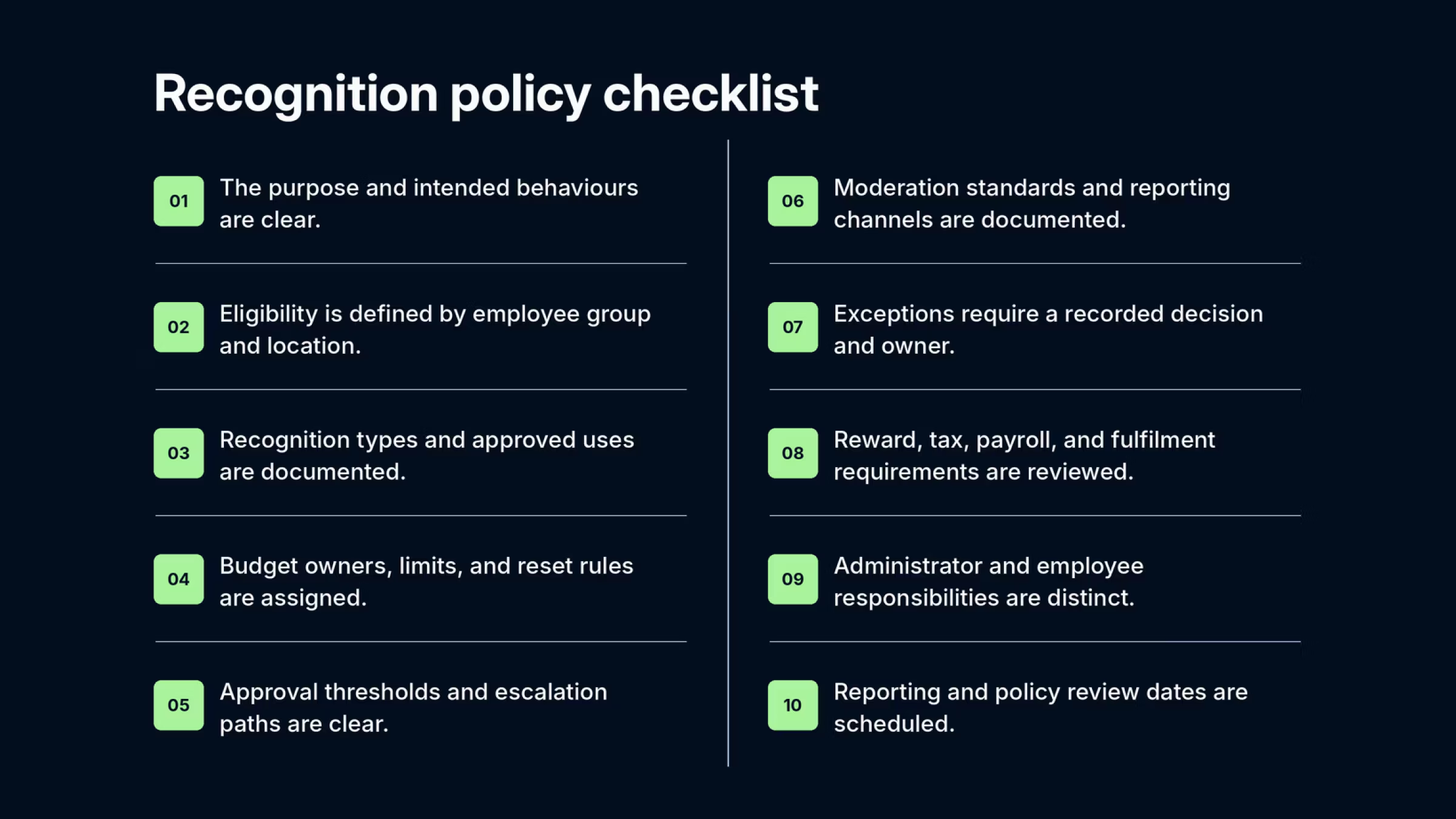
Before moving forward with your version using this template, confirm that:
- The purpose and intended behaviours are clear.
- Eligibility is defined by employee group and location.
- Recognition types and approved uses are documented.
- Budget owners, limits, and reset rules are assigned.
- Approval thresholds and escalation paths are clear.
- Moderation standards and reporting channels are documented.
- Exceptions require a recorded decision and owner.
- Reward, tax, payroll, and fulfillment requirements are reviewed.
- Administrator and employee responsibilities are distinct.
- Reporting and policy review dates are scheduled.
How Awardco can support a governed recognition program
A platform can help an organization operate a policy it has already defined. It cannot determine the organization’s legal obligations, tax treatment, labour terms, or employee eligibility.
Awardco’s employee recognition platform publicly describes support for multiple recognition use cases, including peer recognition, service awards, nominations, milestone moments, incentives, and other recognition programs. Depending on configuration and plan, Awardco may also support automated milestones, approval flows, budgets, roles and permissions, reporting, employee-choice rewards, and global or regional program controls.
Those capabilities can help program owners put clear rules into practice, but internal owners still decide who is eligible, what is approved, how content is moderated, how rewards are treated, and when the policy changes. Confirm exact capabilities, access, integrations, reward availability, and reporting behaviour before publication or purchase. See Awardco’s platform overview, plans, and global recognition solutions for additional context.
Frequently asked questions about recognition policies
What should an employee recognition policy include?
It should define the program’s purpose, scope, eligibility, recognition types, budget ownership, approval rules, moderation standards, exceptions process, reward and tax considerations, responsibilities, reporting, and review cadence.
Who should be eligible for an employee recognition program?
That depends on employment status, location, entity, worker type, policy, labour agreements, tax treatment, and program design. Define covered groups explicitly instead of assuming one rule applies everywhere.
How should recognition budgets be managed?
Assign a budget owner, funding source, limits, reset or expiration rules, visibility permissions, and a process for changes. Finance, Payroll, Tax, and Legal should review monetary recognition before launch.
When should recognition require approval?
Approval may be appropriate above a value threshold, for formal awards, group submissions, exceptions, or recognition tied to incentives, safety, compliance, wellness, or performance. Document approvers, timeframes, and escalation paths.
What should a recognition moderation policy prohibit?
It should address harassment, discrimination, threats, sensitive information, retaliation, favouritism, misleading claims, and attempts to bypass program rules. It should also explain reporting, retention, notification, and appeal procedures.
How should organizations handle exceptions?
Require a documented request, business reason, designated decision-maker, relevant stakeholder review, decision conditions, and an expiration or follow-up date. Manager discretion should not be a catch-all.
Are recognition rewards subject to tax or payroll review?
They may be. Treatment varies by reward type, program, jurisdiction, and employee group. Finance, Payroll, Tax, and Legal should determine the applicable review and reporting requirements.
How often should a recognition policy be reviewed?
At least quarterly or semiannually during early rollout, then on a cadence that fits the program. Review recurring questions, exceptions, moderation activity, budget use, reach, and regional or workforce changes.
Copy the template and build clearer recognition rules
Use this template as a starting point, then adapt it to your organization’s people, locations, budgets, workforce groups, and governance requirements.
Explore Awardco Employee Recognition