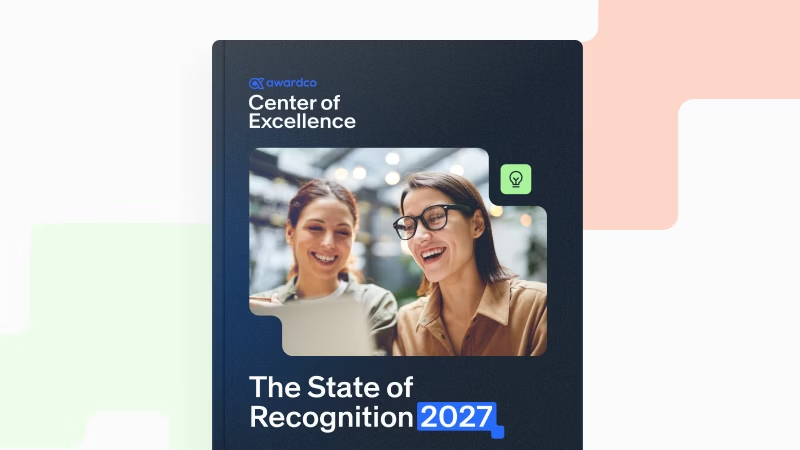

Recognition is easy to believe in and hard to measure. Awardco’s Center of Excellence set out to change that with The State of Recognition 2027, a global employee recognition study of 4,792 employees across 21 countries and 11 industries.
This year’s research goes beyond recognition frequency to examine channel mix, manager-led recognition, reward amounts, and the role of AI. Here are the highlights, with the full data waiting in the report.
The State of Recognition 2027 at a glance
The study builds on last year’s State of Recognition research. That report found that meaningfully recognized employees were 2.3x as likely to be engaged and 1.7x as likely to want to stay. They were also 2.1x as likely to feel included and 2.4x as likely to report high well-being.
For more on those earlier findings, see the data behind recognition. The 2027 study expands the scope to look at the employee experience as a whole.
Recognition channel mix matters
Companies that use a recognition platform still lead with in-person recognition, but they add written recognition far more often. A platform appears to turn recognition from a moment in a one-on-one into a practice of its own.
The gap in who gets recognized at all is striking. Among employees at companies without a platform (or unsure), 15% said they hadn’t been recognized in the last three months, compared with 3% at companies with one.
Engagement scores also rose with every additional channel employees were recognized through. They climbed from 30% among employees who weren’t recognized to 77% among those recognized through three or more channels. The full report shows how scores shift channel by channel.
Manager recognition and service anniversaries have the widest reach
Manager recognition and service anniversaries again showed the broadest impact across the employee experience. Employees who felt recognized by their manager reported double-digit gains across nearly every dimension the study measured, not only engagement.
Each source of recognition tended to influence something different:
- Manager recognition: goal clarity, career prospects, voice, work-life balance, and how fairly employees feel their performance is evaluated.
- Service anniversaries: how employees perceive their rewards and the organization’s long-term vision and strategy.
- Senior leader recognition: how employees feel about company values, even though it’s the type given least often.
Managers set the daily rhythm, and service awards connect employees to the organization over the long term. Learn more about manager recognition training and service awards.
Reward amount matters up to a point
Last year’s research showed that meaningful rewards outperform generic ones. This year, the team looked at what “meaningful” means in dollars.
Employees need a reward to clear a floor before it feels significant, and the report puts that floor at $25 regardless of salary band. Beyond a certain amount, the added sense of significance levels off, and the report identifies where cost and impact balance best.
When employees explained why a reward felt significant, the top reasons were acknowledgment of a contribution and pride in the achievement. Dollar value ranked well below both.
Recognition also adds something pay alone can’t. In the study’s model, recognition explained additional variance in engagement beyond pay satisfaction. Recognition from peers alone, without manager or leader reinforcement, had a small negative effect on how employees viewed their rewards.
Employees are cautious about AI in recognition
AI is the one theme that’s entirely new this year. When employees were asked about AI writing recognition or prompting it, 58% said knowing AI was involved would make the recognition feel less meaningful.
Comfort shifted when AI worked in the employee’s favor, and attitudes varied by region. Employees in Europe were less comfortable with AI, those in Asia Pacific were generally more comfortable, and North America landed in the middle. The report digs into privacy concerns, manager-facing summaries, and the full response breakdown.
Early signs suggest that AI may help identify who deserves recognition and when, while the message itself remains human.
What this means for your recognition program
The research points to four practical directions:
- Check your channel mix: blend written and spoken recognition instead of relying on just one.
- Build manager cadence and milestones into your systems: manager recognition frequency and service anniversaries have real, independent effects.
- Make one-off rewards feel meaningful: consider both the amount and the acknowledgment behind it.
- Be intentional with AI: lead with the benefit to the employee, and keep the human voice in the message.
Awardco’s employee recognition platform brings manager and peer recognition, service awards, and reporting together so these practices can fit into everyday workflows. Available capabilities depend on your plan and configuration.
How to read these findings
The State of Recognition 2027 is survey research, so its findings show associations rather than proof that one practice causes another outcome. Results reflect employees surveyed in May and June 2026 at organizations with 250 or more employees, and the AI findings come from a U.S., UK, Canada, and Australia subsample.
Use the data as a starting point for your own measurement. Awardco’s ROI calculator can help you build a business case around your own numbers.
Read the full State of Recognition 2027 report
The full report goes deeper than this summary. It includes the channel-by-channel engagement data, the complete manager recognition uplift across seven dimensions, the reward threshold analysis, and the global AI sentiment breakdown.
Read the full State of Recognition 2027 report →
Frequently asked questions
What is The State of Recognition 2027?
It’s a research report from Awardco’s Center of Excellence on how recognition shapes the employee experience. It covers recognition channels, manager and leader recognition, reward amounts, and employee attitudes toward AI.
Who participated in the study?
The study surveyed 4,792 full-time, permanent employees in May and June 2026. Participants worked at organizations with 250 or more employees across 21 countries and 11 industries.
Does a recognition platform change how employees are recognized?
According to the research, companies using a platform lead with in-person recognition but add written recognition much more often. Far fewer employees at those companies reported going three months without any recognition.
What does the research say about AI-written recognition?
Most employees said knowing AI wrote or prompted a recognition would make it feel less meaningful. The report suggests AI works best behind the scenes, helping identify who deserves recognition while people write the message.