
Read the white paper
Submission success!

There is still a surprisingly durable story floating around you may have heard: HR is skeptical of technology, slow to change, and especially hesitant about AI because their job centers on people more than others might.
It’s a neat story, perhaps even a convenient one for leaders of organizations to tell themselves so they can put their focus elsewhere, but it is also the wrong story.
When we asked HR admins directly about their relationship with AI at work, we found something intriguing:
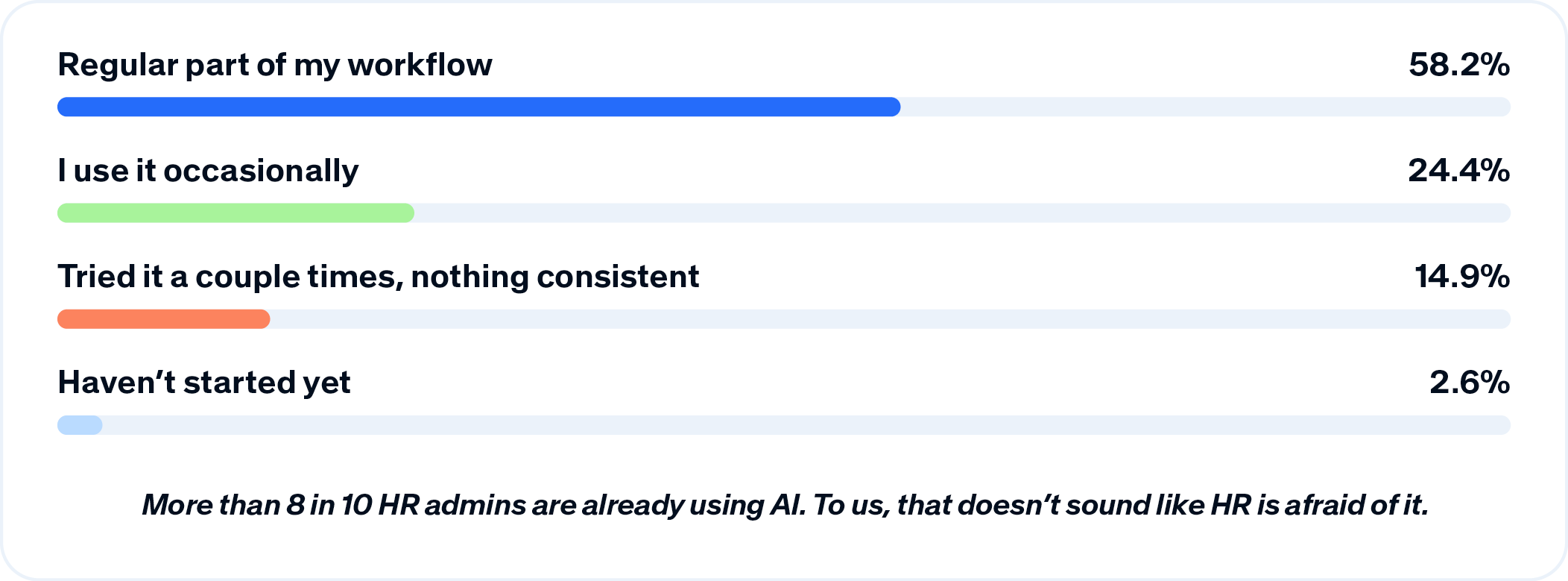
All this matters because it changes the entire conversation. Rather than looking at AI in HR as an early-adoption story, or a decision that leaders will make when it’s convenient, we need to first see and then address the gap between what HR teams are already doing and what many organizations still assume about them. HR has already moved, and in many cases the broader organization has not caught up to what its own HR teams are doing every day.
The popular framing suggests HR still needs to be convinced, but the data points in a different direction: HR teams are asking to be better equipped.
HR admins are doing far more than dabbling with AI
It is easy to assume AI use in HR begins and ends with drafting emails a little faster, or maybe with other simple administrative tasks. That assumption survives only until you look at the data.
Yes, 91.8% of respondents are using AI to write and edit communications. But that is the floor, not the ceiling. Nearly 66% are using it to create or update policies and documents, and nearly the same number are using it to analyze data and pull insights.
Taken together, that looks a lot less like casual experimentation and a lot more like real workflow redesign.
What is striking here is not just the frequency of use, but the sophistication. Respondents described building custom agents, training AI on company style guides, uploading policy documents for compliance checks, analyzing exit interview transcripts for trends, and using AI to triage inboxes by urgency. These are not token use cases. They are practical, high-value applications inside the real administrative spine of HR work.
This is the part many leaders still seem to miss. HR admins are not standing at the edge of the pool deciding whether to get in. They are already swimming laps, in many cases around other leaders in their organizations. The market, however, is still acting like it needs to teach them what water is.
The bigger barrier is support, not resistance
If AI adoption were low, the explanation might be cultural resistance. But that is not what this research found.
When respondents were asked what is holding them back from using AI even more, the largest group said nothing at all; 49.5% said they are already using it regularly. The next biggest concern was accuracy, not fear.
That distinction matters. Accuracy concerns are not the same as anti-AI sentiment. They are a sign that HR admins are thinking seriously about risk, appropriateness, and downstream consequences. In a function responsible for policy, communication, compliance, and employee trust, that isn’t hesitation so much as it is clear, professional judgment.
Average day-to-day confidence in using AI tools sits at 3.49 out of 5. More than half say they feel excited when told to use AI in their role, but meaningful portions also report feeling overwhelmed or pressured, like they are falling behind—and we say again: that doesn’t sound like avoidance, that sounds like a group that is asking for more tools to learn more.
In looking at this data, we realized that two things are true: HR is ahead of the stereotype AND still under-supported in practice.
That is the real leadership challenge. Not “How do we get HR to care about AI?” but “How do we build the training, guardrails, and shared practices that match the reality of how HR is already using it?”
HR’s caution is part of what makes its perspective valuable
One of the most revealing findings in this research is what respondents are not worried about.
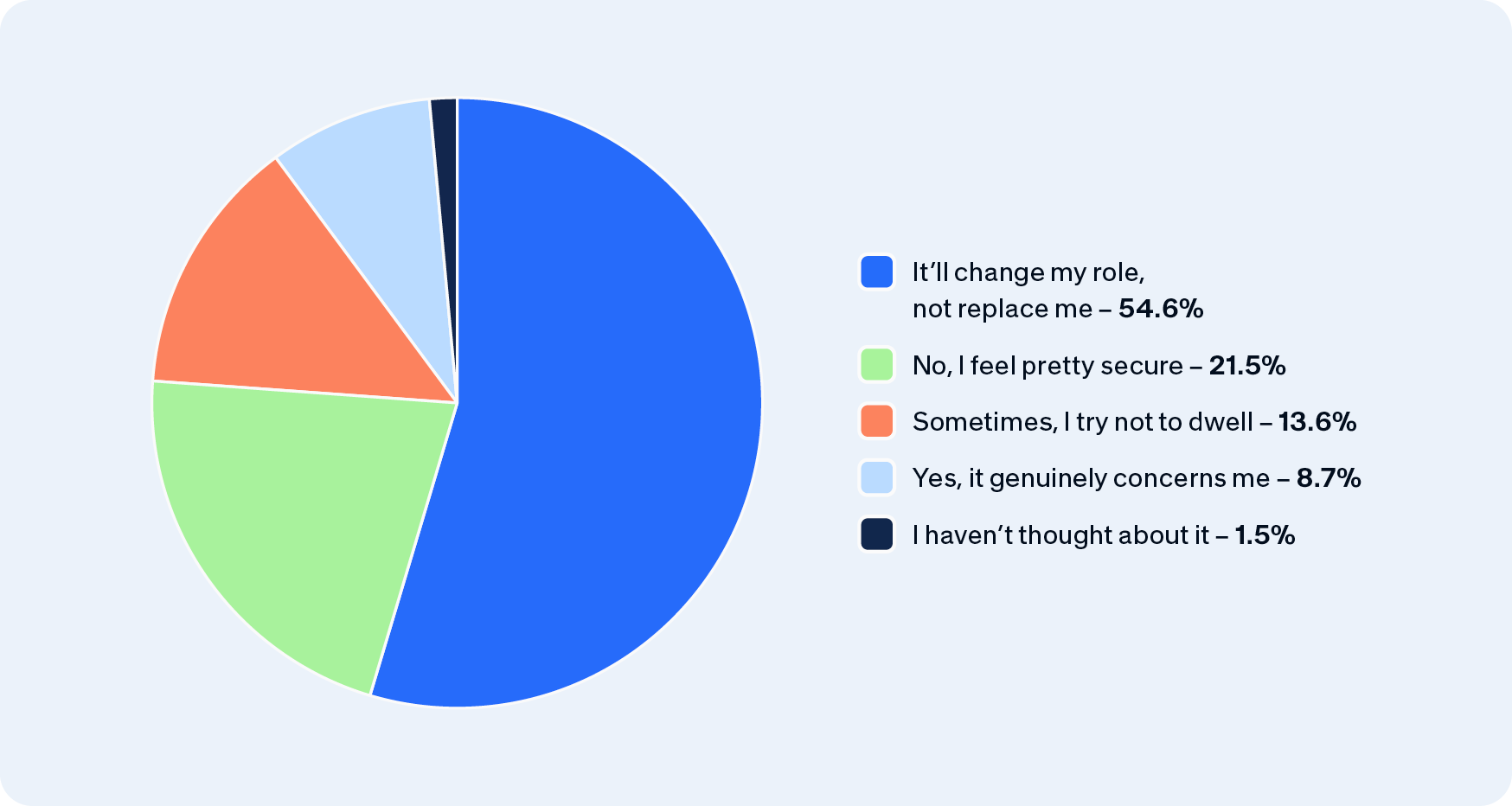
Only 8.7% said they genuinely worry AI could replace their role. A much larger share said it will change their role, not replace it, or that they generally feel secure.
That alone should retire one of the laziest narratives in the AI conversation: that HR is resisting AI out of job insecurity. The data does not support it.
What respondents are worried about is something more substantive. Across open-ended responses, the recurring concern was not replacement. It was dehumanization. HR admins are not afraid that AI will take their jobs; they are concerned that organizations will use AI to skip empathy, flatten nuance, and optimize away the relationship-building that makes HR effective in the first place.
That concern should not be filed away as sentimental resistance. It is a strategic warning.
“AI creates efficiency, but humans create connection,” as one respondent put it.
Another said it even more plainly: “Don’t take the ‘human’ out of it. AI should be a tool, not a replacement.”
This is where HR may actually be ahead of the rest of the business. While other functions are still asking how much work AI can absorb, HR is asking the harder and more important question: what must remain unmistakably human if trust, judgment, and culture are going to survive the transition?
That is not AI skepticism, it’s actually governance. And companies that ignore that distinction will end up implementing AI in ways that are technically impressive and operationally corrosive.
The market is solving the wrong problem
If HR admins were beginners, they would be asking for beginner content. They are not.
When we asked what would be most useful in learning more about AI, the top requests were real examples from other HR admins and ready-to-use prompt templates. Quick-start guides, community spaces, webinars, and step-by-step tutorials all had value, but they ranked lower.
That preference tells us something important. HR admins do not want another round of AI evangelism. They want practical enablement, which means seeing what peers are actually doing, understanding what works in the messy reality of HR, and walking away with something usable today.
That is why the strongest product story here is not simply that Awardco has AI. It is that Awardco is built to help HR teams close the gap between listening, understanding, and acting.
Awardco Engage™ addresses the first gap. It gives organizations a structured way to gather employee feedback through annual surveys, pulse surveys, and manager-facing reporting, then interpret that feedback through dashboards, benchmarks, and key-driver analysis rather than leaving teams to stare at a pile of disconnected responses.
Awardco Intelligence™ addresses the second gap. Instead of requiring admins to export another spreadsheet or build another dashboard, it is designed to help them query data in plain language, surface patterns across recognition, engagement, rewards, and HR data, and get to usable guidance faster. In practice, that means less manual digging, faster summaries, clearer signal, and a more realistic way for lean HR teams to make sense of what deserves attention.
Awardco Recognition addresses the third gap. Once a team understands what employees are signaling, recognition gives leaders a visible and scalable way to respond through awards, rewards, milestone moments, spot recognition, and more intentional reinforcement of the behaviors and contributions they want to encourage.
Taken together, that is the more compelling narrative for AI in HR. The real value is not another flashy assistant layered on top of an already fragmented workflow. It is a connected system that helps HR teams hear employees more clearly, interpret what matters faster, and respond in ways people can actually feel.
This is a meaningful market signal. Too much AI content is still designed around spectacle: big claims, abstract transformation language, generic prompts, polished demos. HR admins are asking for the opposite. They want specifics, context, examples, and tools grounded in the real environment they operate in: fragmented systems, incomplete data, legal sensitivity, and constant interruption.
That means the winners in this category will not be the companies that talk most dramatically about the future. They will be the ones that help HR teams do tomorrow morning’s work better than they could today.
What leaders should take from this
The first takeaway is simple: stop treating AI in HR as a “we’ll get to it when we can” kind of problem.
The second takeaway is more uncomfortable: if your HR team is struggling with AI, the problem may not be willingness. It may be the absence of support, clarity, and institutional learning.
The third is that HR does not need permission to care about both efficiency and humanity; many of the best practitioners are already insisting on both.
That is also why connected systems matter, which is why we bring up Awardco Engage™, Awardco Intelligence™, and employee recognition as a whole. When you have all three tools at your disposal, AI becomes much more than a writing assistant. It becomes part of an operating model for listening, interpreting, and responding with greater speed and consistency. In short, it becomes your HR front-of-house.
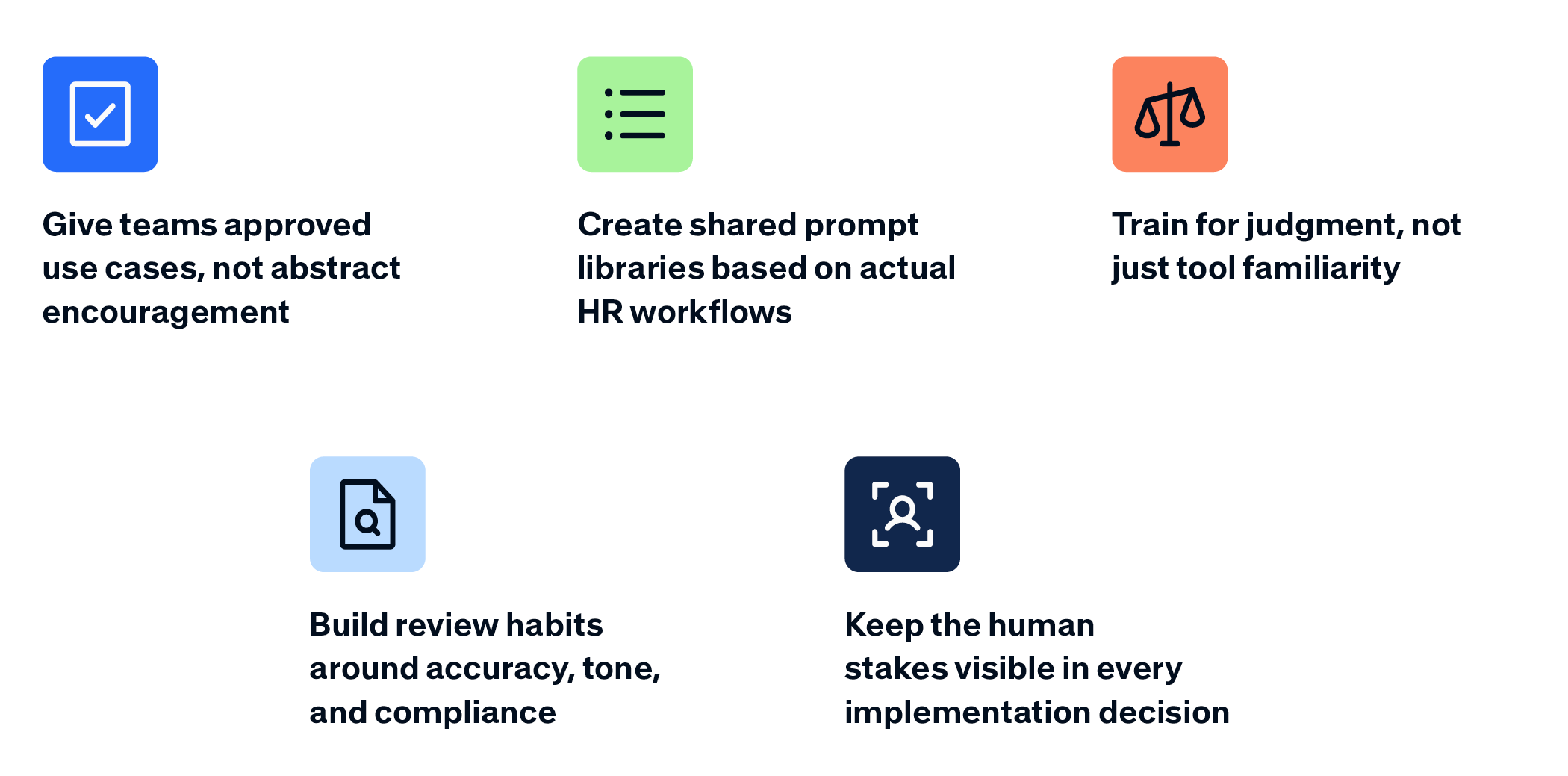
The organizations that will benefit most from AI in HR are not the ones that force adoption through pressure campaigns or vague innovation messaging. They are the ones that do the quieter, harder work of operational enablement:
- give teams approved use cases, not abstract encouragement
- create shared prompt libraries based on actual HR workflows
- train for judgment, not just tool familiarity
- build review habits around accuracy, tone, and compliance
- keep the human stakes visible in every implementation decision
That is how AI becomes an advantage in HR: not by replacing the human function, but by removing some of the administrative drag that gets in the way of it.
The real story
HR is not behind on AI.
If anything, HR may be one of the clearest examples of what mature adoption already looks like: practical use, grounded caution, strong instincts about risk, and a refusal to let efficiency outrank humanity.
That is not a function waiting to be convinced. That is a function already doing the work.
The question now is whether leaders, vendors, and internal enablement teams are ready to catch up.
Let’s chat about how to help your teams do just that at www.awardco.com/start
About this survey
390 HR admins participated between May and June 2026, representing organizations ranging from fewer than 100 employees to more than 10,000. Quotes throughout this report come from the 152 respondents who explicitly opted in to be featured.

