

Read the white paper
Submission success!

Recognition software looks similar from a distance. Most vendors describe the same handful of things: peer recognition, a rewards catalog, some reporting. The differences that actually matter to your program, and your budget, only show up once you look closer.
This guide is built to give you the tools you need to scrutinize the most common rewards and recognition platforms available. It walks through what to evaluate, how enterprise and SMB/mid-market needs differ, and what independent reviewers on sites like G2 say about the platforms you're likely considering. Every rating cited here comes with a source and a date, because these numbers move as platforms expand their capabilities.
How to use this guide
- Find your segment. Section 1 covers the vendors most common in enterprise evaluations. Section 2 covers vendors more common at SMB and mid-market scale. If you know roughly where your organization falls, start there.
- Check the dates. Review-site scores change as new reviews post. Every rating in this guide is dated to when it was pulled, so you can judge how current it is and confirm anything that matters to your decision directly on the source site.
- Use the questions, not just the comparisons. Each vendor profile includes discovery questions worth asking in a demo or an RFP, regardless of which platform you're evaluating. The right question usually tells you more than a feature list does.
- Treat this as a starting point. Vendor capabilities and pricing models change. Use this guide to sharpen your evaluation criteria, then verify the specifics with each vendor directly.
A framework for evaluating recognition platforms
Whatever platforms you're comparing, the same set of questions tends to separate a good fit from a costly mistake:
- Employee adoption and user experience. Will people actually use it, without HR having to push? How easy is the platform to access by employees in various locations, roles, etc.?
- Recognition and program flexibility. Can the platform run peer, manager, milestone, nomination, and incentive programs without extensive custom development?
- Reward network, global coverage, and employee choice. How wide is the reward catalog, and does it reach every region and worker type on your team?
- Engagement, incentives, and broader employee experience. Does recognition connect to listening, incentives, and culture work, or does it live on its own?
- Integrations, automation, and data management. Does it sync with the HRIS and communication tools you already use, and does it reduce manual work?
- Administration, reporting, taxation, and compliance. Can your team run it without a support ticket for every configuration change?
- Implementation, customer success, and support. How long does implementation take, and what support do you get after you go live?
- Pricing transparency, total cost of ownership, and budget efficiency. What's the real value of a dollar of recognition, once markups and fees are counted? What sort of budget controls do you have?
- Company maturity, roadmap, and proof of results. Is the vendor stable, growing, and backed by evidence that its platform drives outcomes?
Keep these nine questions in front of you as you read the vendor profiles ahead. They're the throughline for everything that follows.
Enterprise competitor guide
Enterprise buyers are evaluating recognition platforms as infrastructure: something that has to work across multiple countries, integrate with a mature HR tech stack, and survive an audit. The profiles below cover the six biggest enterprise vendors on the market today.

Awardco
Core positioning. Awardco is a unified recognition, rewards, and engagement platform built around the largest reward network on the planet, alongside configurable program design, budget management, and, through Awardco Engage™, employee listening. The company reports powering recognition for more than 3,000 organizations and over six million users across 163 countries, with customers including AT&T, Pacific Life, Okta, Adobe, and Hertz, and has earned G2 Leader placements across the Employee Recognition, Rewards and Incentives, Engagement, and Lifestyle Spending Account categories in the Winter, Spring, and Summer 2026 grid reports.
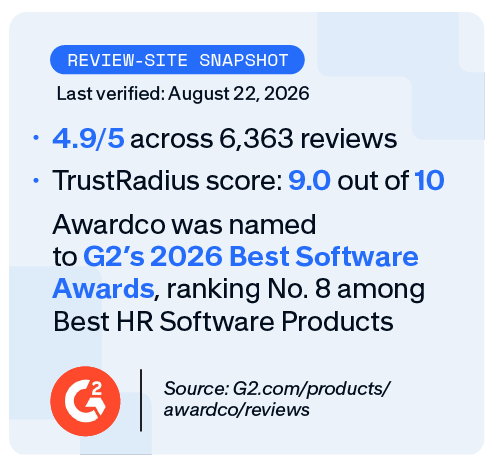
Common buyer concerns to investigate. A recurring theme across reviews is a desire for clearer order and point status: several reviewers note they don't receive an email or notification when an order ships or when points are close to expiring, and have to check the site manually to stay on top of it. Catalog search and filtering is another recurring ask, with more than one reviewer wanting to filter by point value, category, or a specific hotel name rather than browse a large catalog manually. Most reviewers describe setup as simple and easy, but a few users described a full rollout as requiring roughly a month of hands-on work to get data, integrations, and details right.
Discovery questions
- "Will we or our employees get a notification when an order ships or when points are about to expire?"
- "How long does a typical implementation take, and what should our team prepare in advance to avoid extra manual work?"
- "Can employees filter or search the catalog directly if they already know what they want?"
- "How consistent is the point-to-dollar value across different catalog categories?"
- "If an employee has an issue with an order, how do they reach support directly?"
Workhuman
Core positioning. Workhuman pioneered social peer-to-peer recognition and has the deepest brand recognition in the enterprise segment, with more than 7 million users at Fortune 500 and iconic brands, and customers including Cisco, Procter & Gamble, and Whirlpool. It markets an in-house rewards marketplace, an ROI guarantee, and a proprietary analytics layer called Workhuman iQ.
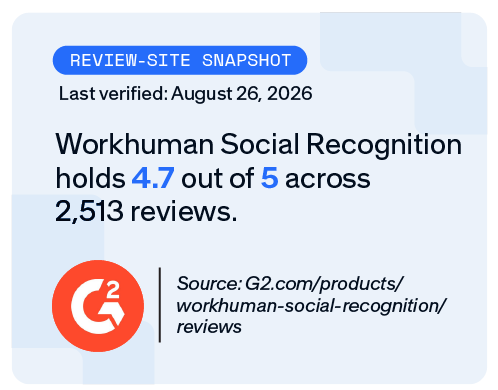
Common buyer concerns to investigate. The single most consistent theme in individual reviews is that the reward/point system feels restrictive relative to the recognition experience: multiple reviewers describe hitting a points cap quickly, and several want the ability to enter a custom point amount rather than choosing from fixed tiers. A related and recurring complaint is the loss of cash-equivalent redemption, at least two reviewers specifically said they miss being able to cash out to a Visa card and now feel limited to catalog merchandise priced at MSRP.
Catalog localization comes up repeatedly from global reviewers, who want more region-specific options rather than a catalog weighted toward U.S. retailers. Navigation and search are a smaller but recurring theme, several reviewers describe difficulty finding a specific coworker or catalog item without heavy filtering. A few reviewers also flagged branding and customization as limited for organizations that want recognition to feel distinctly their own rather than generic, and one detailed enterprise review noted that reporting can be slow to load with larger datasets and lacks combinable custom filters.
Awardco differentiators that matter most
- Reward value and flexibility: Awardco's model doesn't force fixed tiers, and its catalog pricing isn't limited to MSRP. We offer millions of rewards at dollar-for-dollar values, including zero markups through Amazon Business.
- Catalog localization: Awardco offers rewards in 160+ countries, with local fulfillment and regional flexibility, so you can offer rewards that fit any lifestyle in any location.
- Complexity proportional to company size: G2's own review summary states Workhuman’s platform "can feel too heavy for smaller or less mature organizations, both in terms of cost and complexity." Awardco's platform serves organizations from small teams to large enterprises on the same architecture without that same complexity tax at a smaller scale.
- Pricing transparency: Workhuman's pricing is fully custom-quoted with no public rate card, according to third-party analysis, so buyers can't easily benchmark cost before a sales conversation. Awardco's subscription-based, per-employee model gives buyers a clearer starting point for total cost of ownership.
Discovery questions
- "How long does a typical implementation take, and what does the change management process look like?"
- "Walk us through how a manager builds or requests a custom report. Does that require a support ticket and a wait?"
- "What's included in the quote, and what would trigger an additional service fee?"
- "Can a points allotment or award tier be reduced after rollout, and if so, how would that be communicated to us?"
- "Can employees redeem for a cash-equivalent option, or is everything limited to catalog merchandise?"
- "How consistent is the reward catalog for employees in regions like India, both in retailer selection and payment methods?"
- "Are catalog items priced at retail, or is there a markup built into the point value?"
Achievers
Core positioning. Achievers positions itself as a global leader in employee recognition, supporting more than 4 million employees across 164 countries, with a strong emphasis on recognition science, behavioral analytics, and a rewards marketplace it markets at over 3 million options. Customers include General Motors, Meijer, Workday, and Kellanova.
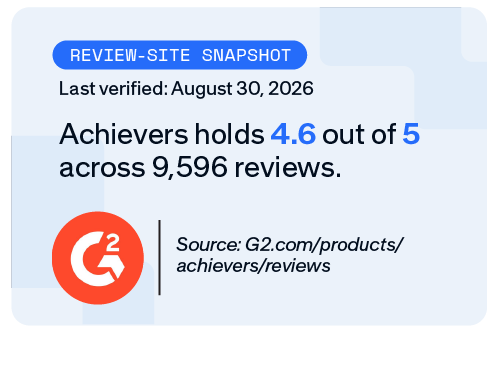
Common buyer concerns to investigate. The most concrete, recurring complaint across G2, Capterra, and GetApp is the loss of cash-equivalent redemption: multiple reviewers specifically said Achievers used to let them redeem to a prepaid Visa or Mastercard gift card and no longer does, leaving catalog merchandise and branded gift cards as the main options. Several reviewers and aggregated review sites (GetApp, Capterra) also describe steep point requirements and catalog pricing that feels high relative to external retail prices, along with limited catalog options in some regions and occasional delays in reward fulfillment.
Interface complexity comes up repeatedly as well: G2's own pros/cons summary states that "the platform's complexity and navigation challenges make it difficult to effectively utilize Achievers" for some users, and a third-party review separately describes a steep learning curve tied to the breadth of configuration options. Physical merchandise returns were also flagged as a slow, document-heavy process by at least one reviewer who had to prove they hadn't damaged a defective item before receiving a refund in points.
Awardco differentiators that matter most
- Cash-equivalent redemption: multiple Achievers reviewers specifically miss the discontinued prepaid Visa/Mastercard redemption option. With A-Pay™, Awardco users can easily use their points at any point-of-sale system, just like they would with a regular payment card, in addition to prepaid card options with Visa.
- Program configuration depth: Awardco's controls for custom program management, budgets, and rules extend further than what Achievers offers without additional service fees.
- Live pricing versus MSRP: Awardco’s reward catalog reflects current, live pricing while Achievers' catalog still prices at MSRP rather than passing through live retail discounts.
- Breadth of catalog: Awardco's reward catalog is materially larger than most competitors' proprietary catalogs. With our Amazon, Best Buy, Priceline, and Revolut integrations, along with thousands of gift cards, charitable donations, experiences, no other reward network offers the same breadth of choice for employees around the world.
Discovery questions
- "Can employees redeem to a prepaid Visa or Mastercard card, or is that limited to catalog merchandise and branded gift cards?"
- "What's the smallest amount of points someone can send to recognize a colleague? Does that feel restrictive for smaller, frequent recognition?"
- "How does the platform price catalog items relative to what the same item costs at retail?"
- "How steep is the learning curve for admins configuring programs and rules?"
- "How would a whole team be recognized for a shared win, versus recognizing individuals one at a time?"
- "What's the return or refund process if a physical reward arrives damaged or defective?"
O.C. Tanner
Core positioning. O.C. Tanner is the longest-tenured brand in the category (100+ years), known for custom-manufactured service awards, symbolic recognition, and a research-driven Culture Cloud platform. The company reports delivering 31 million recognition moments per year for more than 1,100 clients in 180 countries, including large, multinational organizations like GE Appliances, American Airlines, and Capital One.
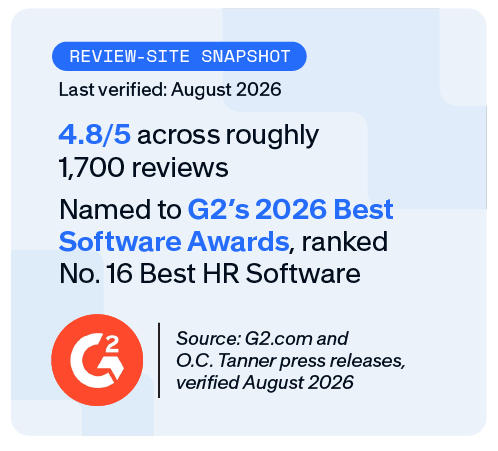
Common buyer concerns to investigate. Mailed physical gift cards were specifically cited as taking over 20 days to arrive in more than one review, and at least one reviewer described selecting an item, leaving the store, and returning to find it no longer available, forcing a re-selection.
The most consistently named admin-side gap, across multiple reviews and search results independent of this specific research, is the lack of a proxy or impersonation feature: administrators cannot view or act on the platform from an employee's perspective, so resolving an employee's account or order issue requires a manual walkthrough rather than direct access.
A smaller number of reviewers flagged general customization limitations and inconsistent notification reliability as areas with room to improve. Separately, Awardco's internal competitive research described O.C. Tanner's pricing as a "luxury" model shaped by the cost of maintaining its own warehouses and manufacturing operations, with a strategic focus on larger clients willing to pay premium prices for custom merchandise.
Awardco differentiators that matter most
- Cost model: Awardco's subscription-based, no-markup structure avoids the overhead O.C. Tanner's warehousing and manufacturing model can carry through to reward pricing.
- Configuration speed: Awardco's platform is built for self-service configuration; O.C. Tanner's manufacturing and design services, while a genuine strength for custom swag, can extend timelines for organizations that want to self-manage program changes.
- Admin experience: Awardco offers unparalleled administration flexibility, putting the power in admins’ hands to run the programs and budgets they want and need.
Discovery questions
- "How is a custom swag or service-award order handled, and how long does that typically take?"
- "Can admins act on an employee's behalf to resolve an account or order issue, or does every issue require a manual walkthrough?"
- "How long does it typically take for a mailed gift card or physical reward to arrive?"
- "Could an employee pick out a reward only to find it's no longer available when they go to redeem it? How is that handled?"
- "How consistent is the reward catalog for employees outside the U.S.?"
- "Does the rewards catalog reflect live market pricing, or the vendor's own warehousing and manufacturing costs?"
Vantage Circle
Core positioning. Vantage Circle is a global employee engagement platform combining recognition (Vantage Recognition), rewards, discounts and perks (Vantage Perks), pulse surveys (Vantage Pulse), and wellness (Vantage Fit) into one suite. It reports more than 700 client organizations and over 3.2 million users, with a catalog spanning 1,000+ gift card brands, an Amazon store integration, and coverage across 100+ countries and 16+ languages.
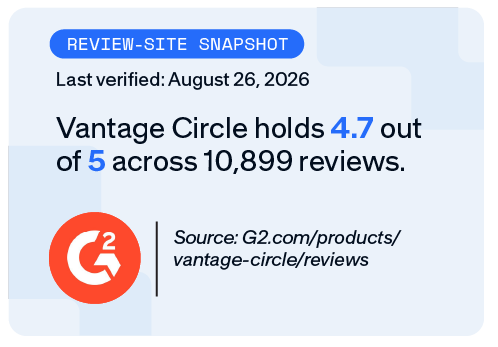
Common buyer concerns to investigate. Several reviewers describe the catalog and reward options as inconsistent by region and note that vendor availability changes over time, sometimes disappearing when needed.
Multiple reviewers also flag that redemption is locked to fixed denominations (e.g., multiples of 50 or 100 points) with no way to redeem an exact point value, and that once points convert to a gift card there's no reversal process. A few reviewers describe the mobile app as "less polished than the web version," with occasional bugs during point purchases and payment. Admin-side, one enterprise reviewer specifically noted that "customization and reporting aren't always as flexible as I'd like" for tailoring recognition programs or pulling deeper insights, and another wanted better cohort/department-level reporting.
Awardco differentiators that matter most
- Regional consistency: Awardco offers millions of rewards around the world, including regional options with localized fulfillment.
- Redemption flexibility: Awardco's ability to redeem exact point values, without forcing round denominations, is a direct answer to a recurring, named complaint in Vantage Circle's own reviews.
- Admin depth and reporting: Awardco's configuration and cohort-level reporting capabilities offer greater capabilities than many competitors.
Discovery questions
- "Does the reward catalog feel consistent across every region we operate in, or does it vary depending on where an employee is located?"
- "Do vouchers or gift cards ever get listed but turn out unavailable at redemption?"
- "Can employees redeem an exact point value, or are they limited to fixed denominations?"
- "For deeper reporting, like recognition trends by team or department, is that available natively, or would we need to export and build it ourselves?"
- "How does the mobile experience compare to the web experience? Any known bugs or friction during redemption?"
Reward Gateway (Edenred)
Core positioning. Reward Gateway (now part of Edenred) is a UK-founded employee engagement hub combining recognition, benefits, discounts, surveys, and communications, serving more than 4,000 companies and 6.5 million employees, with strength in the UK and European mid-enterprise market. Notable customers cited on G2 include American Express, Unilever, Samsung, IBM, and McDonald's.
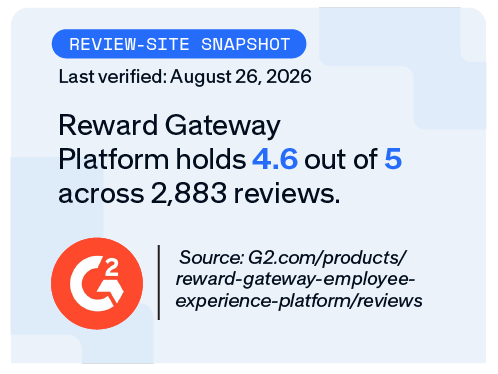
Common buyer concerns to investigate. Multiple reviewers describe the platform's design and search functionality as dated compared to modern engagement tools, and separately note that its communications and blog features haven't kept pace with newer platforms.
A recurring theme across several reviewers is a backend administration learning curve: more than one described the admin experience as clunky at first, though most said it became manageable with time. Reviewers also note that points can expire without a reminder, and G2's aggregated review data echoes limited recognition options and unclear communication around points allocation and reward timelines as recurring dislikes, alongside occasional login and verification friction.
It's also worth knowing that a meaningful share of Reward Gateway's overall review volume on G2 comes from MoveSpring, a wellness and step-challenge feature bundled under the same product listing, rather than the core recognition and rewards platform, so the aggregate score is somewhat diluted for buyers evaluating recognition specifically.
Awardco differentiators that matter most
- Modern UI and search: Awardco’s website and mobile app make recognizing and redeeming points a breeze for every employee.
- Admin ease from day one: Awardco onboarding is straightforward and puts power in the admins’ hands from the start, giving them the capabilities to run their programs and budgets without assistance.
- Catalog localization: Awardco offers millions of rewards and the ability to build custom reward catalogs based on employee metadata.
Discovery questions
- "Is your priority a broad benefits-and-discounts hub, or a recognition and rewards platform specifically?"
- "How would you describe the day-to-day experience of using the platform: modern, or a bit dated?"
- "How long does it typically take an admin team to feel comfortable with the backend? Is extra support available to get there?"
- "Is there a reminder before points expire, or could someone lose points without realizing it?"
- "How consistent are the discount and gift-card options across regions, down to specific towns or cities where our employees live?"
BI Worldwide
Core positioning. BI Worldwide operates primarily as a behavioral-economics-driven engagement agency, delivering sales incentive programs, channel partner incentives, and employee engagement solutions, often through custom-built programs rather than a self-serve SaaS platform. The company reports serving Global 2000 corporations in more than 140 countries and 20+ languages, with 1,001 to 5,000 employees of its own.
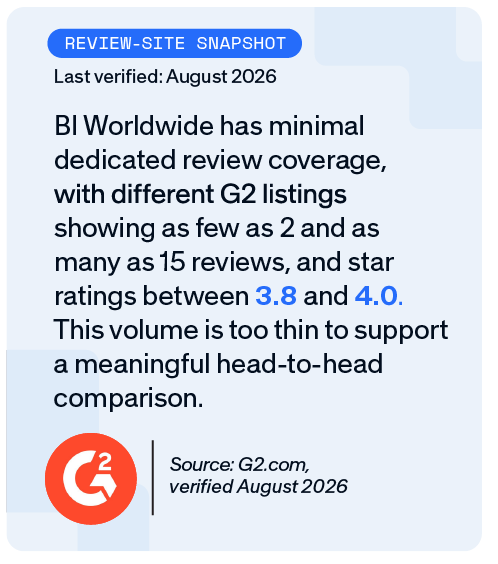
Common buyer concerns to investigate. BI Worldwide's model leans toward custom, agency-delivered engagement programs rather than a configurable self-serve platform. For buyers comparing it to Awardco, the relevant discovery question is whether they want a platform they configure themselves or a managed-services engagement partner.
Awardco differentiators that matter most. Self-service configurability and a transparent, subscription-based cost model are the clearest points of contrast to be aware of.
Discovery questions
- "Are you looking to run recognition and incentive programs yourselves, or work with a partner who designs and manages them for you?"
- "How is pricing structured: platform fee, per-program fee, or a blended model?"
- "If you ever wanted to bring program design in-house, would that be possible, or does it depend on this agency relationship?"
For a more robust enterprise competitor comparison, please view the full white paper.
SMB and mid-market competitor guide
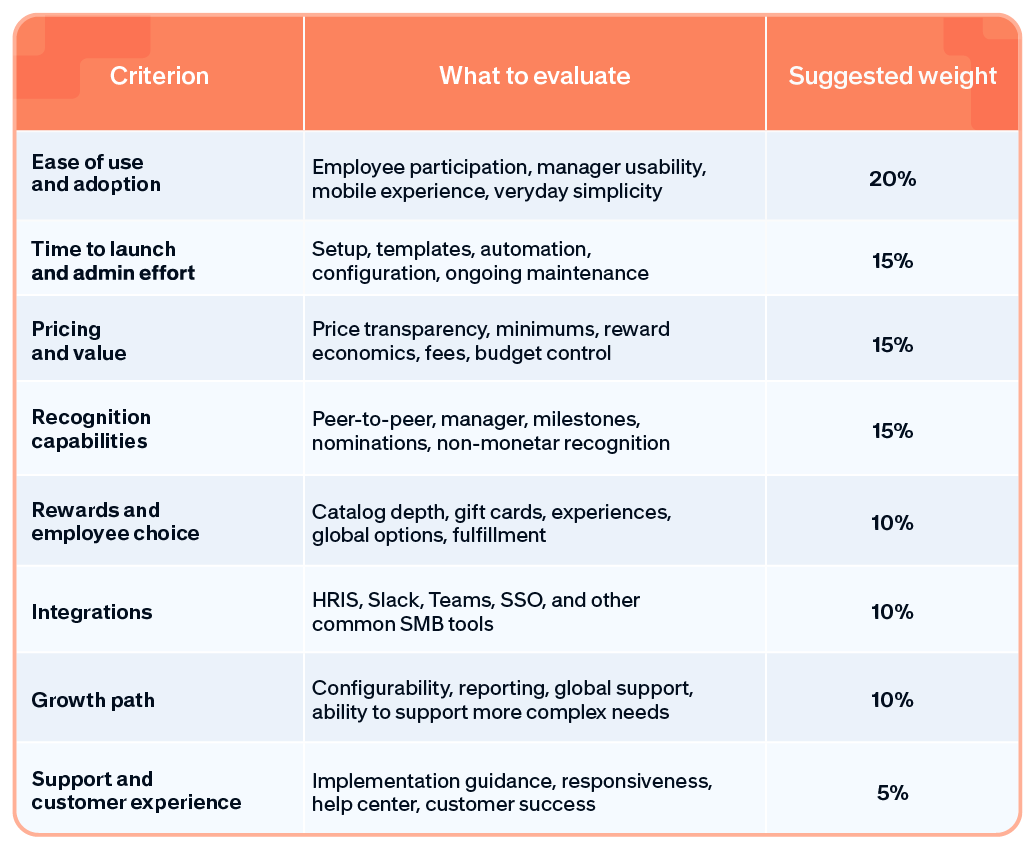
SMB and mid-market buyers are usually evaluating recognition software for the first time or replacing a platform they've outgrown. Speed to value, admin burden for a lean HR team, and pricing clarity dominate these conversations more than global scale or governance depth.
Awardco
Core positioning. For SMB and mid-market buyers, Awardco's core pitch is that a program doesn't have to be replaced later as it grows. The platform runs on the same underlying product for a 50-person company and a 50,000-person enterprise. Awardco supports over 1,000 SMB and mid-market customers with fewer than 1,000 employees in addition to some of the largest companies in the world, all on the same architecture. That matters most for buyers who've already outgrown a lighter-weight tool, or who don't want to face that problem in two or three years.
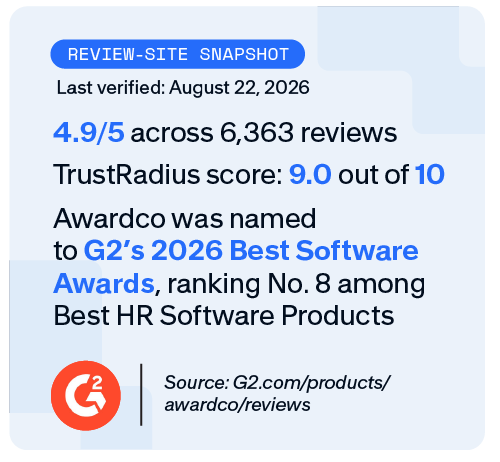
Common buyer concerns to investigate. Cost relative to budget comes up more for this segment than for enterprise buyers. Implementation effort also varies by how much a smaller team wants to customize at launch. While most small-business and mid-market reviewers describe setup as simple and fast, some do mention longer-than-expected setup.
Discovery questions
- "What's your budget per employee for a recognition platform, and how does that compare to what you're paying today, if anything, for a similar tool?"
- "How much internal IT or admin support do you have to get a new platform running, and how quickly do you want to launch?"
- "If you wanted a fully custom setup at launch instead of a standard configuration, how much extra time and coordination should you expect to invest?"
- "Would your team want notifications when points are about to expire or when an order ships, or is that something you'd rather check manually?"
- "How important is it that employees can search or filter the reward catalog quickly, rather than browse a large list?"
- "If your headcount grows significantly in the next two or three years, would you want the same platform to grow with you, or would you expect to re-evaluate at that point?"
- "Has cost ever been a reason you hesitated on a recognition platform before, and what would make the investment feel worth it?"
Bonusly
Core positioning. Bonusly is a peer-to-peer recognition platform built around a monthly points allowance every employee distributes to colleagues, with strong gamification, social feed features, and an AI-powered recognition assistant called Bizy. More than 3,400 organizations use it, including DoorDash, Toast, and SeatGeek.
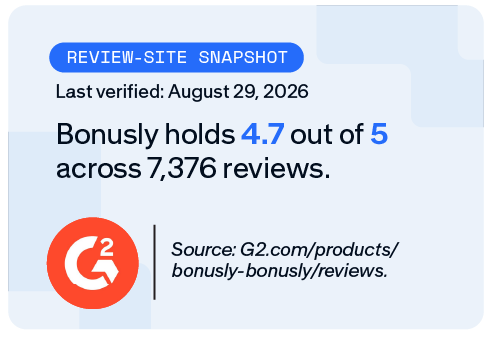
Common buyer concerns to investigate. Reviewers consistently point to a monthly points allowance that runs out quickly, especially for anyone trying to recognize several colleagues in the same month, and several specifically wish for a way to carry over or add points when a busy month calls for more recognition than the allowance covers. Limited configurability to a company's brand, culture, and program rules is a second recurring theme: the experience looks and feels largely the same from one Bonusly customer to the next.
A related critique across reviews is that the peer-to-peer model can end up reflecting social proximity as much as actual contribution, since recognition flows most easily between people who already work closely together, which can undercut perceived fairness for less visible roles. Pricing also comes up as a growth concern: reviewers and comparison data describe costs that can rise meaningfully once a program moves beyond a single team's basic use case into multiple programs or more advanced reporting needs.
Awardco differentiators that matter most
- Catalog breadth and configurability: Awardco's larger, more configurable catalog and branded experience address Bonusly's most-cited limitation directly.
- Program maturity path: Bonusly's largest clients tend to use it in pockets rather than as a unifying, company-wide program; this is a relevant question for buyers anticipating growth.
- Reward allowance flexibility: Bonusly's fixed monthly points allowance is a recurring limitation, especially for managers who want to recognize more people in a busy month. Awardco's budget model doesn't force that same hard monthly ceiling.
- Program maturity path: Bonusly's largest customers tend to run it in pockets or individual departments rather than as one unified, company-wide program. Awardco is built to run multiple concurrent programs, with separate budgets and rules, from a single platform.
Discovery questions
- "How does the platform address fairness in peer-to-peer recognition? Could it end up feeling like a popularity contest?"
- "Could the platform support a formal service-anniversary or incentive program alongside day-to-day recognition, or is it built for one thing at a time?"
- "Can the platform reflect our company's brand and culture, or does it look the same for every customer?"
- "What happens if a team runs out of points to give in a given month?"
- "How does the platform calculate and report on the tax implications of recognition and rewards?"
- "As a program grows, does monthly cost tend to grow faster than headcount?"
Nectar
Core positioning. Nectar (Nectar HR) is a recognition, rewards, and internal communications suite (Nectar Recognize, Comms, and Engage) serving more than 1,700 customers across hospitality, healthcare, manufacturing, retail, and other industries, with a claimed 85% user adoption rate.
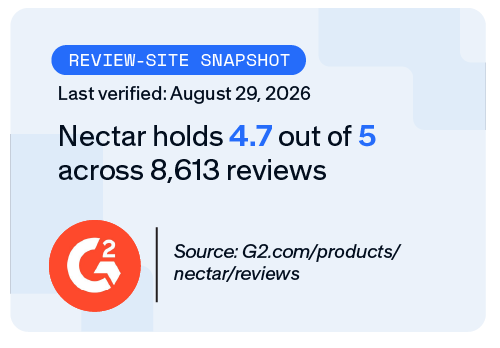
Common buyer concerns to investigate. Points limitation isn't a minor or occasional complaint, it's the single most common criticism of Nectar on G2, and it shows up directly in Nectar's own G2 discussion board, where a user publicly asked the vendor "why do we need so many points for things?"
Several third-party reviews add detail: company branding options and the Amazon rewards catalog are reportedly limited to Nectar's more expensive Plus and Custom plans rather than included at the base tier. Third-party analysis (PeopleManagingPeople, 2026) separately describes Nectar as better suited to small-to-midsize teams than large enterprises with complex, multi-system HR integration needs.
Awardco differentiators that matter most
- Point sufficiency: "Limited Points" and "Insufficient Points" are Nectar's two most common complaints by a wide margin on G2, well ahead of any other issue. Awardco offers a dollar-for-dollar redemption network, ensuring your budget (and your employees’ points) stretch as far as cash would.
- Scalability and rules configuration: Awardco's ability to support multiple concurrent programs, advanced reporting, and complex rules addresses the scale limitation Nectar reviewers and analysts describe.
- Budget model: a single, transparent cost structure without funding the platform fee and reward budget as two separate line items is a relevant contrast for buyers doing total-cost math.
- Feature access by tier: Awardco doesn’t lock branding, customization, or reward options behind certain plans. While some premium features require higher packages, even the basic tier gets access to unlimited programs, bulk recognition, surveys, incentives, and customization.
Discovery questions
- "Is there a risk of running short on points before the end of a recognition cycle?"
- "Are features like branding customization and the rewards catalog available on the base plan, or would upgrading to a higher tier be required?"
- "Does everyone need their own account set up before they can be recognized, or can recognition go out regardless of enrollment status?"
- "How many separate recognition or incentive programs could we run at once?"
- "How does the mobile or desktop experience hold up under regular use, and how quickly does support resolve issues?"
- "If two different teams needed two different budgets or rules for two different programs, could the platform handle that natively, or would it take manual work?"
Motivosity
Core positioning. Motivosity positions itself as a people-first employee experience platform rather than a pure rewards tool, combining recognition (peer-to-peer, milestones, spot bonuses, manager-driven awards) with a social feed, org chart, personality profiles, and add-ons like Lifestyle Spending Accounts and swag stores. It reports a global rewards marketplace spanning 140+ countries and 70+ languages.
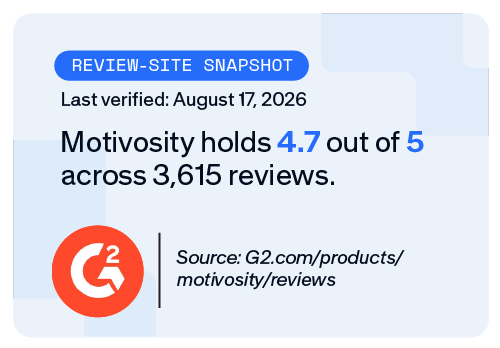
Common buyer concerns to investigate. One consistent theme is reward fulfillment cost: one reviewer specifically noted that shipping fees for physical rewards were expensive, and that a courier charged an additional handling fee on delivery, on top of what was already paid through the platform. Reviewers also cite difficulty locating past appreciation or transaction history, described by more than one as slow to load or hard to navigate, and G2's aggregated data separately flags reporting bugs and limited editing options as an admin-side pain point.
Other reviewers wanted the personality quiz and full profile completion to be optional rather than required, and one reviewer flagged that gift images and GIFs displayed in boxes too small to see clearly, a specific accessibility concern for employees with visual impairments.
Awardco differentiators that matter most
- Allowance flexibility: Motivosity reviewers describe a small, fixed monthly amount with limited rollover, which can push people toward less genuine, obligation-driven recognition near the end of a cycle. Awardco's budget model doesn't force that same small, hard monthly ceiling and allows admins to set any allowance desired.
- Fulfillment cost transparency: Awardco offers zero markups through Amazon Business and free, transparent fulfillment, making sure no part of the redemption process is a negative surprise.
- Recognition history and reporting: Awardco's reporting is built for straightforward access to recognition history at both the employee and admin level.
- Optional personalization: more than one Motivosity reviewer wanted profile elements like the personality quiz to be optional rather than a requirement to reach full profile completion. Awardco doesn't gate the core recognition experience behind mandatory profile-building steps.
Discovery questions
- "What's the default monthly recognition allowance per employee, and does the unused amount roll over or expire?"
- "Could a small, fixed allowance push recognition to feel forced or obligatory near the end of a budget cycle?"
- "Are there any additional fees, like shipping or handling, that show up after a reward has already been paid for?"
- "Can employees easily look back at recognition they've given or received, or does that take digging to find?"
- "Beyond recognition, is this meant to also cover org chart, survey, and interest-mapping features, or would we integrate best-of-breed tools alongside it?"
- "Is completing a personality profile or quiz required to use the platform fully, or is that optional?"
Assembly
Core positioning. Assembly is an employee recognition and rewards platform built around fast setup, GIF- and emoji-forward peer recognition, and AI-assisted recognition drafting (DoraAI). Founded in 2017 and based in the Los Angeles area, Assembly was acquired by Quantum Workplace, a talent management and engagement-survey platform, in January 2026. On G2, the product is now listed as "Assembly by Quantum Workplace," folding recognition and rewards into Quantum Workplace's broader talent management suite.
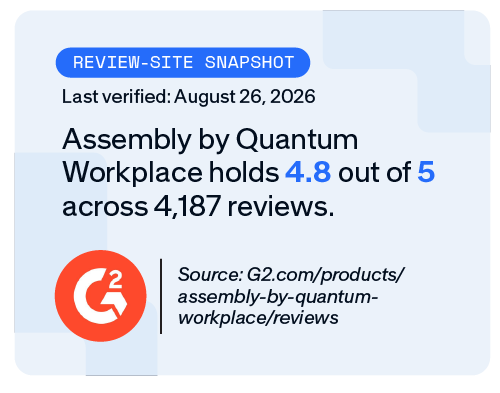
Common buyer concerns to investigate. The most consistent theme across G2's aggregated review data is a fixed, expiring monthly point or "trophy" allowance: multiple reviewers describe hitting a monthly cap (specific limits mentioned include a 12-point-per-person cap and a 112-trophy monthly maximum) and having unused allowance disappear at month's end rather than roll over.
A closely related theme is limited flexibility in redemption; several reviewers wish they could cash out an exact or uneven point total rather than being limited to fixed thresholds. Customization is another recurring gap: more than one reviewer specifically wanted deeper reporting and analytics or more advanced configuration options for complex organizational needs, and a smaller number cited navigation as confusing, including difficulty finding a specific coworker in a large employee list.
Awardco differentiators that matter most
- No forced monthly expiration: Awardco's budget model doesn't force that use-it-or-lose-it mechanic, allowing budget flexibility for users and admins.
- Exact-value redemption: Awardco's reward catalog, spanning tens of millions of items with items available in over 160 countries, allows for totally free redemption instead of requiring thresholds.
- Configuration and reporting built for scale: Awardco's program design is built around granular budget, rule, and reporting controls from the start—each of which is easy to access, export, and act on.
- A platform not mid-acquisition: Assembly was acquired by Quantum Workplace in January 2026, and its recognition and rewards product is now being folded into a broader talent management suite. For buyers who prioritize a vendor whose roadmap and support model aren't actively being integrated into someone else's platform, Awardco is the choice.
Discovery questions
- "Does the platform give employees a fixed number of points or trophies each month, and what happens to the ones that go unused?"
- "Can employees cash out an exact point total, or are they limited to fixed redemption thresholds?"
- "For team members outside the U.S., how consistent are their redemption options compared to U.S.-based employees?"
- "How advanced is the reporting and configuration available out of the box, versus what might require a workaround?"
- "How is the recent Quantum Workplace acquisition affecting the product roadmap, support model, or pricing, if at all?"
Guusto
Core positioning. Guusto is built specifically for frontline, deskless, and distributed workforces, with a pay-for-what-you-use model (organizations pay for employees who actively send recognition rather than for full headcount) and no-markup gift card fulfillment.
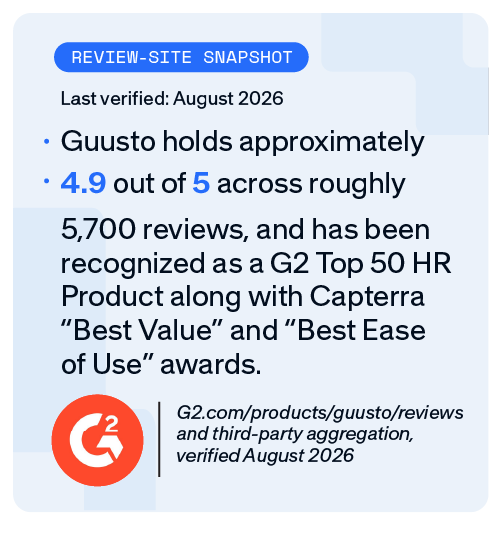
Common buyer concerns to investigate. A meaningful share of reviewers, including several outside the U.S. and Canada, describe a narrower merchant catalog, fewer local redemption options, and no automatic currency conversion for international team members. A second recurring theme is redemption friction: multiple reviewers want smaller or more flexible gift card denominations, broader brand selection, and fewer geographic restrictions on which cards are available where.
Customization and reporting come up repeatedly as well, as several reviewers specifically asked for more brand customization and deeper analytics than the platform currently offers. Other reviewers describe a real learning curve around recipient account setup and navigation. A few reviewers also noted that Guusto's recognition experience feels less social and gamified than competitors like Bonusly or Kudos, with fewer points, leaderboards, or badges, which can make it feel more transactional than community-driven.
Awardco differentiators that matter most
- A unified platform, not gift-cards-only: Guusto's core product is funded gifting; deeper program types, swag, wellness perks, and culture analytics either don't exist or sit behind higher pricing tiers. Awardco's recognition, rewards, and engagement capabilities are part of one platform rather than tiered add-ons.
- Admin customization and reporting: Awardco's more configurable program design and deep analytics allow for greater branding flexibility and better reporting.
- Program depth beyond gifting: Awardco supports a broader range of recognition program types (peer, manager, nomination, incentive) alongside its reward catalog; Guusto's core strength is closer to funded gifting and appreciation than a full multi-program recognition suite.
Discovery questions
- "What share of your workforce is frontline, deskless, or seasonal, and how do they receive recognition today?"
- "Are you looking for a single funded-gifting tool, or a full recognition program with peer, manager, and milestone workflows?"
- "How consistent is the reward catalog for team members outside the U.S. or Canada, and does currency conversion happen automatically?"
- "Are features like HRIS syncing or automated milestones included on the base plan, or are they on a higher tier?"
- "How does the platform handle employees who don't have a company email address or device?"
Snappy
Core positioning. Snappy is an enterprise and mid-market gifting platform built around recipient choice: instead of sending a fixed gift, senders send a curated selection and let the recipient pick. It's positioned primarily as a gifting tool, not a full recognition platform. G2 lists Snappy as trusted by over 43% of Fortune 100 companies, with more than three million gifts sent to date.
Common buyer concerns to investigate. The most common complaint, by mention volume, is a limited gift selection, especially at lower budget tiers, with a few reviewers specifically noting that inventory on popular items runs out and restocks slowly. A related and recurring ask is for gift card options instead of physical merchandise; several reviewers said they'd prefer the flexibility of a gift card to being handed a curated physical selection.
Cost comes up specifically and repeatedly: reviewers describe the platform as expensive for what's delivered, one flagged a $25 minimum on the lowest pricing tier as a real constraint for smaller companies, and another described received merchandise as feeling cheap, with pixelated branding and low build quality.
A smaller number of reviewers also flagged limited customization, needing to build an entirely new campaign to make adjustments, and friction during initial funding setup. Beyond the review data, Snappy's core design lacks true recognition capabilities (peer-to-peer, nominations, values-based recognition), so buyers who want a full recognition program have to build that layer manually using tools like Slack or Teams alongside Snappy's gifting experience.
Awardco differentiators that matter most
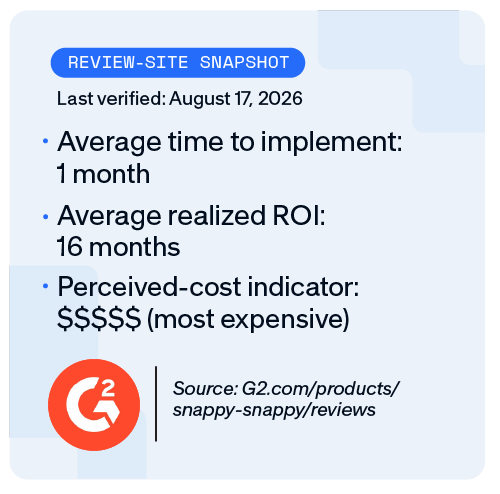
- Cost and perceived value: G2's own data rates Snappy at the highest perceived-cost tier in its category, and multiple reviewers independently described pricing as steep relative to what's delivered, including a $25 minimum per gift and complaints about item quality. Awardco offers transparent pricing, no hidden fees, and zero markups through Amazon Business, increasing the power of your rewards budget.
- Time to value: G2 benchmarks Snappy's average realized ROI at 16 months, notably long for a gifting tool. The same G2 benchmark has Awardco at 11 months, meaning customers make back their investment within a single year.
- A unified program, not gift-plus-a-second-tool: Awardco combines recognition (the "why") with rewards (the "what") in one workflow. Snappy handles reward selection well but has no peer, nomination, or values-based recognition layer, so buyers end up managing that separately in Slack or Teams, adding real, ongoing admin work.
Discovery questions
- "How does an employee find out why they're receiving a gift, and where does that message live?"
- "If Slack or Teams is used for the actual recognition moment, how consistent would that be across teams and managers?"
- "How much manual work would it take to track why a gift was sent and what it was for?"
- "Could cost per gift, or a minimum spend per person, limit who gets included in a program?"
- "How consistent is the gift selection for team members outside the U.S.?"
- "What's a realistic timeline before a program like this starts paying off?"
TerryBerry
Core positioning. TerryBerry is a 100+ year old provider of employee recognition and engagement, historically known for tangible service-award products (pins, plaques, jewelry) and now offering a broader digital platform combining recognition, rewards, wellbeing, and engagement surveys. The company reports more than 40,000 clients creating over 1 million recognition moments annually, serving 150+ countries.
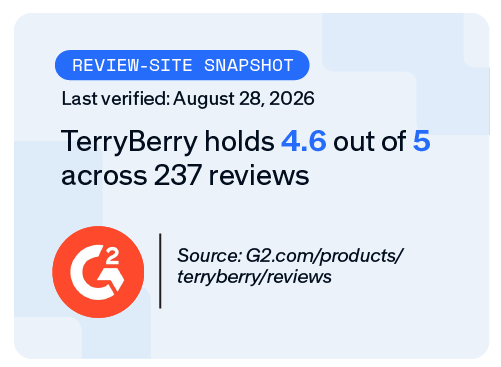
Common buyer concerns to investigate. Third-party review sites reinforce a consistent theme around the platform's age and flexibility: SelectSoftware Reviews describes the interface as "a little outdated" with limited customization, and separately notes that customers must pay for higher subscription tiers to access certain features rather than getting them at the base level. Info-Tech's SoftwareReviews.com reports that pricing "can be improved for smaller-size organizations," suggesting cost scales less favorably at smaller headcounts than for larger customers.
A specific, named complaint shows up in more than one G2 review: shipping charges for physical rewards aren't built into the displayed gift price, so the final cost at checkout can run higher than expected, and one reviewer separately mentioned occasional technical issues requiring resolution.
G2's own alternatives page adds a structural gap: it states plainly that TerryBerry "lacks advanced reporting and comprehensive employee profile views that consolidate communication, awards, and redemption history in one place," and separately describes "limited customization and flexibility in reward options and program management."
Awardco differentiators that matter most
- Feature access without tier-gating: SelectSoftware Reviews reports that TerryBerry customers must pay for higher subscription tiers to unlock certain features rather than getting a complete experience at the base level. Awardco doesn't wall off core recognition, reporting, or catalog capabilities behind pricing tiers.
- Modern, digital-first interface: SelectSoftware Reviews independently describes TerryBerry's interface as outdated with limited customization. Awardco's platform is built as a modern, digital-first product rather than a legacy system with newer features layered on top.
- Transparent, all-in reward pricing: more than one TerryBerry reviewer specifically flagged that shipping charges aren't built into the displayed gift price, creating an unexpected cost at checkout. Awardco's no-markup model is built around transparent, predictable pricing with no checkout surprises.
- Reporting and unified employee history: G2's own comparison content states TerryBerry lacks advanced reporting and a consolidated view of an employee's communication, awards, and redemption history in one place. Awardco's reporting and employee profile are built around that kind of unified view from the start.
- Program configurability: TerryBerry trails on Ease of Setup and Ease of Admin in direct G2 comparison, and G2's own alternatives content separately describes "limited customization and flexibility in reward options and program management." Awardco's program design offers deeper, more granular configuration.
- Budget predictability: a redemption rate reported to run double the industry average has reportedly required at least one TerryBerry customer to pivot their program to stay within budget. Awardco's transparent, no-markup cost model and reporting give administrators more predictable visibility.
- Cost that doesn't penalize smaller organizations: Info-Tech's SoftwareReviews.com specifically notes TerryBerry's pricing could be better suited to smaller organizations. Awardco runs the same core platform for a 50-person company and a 50,000-person enterprise, without a separate cost structure that scales unfavorably at smaller headcounts.
Discovery questions
- "How predictable is the recognition budget likely to be month to month? Any common surprises customers run into?"
- "Are all features included in the base plan, or do some require upgrading to a higher tier?"
- "Could the final cost of a reward come in higher than expected once shipping or handling is added?"
- "Can an employee's full recognition, award, and redemption history be seen in one place, or does that require pulling from multiple views?"
- "How much of running a program relies on the vendor's support team versus our own team being able to self-serve changes?"
- "How does pricing scale as an organization grows or shrinks?
View a visual comparison chart by viewing the full PDF here.
Questions worth asking across any vendor
Each profile above includes vendor-specific discovery questions, but for those who aren’t sure what they need and therefore haven’t yet narrowed down vendor options, use these discovery questions for yourself to help decide which platform options best fit your needs.
- How important are global reward options and local fulfillment to your workforce?
- How much control does your team need over program design, eligibility, budgets, and approvals?
- What work is still manual today, especially service anniversaries, HRIS updates, fulfillment, and reporting?
- How do you measure whether recognition changes engagement, retention, or performance?
- What fees or markups would be included in a given reward model, and how would you find out?
- What will your program need to support in two or three years?
Find the right rewards and recognition vendor for you
As seen above, each recognition vendor has certain strengths and specific gaps to be aware of. It’s important for any buyer to do enough research to find the vendor whose strength best fits the unique needs of your business.
For a vendor that offers flexible and scalable recognition, the largest reward network on the planet with transparent pricing, and engagement survey tools that all scale from SMB needs to enterprise requirements, Awardco is the right choice for you. Reach out to get a demo.

