
Submission successful!
Download white paper
Submission successful!

As part of our research with the Awardco Centre of Excellence, we speak with leaders from across different industries and organisations. Recently, a senior HR leader at a large enterprise shared a perspective we’re hearing more frequently: the organisation wasn’t questioning the value of recognition. In fact, they believed employee recognition played an important role in culture, engagement, and employee experience. The challenge was one of priorities.
Over the next several years, the focus of this senior leader would be on AI, workforce transformation, future jobs, and navigating a rapidly changing business landscape. With so much organisational energy directed towards these initiatives, employee recognition simply wasn’t viewed as a priority for the immediate future for this particular leader.
It’s an understandable position, and it’s one many organisations are currently wrestling with. After all, when leaders are being asked to prepare the workforce for AI, redesign operating models, build new capabilities, and manage ongoing uncertainty, recognition can seem like something that can wait.
But what if we’re thinking about it the wrong way? What if recognition isn’t competing with workforce transformation, AI adoption, and future-of-work initiatives? What if it’s actually one of the mechanisms that helps those initiatives succeed?

Our research shows that while AI adoption at work has doubled in the last two years, organisations that adapt to use recognition in such times of change have employees that are 2.3x more likely to be engaged and 1.7x more likely to want to stay. Recognition as a positive mechanism to assist in organisational change is clear.
While technology may reshape how, where, and when work gets done, transformation still depends on people and their ability to change how they work, collaborate, learn, and adapt. And that is precisely where recognition becomes increasingly important.
Every transformation is a behaviour change initiative
Organisations don’t transform because technology changes. They transform because people do. Whether the goal is AI adoption, skills transformation, digital innovation, or organisational redesign, success depends on employees embracing new behaviours.
Leaders need people to:
· Learn new skills
· Experiment with new technologies
· Share knowledge across teams
· Challenge established ways of working
· Adapt to ambiguity
· Collaborate differently
Most organisations communicate these expectations well. Far fewer reinforce them consistently, and therefore adoption may suffer. Recognition is one of the most scalable ways leaders can reinforce the behaviours they want to see more of in their employees. Every recognition moment sends a companywide signal about what matters, and that signal helps communication and adoption better than anything.
When employees see peers recognised for innovation, learning agility, collaboration, or customer impact, they gain clarity about what success looks like in the future organisation.
Case Study: Alera Group
Alera Group’s transformation challenge was unifying a fast-growing, geographically dispersed business formed through 24 mergers and 280 offices around one shared culture. To make their values stick beyond workshops and communications for their global org, Alera used Awardco to turn appreciation into a daily behaviour—tying recognition to company values, giving managers monthly budgets, and extending the programme into onboarding, milestones, and branded rewards.
That made the culture visible in everyday work and helped drive measurable gains in adoption, retention, and brand unity.
.avif)
During uncertainty, employees look for signals
It’s a well-known fact that periods of change create a whole host of questions from employees that leaders don’t always hear directly. Questions such as:
· Am I still valued?
· Do I belong here?
· Am I focusing on the right things?
· What does success look like now?
· Does my work still matter?
Organisations often respond to uncertainty with more communication, and while communication is critical, employees don’t just need information—they need evidence. Evidence that their contributions matter, evidence that they’re making progress, evidence that they’re helping move the organisation forward.
Recognition provides that evidence. Every meaningful recognition moment reinforces not only what someone accomplished, but why it mattered. In times of uncertainty, that clarity becomes a source of confidence.
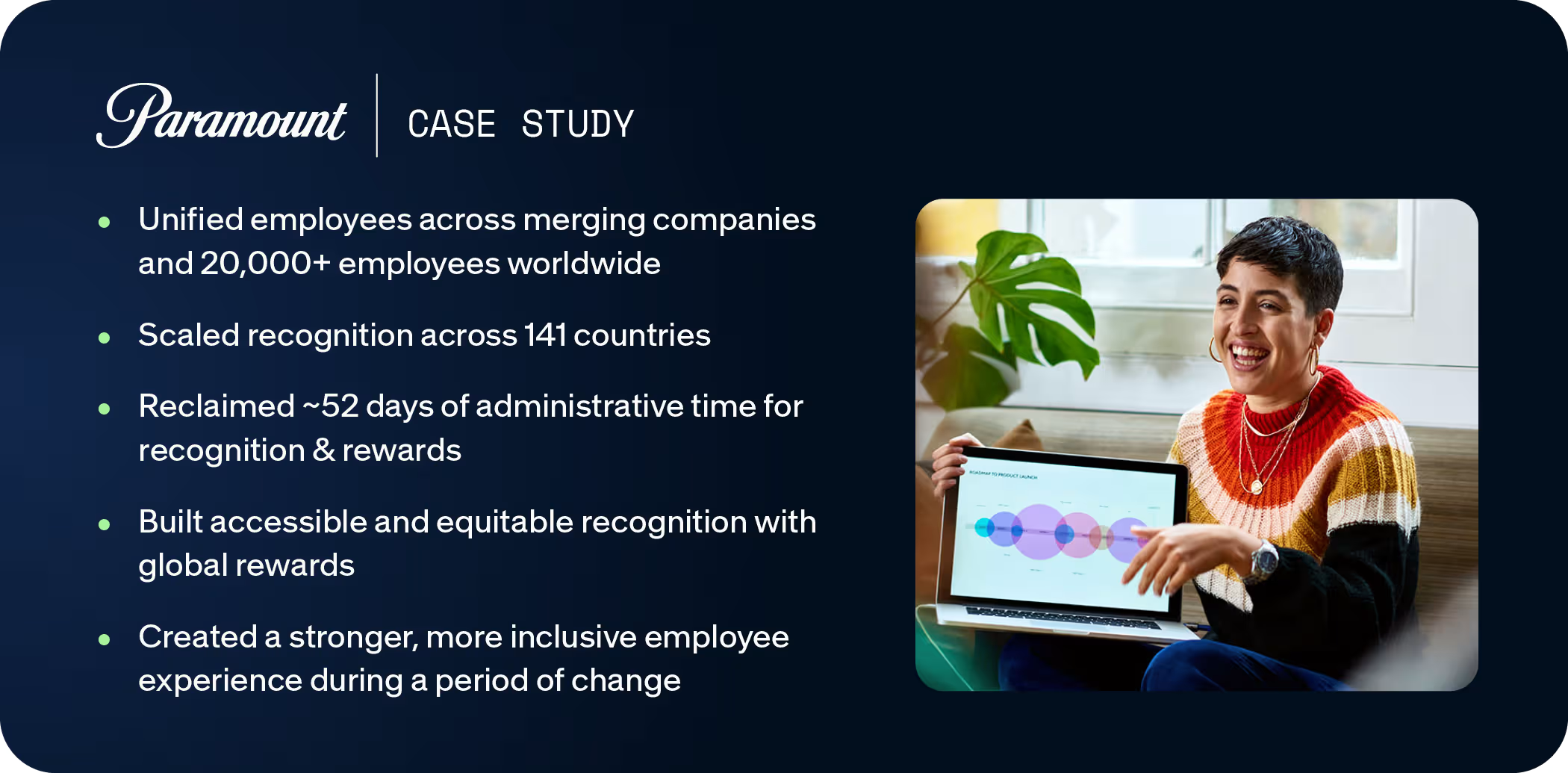
Paramount faced a major moment of change when Viacom and CBS merged under the Paramount banner, creating a challenge far bigger than simply combining systems or brands. The real task was building one culture across legacy employee populations and a global workforce of more than 20,000 people—while many employees were also transitioning to remote work and looking for signs that they still belonged in the new organisation.
Paramount used Awardco to make those signals visible. By consolidating fragmented recognition programmes, expanding access to flexible global rewards, and making appreciation equitable across legacy groups and geographies, Paramount gave employees tangible evidence that they were seen, valued, and included in what came next.
Recognition preserves culture when organisations are evolving
Restructures, workforce reductions, and organisational redesigns don’t just impact reporting lines. They impact culture.
When organisations lose people, they often lose institutional knowledge, relationships, and the individuals who have long embodied and reinforced the organisation’s values. One of the greatest risks during periods of transformation is Cultural Drift.
.avif)
Yet the impact of organisational change is not limited to those who leave. Those who remain often carry a quieter, heavier burden. Alongside the pressure of new responsibilities and expanded workloads, many experience what psychologists refer to as survivor’s guilt: a complex mix of relief, grief, uncertainty, and concern for former colleagues. Even when employees remain committed, they may feel disconnected, emotionally exhausted, or unsure of their place in the organisation’s future.
This is where recognition plays a critical role. Recognition does more than celebrate performance. It helps rebuild connection. It reminds employees that their contributions matter, that their efforts are seen, and that they continue to play an important role in moving the organisation forward.
At the same time, every recognition moment makes culture visible. It highlights the actions, decisions, and behaviours leaders want others to emulate, reinforcing values not through posters or presentations, but through real examples happening every day across the business.
In a rapidly changing environment, recognition becomes a living expression of culture, helping employees reconnect with what matters most, even as the organisation evolves around them. When structures change, recognition helps preserve organisational and personal identity.
The future of work requires more recognition, not less
Much of today’s workforce conversation centres on skills. Organisations are investing heavily in upskilling, reskilling, AI literacy, and future workforce planning.
Yet many overlook a simple truth: people pay attention to what gets recognised and rewarded. If organisations want employees to embrace learning, experimentation, adaptability, and innovation, those behaviours need to be visible. Rewards and recognition helps shine a spotlight on those behaviours.
Leaders can use recognition to showcase:
· Employees embracing new technologies
· Teams experimenting responsibly with AI
· Individuals sharing knowledge and expertise
· Celebrating failing fast and reinforcing psychological safety
· Managers helping others learn and grow
· Cross-functional collaboration and problem solving
Recognition turns abstract transformation goals into real examples employees can see and replicate. Here are more real-world examples:
Crumbl
At Crumbl, leaders used recognition to keep values visible as the business scaled rapidly across a remote-first workforce. Employees see, celebrate, and learn from one another’s contributions in real time, while values-based recognition helps turn mission and culture from words on paper into everyday actions employees can replicate.
PMG
At PMG, leaders used recognition to make great work visible across a fast-moving global agency, helping employees see what excellence looked like, learn from one another, and carry strong behaviours across teams. By centralising recognition and embedding it into Slack, office displays, onboarding, and the broader employee journey, PMG turned appreciation into a visible part of how the company works every day.
Lineage
At Lineage, leaders used recognition to bridge the digital divide for a largely deskless workforce, pairing leadership buy-in, onboarding, and hands-on rollout support to make recognition accessible across warehouses, loading docks, and frontline operations. The result was full launch engagement, a sharp increase in recognition activity, and stronger retention among recognised employees—proof that visible appreciation can help scale new behaviours even in complex, offline environments.
The future of work isn’t built solely through training programmes. It’s reinforced through everyday behaviours. Recognition helps organisations scale those behaviours faster.
Recognition is transformation infrastructure
Too often, organisations view recognition as a cultural initiative. Something important, but secondary. Something valuable, but not urgent.
Yet the organisations navigating change most effectively understand something different. Recognition is not simply about celebrating success after transformation occurs. It’s about reinforcing the behaviours, mindsets, and contributions that make transformation possible in the first place.
It helps reduce uncertainty. It preserves culture. It accelerates learning. It reinforces desired behaviours. It connects people to purpose. In other words, recognition is not separate from workforce transformation. It is part of the infrastructure that supports it.
As organisations invest in AI, future skills, workforce planning, and organisational change, the question should not be whether recognition remains a priority. The question should be: Can organisations afford to navigate transformation without it?
Because while technology may shape the future of work, it is people who bring that future to life. And people need to know that what they do matters.
Learn how to transform your workforce at www.awardco.com
Author: Chantale Callingham
SVP Global Client Success & EMEA Operations
Awardco Centre of Excellence Employee Experience Executive

