

Employee engagement stats: What the data means for HR leaders
Every engagement survey creates a similar moment. A number lands in a leadership meeting, someone asks whether it is good, and the conversation quickly turns to what should happen next. Should leaders hold manager training? Should there be more team parties? Should there be more monetary bonuses?
That period of “what should we do?” is where most engagement programmes fall short. In Awardco’s latest study, overall employee engagement measured 64%—a composite of advocacy, motivation, intent to stay, and belonging. That number, or whatever number leaders might obtain from their own internal surveys, can tell leaders the employee experience deserves attention, but it cannot tell them whether the next move belongs to managers, Talent, Internal Communications, Learning, Operations, or the executive team.
The latest Awardco Center of Excellence research gives HR leaders a more useful place to start. The findings suggest that employees generally understand what they need to do today, but many are less confident about what comes next—which can impact their engagement. Employees want to see a future for themselves, trust the company’s direction, feel recognised beyond their immediate manager, and receive the support needed to work through AI-driven change. That is a tall order for any leader.
And that’s the story behind the statistics: the goal is not to chase a better score in the abstract, but to turn each signal into a focused decision—what it means, what to change, who owns it, and how to measure progress.
What does employee engagement actually measure?
Before deciding what to fix, leaders need to know what their engagement score actually represents. “Employee engagement” is often used to describe everything from happiness to productivity. Those ideas are related, but they are not interchangeable.
In this study, engagement is a composite of four employee experiences: whether employees would recommend the company as a good place to work, whether they are motivated to do their best, whether they are unlikely to look for a new job soon, and whether they feel they belong at the company.
That composite is a lens on employee experience. It is not a measure of satisfaction, retention, performance, productivity, or business results. A useful interpretation pairs the score with workforce data, manager feedback, exit data, operating metrics, and employee comments.
The study surveyed full-time, permanent employees at organisations with 250 or more employees across 21 countries and 11 industries in May and June 2026. The final sample size, regional groupings, and AI subsample should be confirmed against the approved report before publication.
The headline score hides the decision
Once the measure of engagement is clear, the “headline” engagement score leaders often look at becomes easier to read. In our report, the 64% composite is not one story; it is four experiences moving together.
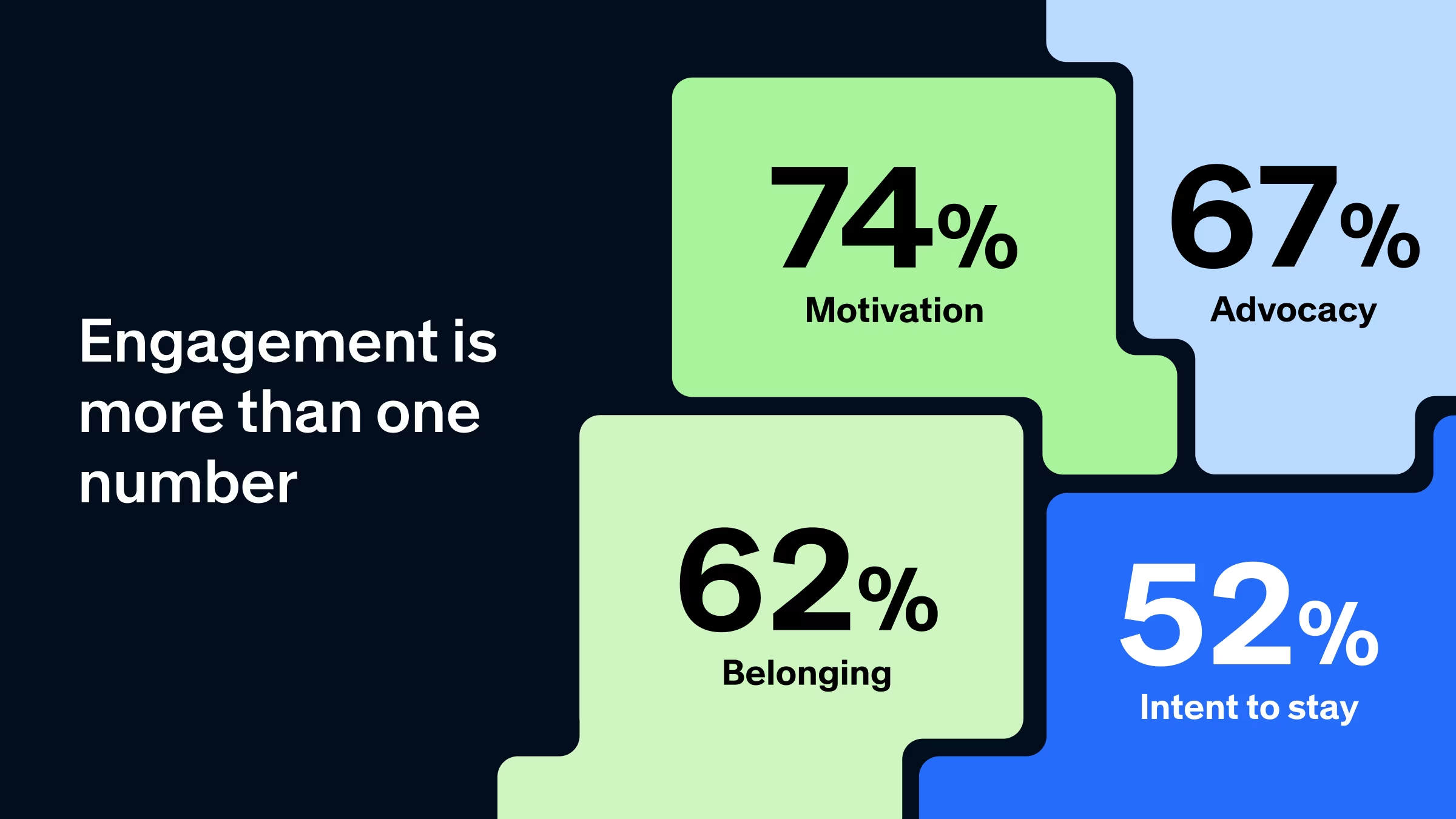
Motivation is the strongest component of engagement at 74%. Advocacy is 67%. Belonging is 62%. Intent to stay is 52%—the lowest of the four by a wide margin.
That contrast is where the interpretation begins. Employees may be motivated to contribute while remaining unsure whether they will grow—or remain—tomorrow. Think of how many people you’ve worked with who were willing to contribute at a high level, but were not sure they had a future with the organisation. Their effort was real. Their confidence in staying was not.
The data, however, does not prove a single cause. It does show why retention should not be treated as a simple extension of motivation, but if leaders want to understand what is happening inside their own organisation, they should look at the four components separately, identify the most consequential gap, and decide what evidence would show that conditions are improving.
The answer is rarely to improve whichever item is easiest to move. A better engagement strategy considers motivation, advocacy, belonging, and intent to stay together.
The future employees can see matters most
The strongest thread in the research is not about whether employees know what to do. It is about whether they can see what comes next.
Career prospects scored 69% in our study, below several stronger operational categories. More importantly, career prospects emerged as the strongest overall engagement lever and the only item that appeared across all four engagement components.
That makes career visibility both a high-value driver and an area with room to improve. The practical question is not whether your organisation has a career framework. It is whether employees can see a future for themselves inside it.
What blocks that view? It may be unclear roles, limited mobility, missing skills, weak manager conversations, unavailable mentors, or simply a lack of visible opportunities. The solution starts by finding out which of those problems employees are actually experiencing. From there, organisations can map the roles, skills, mentors, and internal opportunities people can access; train managers to discuss growth throughout the year; and make development commitments visible enough to track.
Then leaders need to return to the data. Career prospects, learning opportunities, intent to stay, and internal movement should be reviewed together. A career path that exists only in a talent document is not a career path employees can see. Talent teams can build the infrastructure, but managers make it visible through everyday conversations. Regular recognition can also help highlight progress along the way.
Career visibility is only half of the future story. Employees also need to believe the organisation itself is going somewhere worth joining.
The research separates two communication challenges that are easy to confuse. Employees may understand their objectives and how their work contributes to team goals while still feeling uncertain about where the company is going—or whether they want to build their future there.
Current-work clarity answers, “What should I do?” Future confidence answers, “Why should I build my future here?” The second question requires more than a strategy deck. Executives and Internal Communications leaders need to explain the direction in plain language, connect it to team and individual work, communicate progress and trade-offs repeatedly, and give managers the context to discuss what the strategy means locally.
This is not a call for forced optimism or overpromising. Strategy communication builds confidence when it is specific, repeated, and credible. Leaders should measure understanding and confidence separately, because knowing the plan and believing in the future are not the same experience.
Recognition makes the present feel connected to the future
Career visibility and confidence in the company’s future address what comes next. Recognition addresses what employees experience in the present: whether their contributions are seen and valued.
Manager recognition scored 79%, compared with 50% for recognition from senior leaders. The score for systems that promote meaningful recognition was 60%.
The study does not prove that recognition caused those differences. It suggests an area to investigate: the manager relationship may be stronger than the enterprise-wide recognition rhythm and infrastructure around it.
That gap calls for more than telling managers to say thank you more often. Managers need to give timely, specific recognition tied to contribution, progress, values, and meaningful work. Senior leaders need a consistent rhythm for recognising work across teams, locations, and workforce groups. HR and People teams need to make the practice sustainable by clarifying the moments, channels, guardrails, access, reporting, and enablement that support it.
Employees should continue recognising one another as a source of connection, even when peer recognition has a smaller or less consistent relationship to the composite score. Recognition is one part of the employee experience. It does not replace fair pay, manageable workloads, effective management, career opportunity, or safe working conditions. Its value comes from reinforcing the contributions and behaviours an organisation wants people to see and repeat.
AI access is not AI readiness
The same pattern appears in the way organisations are preparing people for change. Providing a resource is not the same as helping employees use it with confidence.
Among employees in the approved AI subsample, 61% said they had access to the AI tools they needed. Understanding was 52%, manager promotion was 43%, peer sharing was 42%, and training was 35%.
The 26-point gap between access and training is the clearest signal. Procurement has moved faster than the habits, judgement, and confidence employees need to use the tools well.
That makes AI adoption a change-management and training effort, not only a technology decision. Leaders should identify which roles and workflows will change, define acceptable use cases, train employees on both the tools and the judgement required to use them responsibly, and equip managers to model use and answer questions. Peer-sharing mechanisms can turn isolated experiments into practical examples. Measurement should include understanding, confidence, use, quality, and employee experience—not just licences purchased.
These findings apply to the approved AI markets, not every employee population. AI-written recognition is not automatically meaningful, either. Trust and human judgement still matter.
Use regional data to localise action—not rank countries
At this point, the findings may look like a global prescription. They are not.
The report shows substantial regional variation. Some may reflect employee experience; some may reflect how respondents use rating scales across cultures. Raw country rankings are therefore a weak basis for action.
Global HR leaders should compare each market with its own baseline and trend, use corrected driver analysis where supported, and involve regional HR and employee representatives in interpretation. Communication, manager enablement, recognition norms, career programmes, and AI training may need to look different across markets even when the underlying priorities are similar.
A regional score is not a league table. It is a prompt to ask better local questions.
Turning engagement data into action in 90 days
A survey becomes useful when it changes what leaders do next. That does not mean launching a company-wide engagement initiative every time a score moves. It means choosing a small number of priorities and giving people enough clarity, ownership, and time to act on them.
During the first 15 days, leaders should confirm what their engagement measure includes, review the four component scores, examine response rates and segment differences, and compare the results with manager feedback, exit data, employee comments, and relevant business metrics. The goal is to identify two or three priority gaps—not to solve everything at once.
By day 30, each priority should have an owner. That may include an executive sponsor, an HR or People lead, a manager owner, and someone responsible for measurement. Leaders should define what will change for employees and managers, as well as what the organisation will not attempt in the first 90 days.
From days 31 to 60, the work becomes visible. Managers need practical conversation guides and time to use them. Employees need to understand why the change is happening, what behaviours are expected, what support is available, and when they can expect to see progress. Career conversations, recognition practices, strategy communication, mentorship, or AI enablement can then be launched where the data supports them—with local versions for different regions, roles, shifts, and workforce groups.
The final 30 days are for learning, not declaring victory. Review leading indicators such as manager participation, career conversations, training completion, recognition reach, communication reach, and employee questions. Look for segment gaps. Adjust the intervention before scaling it, then set a six- or 12-month review for the engagement components and relevant business outcomes.
Priority signal
First action
Owner
Leading measure
Later outcome to review
Low career visibility
Manager growth conversations and visible pathways
Talent + managers
Conversations, commitments, internal opportunities
Career prospects, intent to stay, internal movement
Low future confidence
Repeated strategy communication and local manager discussion
Executives + Internal Comms
Reach, understanding, questions answered
Vision and strategy, advocacy, intent to stay
Low senior-leader recognition
Leadership recognition cadence with specific criteria
Executives + HR
Coverage, frequency, workforce reach
Recognition, values alignment, belonging
Low recognition-system score
Clarify moments, access, rules, channels, and reporting
HR/EX + programme owner
Participation, reach, manager adoption
Recognition and belonging
AI access-training gap
Role-based enablement and manager modelling
IT/L&D + managers
Training completion, confidence, use cases
Enablement, work quality, change readiness
What the data does not mean
The value of engagement data depends on using it carefully. The findings do not mean that:
- A 64% composite describes every employee, team, or region.
- A regional score can be used as a league table.
- A statistical predictor proves that one intervention caused an outcome.
- Recognition replaces fair pay, manageable workloads, effective management, career opportunity, or safe working conditions.
- A platform can make organisational decisions or create trust by itself.
- Higher participation automatically means higher engagement.
- AI access equals AI readiness.
How Awardco can help HR move from data to action
The work begins with the right question and a credible plan. Technology can help close the loop once those are in place.
Awardco® can be evaluated as part of a listening-to-action workflow, especially with Awardco Engage™ as it helps organisations collect employee feedback and connect insights with visible follow-through, subject to current product scope and plan validation. Awardco’s recognition capabilities can help make meaningful recognition more consistent, visible, and measurable across manager, senior-leader, peer, milestone, and values-based moments.
Read the Centre of Excellence 2027 report
Explore Awardco’s employee engagement platform
See how Awardco supports employee recognition