

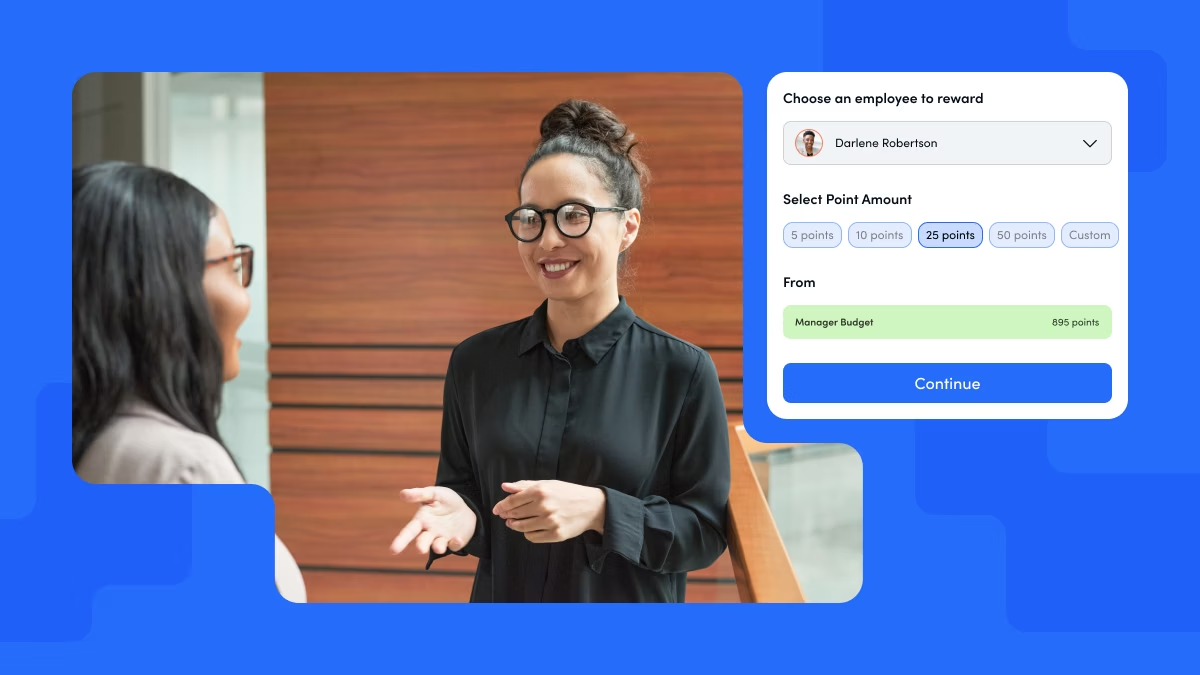


As a partner to corporate teams running employee recognition programmes, I've had a close view of what it takes for recognition to take hold after launch. One thing comes up constantly: managers are the hardest and most important group to bring along. It's rarely a knock on managers as most genuinely want to recognise their people well, but recognising well is a skill few have been taught. We ask them to coach, give feedback, and acknowledge good work, then assume the "how" will sort itself out.
That's the real gap. Most organisations don't have a motivation problem, they have a solvable education gap. Awardco's 2026 research shows what's at stake:
- 43% of employees are recognised at least monthly by their manager
- 34% go six months or longer without hearing anything
- 5% say they've never received recognition from their manager at all
Awardco sees this as a training and education issue that can be addressed through meaningful and intentional change management design.
Recognition is a leadership behaviour, not an HR task
The first step in this educational mission is facilitating the following mental shift in your organisation’s leaders: Recognition isn't an extra item on a manager's plate. It's a core leadership behaviour, right alongside giving feedback or running a good one-to-one. Like any other leadership behaviour, it needs cadence, specificity, and practice to be developed.
The data backs this up:
- Employees who feel meaningfully recognised are 2.3 times more likely to be engaged
- They're also 1.7 times more likely to want to stay on your team
- Teams led by the lowest-recognising managers land around the 27th percentile for engagement
- Teams led by the highest-recognising managers land around the 69th percentile
That's the difference between a team that's coasting and a team that's genuinely bought in. Recognition frequency alone explained 15% of the variance in engagement scores in Awardco's 2026 study, which is a big number for a single behaviour to carry.
The real gap isn't that recognition never happens
Only 62% of employees say they were meaningfully recognised in the past three months, showing that meaningful recognition is too infrequent and too informal to become part of how managers actually lead.
Some employees get thoughtful, specific recognition every few weeks. Others go most of a year without hearing anything from their manager at all. That inconsistency is what training needs to fix.
Why recognition training alone isn't enough
Here's where I'd push the conversation a step further than most recognition guides go. You can teach a manager the mechanics of recognition, when to give it, how to make it specific, which channel to use, but if that manager struggles to communicate clearly or read the room, the recognition still won't land the way it should.
Recognition and soft skills are tied together more than people realise. Giving specific, meaningful recognition requires a manager to notice what an employee did well, articulate why it mattered, and deliver it in a way that feels genuine rather than performative.
That's communication. That's empathy. Those are soft skills, and they're trainable, the same way recognition habits are trainable.
So when I think about building out manager recognition training, I don't think it should live in a silo. It should sit inside a broader leadership development effort that also covers things like:
- Active listening, so managers actually catch the moments worth recognising
- Giving feedback with care, since recognition and constructive feedback pull from the same communication muscle
- Reading what an employee needs in the moment, because some people want public recognition and others would rather have a quiet word after a shift
- Following through consistently, so recognition doesn't disappear the moment things get busy
A manager with strong empathy skills picks up on these cues faster, and their recognition efforts go a lot further as a result.

Four frameworks that make manager recognition training stick
If I had to boil this down for a manager who's short on time, I'd point them to four things: consistency, specificity, channel choice, and follow-through.
1. The cadence framework
Recognition works best on a rhythm. Quarterly is a floor, not a goal. Monthly recognition is where the habit really starts changing behaviour. Going longer than three months between moments of recognition makes engagement slide noticeably.
2. The meaningful recognition framework
Vague praise doesn't stick. "Great job today" is nice, but something like "the way you handled that upset customer and turned it into a five-star review, that's exactly the kind of ownership we want to see" gives someone a behaviour to repeat.
That matters because employees who are recognised are 92% likely to repeat the recognised action. Recognition isn't just a thank you. It's a reinforcement tool, and training should focus managers on naming the specific behaviour they want to see again.
3. The channel hierarchy framework
A quick Slack or Teams message is fine as an entry point, but it shouldn't be the whole strategy. Awardco's research found that instant-message recognition alone had no measurable effect on engagement compared to more formal methods like:
- Manager emails
- One-to-one conversations
- Company-wide awards
- A dedicated recognition platform
The best approach blends both. Let chat tools be the quick, in-the-moment entry point, but build the habit of following through with something more visible and lasting, especially when the moment calls for it.
4. The listen-to-recognise framework
Recognition works better when managers actually know where appreciation is missing in the first place. This is where listening tools matter. Connecting employee listening with recognition action, rather than treating them as two separate systems, helps managers close the loop between hearing a problem and responding to it with visible recognition and follow-through.
Awardco Engage™ provides the framework to pulse employees, analyse feedback data, and build custom recognition programmes to fit any uncovered gaps in one platform.
Training managers to recognise in the flow of work
A key to remember when training managers in soft skills and recognition is this: teach moments, not modules. Give managers concrete triggers for when recognition should happen, like:
- After a one-to-one where something notable came up
- After a project milestone or a hard deadline gets hit
- After serving a customer or turning a tough situation around
- After strong collaboration across teams
- During onboarding and early tenure, when recognition has an outsized effect on whether someone stays
- For frontline wins and strong shift-based performance
Training managers to notice these moments as they happen, rather than waiting for an annual review cycle, is what actually builds the habit.
Don't forget the frontline
One thing I come back to often is how much harder recognition can be for deskless and frontline teams. A manager on a restaurant floor or in a warehouse doesn't have the luxury of sitting down to write a thoughtful recognition note between tasks.
That is precisely why companies with offline and frontline workforces need a platform that offers specific solutions for these demographics. Tools like AwardaCodes™ and External Recognition™ exist so recognition can happen in the moment, on the spot, without a manager needing to step away from the floor to make it happen.
Removing friction is often what determines whether a good intention actually turns into a habit.
The business case is real
It is worth saying plainly that this is not just a feel-good exercise. Organisations that have operationalised recognition well have seen results like:
- 50% higher employee productivity
- 28% lower turnover
- 121% higher employee performance
- 23% higher profitability
And across a broader set of Awardco customers, recognition has been linked to 22% productivity improvement, 31% lower turnover, 94% higher job satisfaction, and 78% lower absenteeism.
Those figures are not a guarantee for any single training rollout, but they are proof that when recognition is treated as an operating habit instead of a nice-to-have, the business case shows up in the figures leadership actually cares about.
Where to start
If you are building out manager recognition training, my advice is to resist treating it as a one-off workshop. Pair the tactical training, cadence, specificity, and channel strategy with real coaching on communication and empathy. Give managers the chance to practise, get feedback, and build the muscle over time.
That is how recognition stops being a nice-to-have and becomes a genuine leadership habit, one that shows up in engagement scores, retention figures, and the everyday feel of a team.
If you want to see how Awardco helps teams turn recognition into a measurable leadership habit, we would love to show you. Reach out today.














.svg)


.svg)


