
Employee incentive programs are structured programs that reward employees for achieving defined goals, completing specific actions, or demonstrating behaviors an organization wants to encourage. They can be monetary, like bonuses or profit sharing, or non-monetary, like recognition, development opportunities, wellness support, additional PTO, and experiences.
Organizations use incentive programs to make performance expectations visible, connect effort to results, and give employees a reason to engage with the goals that matter most to the business. This guide covers 18 program types, how to choose between monetary and non-monetary rewards, and a framework for measuring what a program actually returns.
What are employee incentive programs
An employee incentive program is a defined structure that ties a reward to a specific action, goal, or behavior, and it's set up in advance to motivate that outcome. That timing matters because it's what separates incentives from a few related terms people often use interchangeably.
- Incentives are established before the action and intended to motivate participation or performance. Employees know what's expected and what they'll earn for meeting it.
- Recognition is appreciation given after an action or contribution has occurred. It's reactive and relational rather than tied to a predetermined goal.
- Rewards are the tangible value an employee receives. A reward can be the payout of an incentive program or the expression of recognition; it's the "what," not the "why" or "when."
- Compensation and benefits are core terms of employment. Incentives, by contrast, are typically variable, goal-linked, or behavior-linked, and sit on top of the base employment relationship.
The strongest programs connect a clear behavior or outcome to a meaningful reward, a defined time frame, and a way to measure results.
Employee incentives programs at a glance
Awardco support level reflects documented platform fit, not a claim that Awardco administers every underlying payroll, benefits, or compensation process behind a program. Strong means the platform can directly configure, distribute, track, or report on the incentive workflow. Partial means Awardco supports the reward, recognition, points, budget, or reporting layer, while the core program still requires payroll, benefits, HRIS, or legal administration.
Why employee incentive programs matter
Global employee engagement dropped to 20% in 2024, its lowest point since 2020 and the second consecutive year of decline, according to Gallup's State of the Global Workplace report. Gallup also estimates that low engagement costs the global economy roughly $10 trillion in lost productivity a year, or about 9% of global GDP. On the other side of that equation, Gallup's key insights on the global workplace found that high engagement is associated with a 23% increase in productivity and a 51% reduction in turnover.
Incentive programs won't close that gap on their own, but they give organizations a concrete way to try. Done well, they can:
- Make effort visible. When specific behaviors are rewarded, employees are more likely to feel seen for the work they're actually doing.
- Clarify expectations. A well-designed program defines what good looks like and makes the link between effort and outcome explicit, rather than implied.
- Reinforce culture. Rewarding the behaviors that reflect your values helps build the culture you're trying to create, instead of just describing it.
- Support participation across sales, safety, wellness, training, recognition, and referral programs, where visibility and consistency drive most of the results.
A few real examples of what this looks like in practice:
- BPM, one of the largest accounting and advisory firms in the U.S., runs 34 active recognition programs through Awardco and has reached a 98% employee recognition rate, meaning nearly every employee has been recognized on the platform.
- Aptive, which manages a large, seasonally fluctuating field workforce, gained complete visibility and control over incentive budgets that had previously been tracked manually across decentralized teams, eliminating reward breakage in the process.
- WOW! mobile boutique saw employee performance increase 120% year over year, engagement scores rise 10% year over year, and attrition drop 30% year over year after launching a more personalized incentive program tied to their compensation model.
- Lineage, a global cold storage and logistics company with more than 26,000 employees (most of whom are deskless), found that employees recognized once within their first three months had roughly 20% lower attrition at the 12–15 month mark, and those recognized twice or more saw a 30% reduction. Year-over-year recognitions increased 133%.
- Southern Oregon Head Start (SOHS) used Awardco across 25 locations to cut attrition from 45% to 8% over two years, with 80–85% login adoption and an estimated 8x return on investment.
- America First Credit Union (AFCU) adapted its high-touch, biannual bonus program for 1,800+ newly remote employees in just two weeks, cutting administrative time by roughly 93% and increasing month-to-month recognitions by 307%.
It's worth saying plainly what incentives can't fix. They're not a substitute for fair compensation, reasonable workloads, good management, or a healthy employee experience. A points catalog won't repair a broken relationship with a manager, and no incentive program should be asked to carry that weight. The programs that work best sit on top of a foundation that's already solid.
Monetary vs non-monetary employee incentives
Points programs sit in an interesting middle ground: they're non-cash in delivery, but they carry real monetary value once an employee redeems them. That's worth keeping in mind when you're building a program budget.
The strongest incentive portfolios don't pick one category and stop there. They match the reward to the behavior, the employee's preference, and the business objective, which usually means blending monetary and non-monetary options rather than choosing between them.
18 employee incentive program types
1. Points-based incentive programs
- What it is: A system where employees earn points for completing tasks, reaching goals, participating in programs, or demonstrating specific behaviors, then redeem those points from a rewards catalog.
- Best for: Repeated behaviors and broad participation across roles.
- Example program design: Employees earn points for training completion, peer recognition, and safety milestones, redeemable through a flexible catalog.
- Implementation effort: Low–medium. Most of the complexity is in initial setup, not ongoing administration.
- Expected ROI lens: Participation rate, redemption velocity, repeat participation, and cost per completed action.
- Awardco fit: Strong. Configurable points, employee reward choice, automated distribution, budgets, and reporting.
2. Performance bonus programs
- What it is: One-time bonuses tied to individual, team, or company performance against defined targets.
- Best for: Clear, measurable performance goals with a direct payout.
- Example program design: A quarterly bonus tied to hitting 100% of a department's operational targets.
- Implementation effort: Medium–high, largely due to payroll and compensation coordination.
- Expected ROI lens: Goal attainment, incremental output, quality, and cost per outcome.
- Awardco fit: Partial. Payroll and compensation administration typically remain outside the rewards platform. However, Awardco strongly supports performance bonuses if points are the bonus payment.
3. Sales commissions and SPIFFs
- What it is: Commission structures and short-term, targeted incentives (SPIFFs) that reward specific sales behaviors or results.
- Best for: Revenue targets, pipeline movement, and time-boxed sales contests.
- Example program design: A tiered bonus for reps who hit 100%, 110%, and 120% of quota, plus a short SPIFF for a new product launch.
- Implementation effort: Medium.
- Expected ROI lens: Pipeline growth, conversion rate, revenue, and quota attainment.
- Awardco fit: Strong. Configurable sales incentives, points, reward choice, and reporting.
4. Profit-sharing programs
- What it is: Distribution of a portion of company profit to employees according to a defined formula.
- Best for: Company-wide performance and a sense of shared ownership.
- Example program design: An annual profit-sharing payout calculated as a percentage of net income, distributed based on tenure and role.
- Implementation effort: High. Legal, payroll, finance, and plan governance requirements are significant.
- Expected ROI lens: Profitability, retention, participation, and employee understanding of business performance.
- Awardco fit: Partial/adjacent workflow, unless the program uses Awardco only for an approved reward or recognition layer.
5. Safety and quality incentives
- What it is: Rewards for safety observations, incident reduction, quality scores, compliance completion, and improvement suggestions.
- Best for: Physical or field-based roles where safe practices and quality outcomes are measurable.
- Example program design: Points awarded for completed safety audits and near-miss reporting, structured to avoid discouraging incident disclosure.
- Implementation effort: Medium.
- Expected ROI lens: Incident rate, quality defects, near-miss reporting, and audit completion.
- Awardco fit: Strong. Safety and quality incentive programs, points, recognition, and reporting.
6. Wellness and fitness incentives
- What it is: Rewards for participation in fitness challenges, health screenings, healthy habits, or mental wellness programs.
- Best for: Supporting employee health and encouraging voluntary participation.
- Example program design: Points earned for completing a wellness challenge or a preventive screening, redeemable through the rewards catalog.
- Implementation effort: Low–Medium. Avoid requiring disclosure of sensitive health information.
- Expected ROI lens: Participation, completion rate, absenteeism, and program engagement — not medical outcomes, unless properly sourced and approved.
- Awardco fit: Strong. Wellness programs, goal-oriented incentives, points, reward choice, and participation reporting.
7. Training and certification incentives
- What it is: Rewards for completing compliance training, certifications, product learning, or required coursework.
- Best for: Compliance deadlines and skill development.
- Example program design: Points and leaderboard recognition for completing certification modules ahead of schedule.
- Implementation effort: Low–Medium.
- Expected ROI lens: Completion rate, time to completion, assessment scores, and post-training performance.
- Awardco fit: Strong. Training incentives, points, leaderboards, automation, and reporting.
8. Tuition reimbursement and learning stipends
- What it is: Financial support for tuition, certifications, conferences, books, or employee-directed learning.
- Best for: Career growth, internal mobility, and long-term retention.
- Example program design: An annual learning stipend employees can apply toward approved courses or certifications.
- Implementation effort: Medium. Reimbursement policy and payroll administration typically sit outside Awardco.
- Expected ROI lens: Participation, skill attainment, internal mobility, promotion rate, and retention.
- Awardco fit: Partial/workflow support.
9. Additional PTO and time-off incentives
- What it is: Extra PTO, floating holidays, recovery time, or milestone days awarded as an incentive.
- Best for: Rest, work-life balance, and milestone recognition.
- Example program design: An extra day off awarded for hitting a quarterly team goal.
- Implementation effort: Medium–High, given policy, scheduling, and regional considerations.
- Expected ROI lens: PTO utilization, burnout indicators, absenteeism, and retention.
- Awardco fit: Partial/policy-dependent. Awardco can support the reward or recognition layer, not time-off administration itself.
10. Experience-based incentives
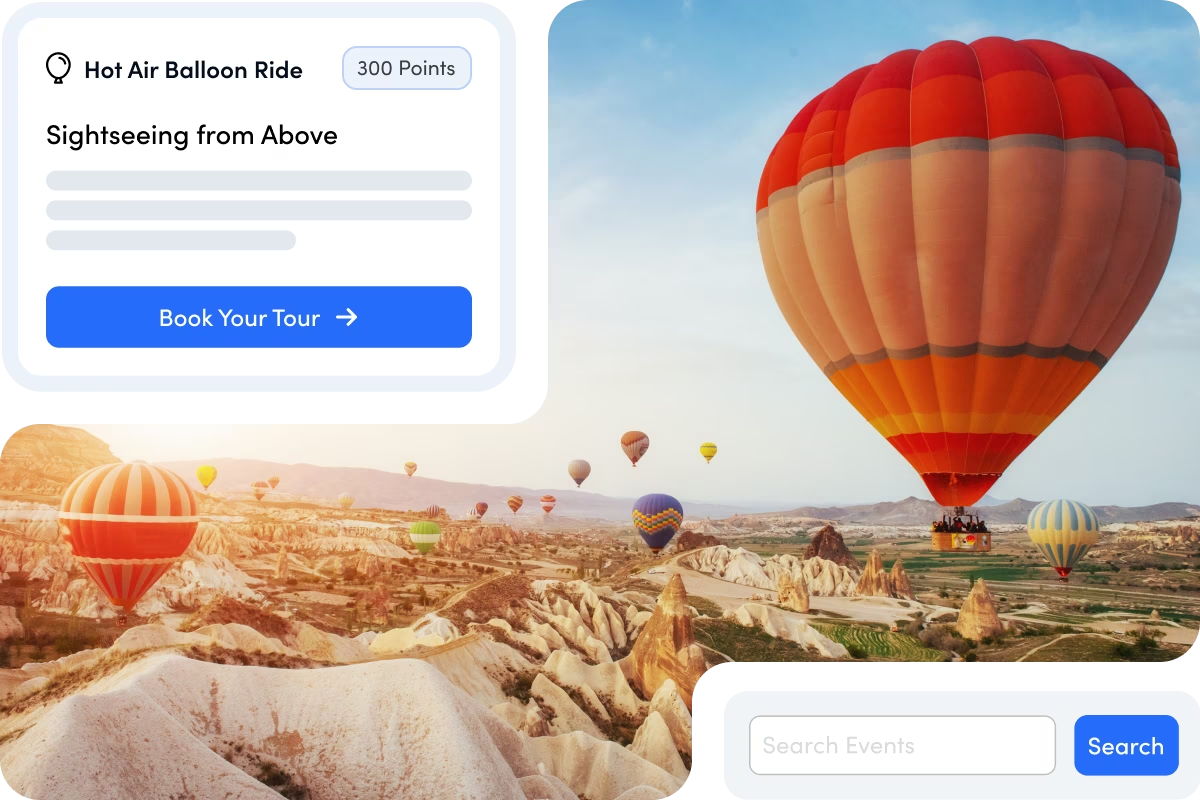
- What it is: Travel, concerts, events, hotel stays, and other memorable experiences offered as a reward.
- Best for: Major milestones and top-tier achievements.
- Example program design: A top-performer trip awarded annually to employees who exceed a defined performance threshold.
- Implementation effort: Medium. Availability and fulfillment should be verified by region.
- Expected ROI lens: Participation, redemption rate, perceived value, and repeat performance.
- Awardco fit: Strong for travel and experience reward delivery.
11. Gift and rewards marketplace programs
- What it is: Gift cards, merchandise, custom swag, charitable giving, and other employee-selected rewards.
- Best for: Broad appeal and personal choice across a diverse workforce.
- Example program design: A points catalog offering gift cards, merchandise, and charity donation options side by side.
- Implementation effort: Low–Medium.
- Expected ROI lens: Redemption velocity, reward relevance, participation, and administrative time saved.
- Awardco fit: Strong. Rewards marketplace, custom catalogs, global and local options, and redemption reporting.
12. Employee referral incentives
- What it is: Bonuses or rewards for referrals that meet defined hiring and retention criteria.
- Best for: Expanding the talent pipeline through employee networks.
- Example program design: A referral bonus split between the hire date and a 90-day retention milestone, aligning the incentive with quality rather than volume.
- Implementation effort: Medium. Eligibility, timing, and payroll or tax review require attention.
- Expected ROI lens: Qualified applicants, time to fill, cost per hire, and 90-day retention.
- Awardco fit: Strong for reward delivery.
13. Team-based incentive programs
- What it is: Shared goals, team challenges, and collective milestones rewarded at the group level.
- Best for: Building collaboration and shared accountability.
- Example program design: A department-wide goal with a shared reward pool, distributed evenly once the milestone is hit.
- Implementation effort: Medium. Clear contribution criteria help avoid free-rider concerns and winner-take-all dynamics.
- Expected ROI lens: Team participation, shared goal attainment, and quality outcomes.
- Awardco fit: Strong. Team recognition, points, contests, and reporting.
14. Innovation and idea incentives
- What it is: Rewards for ideas that improve processes, reduce costs, increase safety, or enhance customer experience.
- Best for: Surfacing frontline knowledge and process improvement.
- Example program design: Points awarded when a submitted idea is formally implemented, with a clear submission and evaluation process.
- Implementation effort: Medium. Requires a defined submission, evaluation, and reward workflow.
- Expected ROI lens: Ideas submitted, ideas implemented, cost savings, and participation.
- Awardco fit: Strong.
15. Customer service incentives
- What it is: Rewards for customer satisfaction, service quality, response time, and resolution outcomes.
- Best for: Support and success teams where service quality is measurable.
- Example program design: Team-level rewards tied to CSAT thresholds over a rolling period, designed to avoid individual gaming.
- Implementation effort: Medium. Metric selection matters; rewarding speed or ratings alone can encourage poor service.
- Expected ROI lens: CSAT, first-contact resolution, quality review scores, and customer retention.
- Awardco fit: Strong. Configurable goals, recognition, points, and reporting.
16. Milestone and tenure incentives
- What it is: Rewards for onboarding completion, service anniversaries, project milestones, and role achievements.
- Best for: Lifecycle moments that deserve consistent, automated recognition.
- Example program design: Automated point awards and gifts triggered by tenure anniversaries and onboarding completion.
- Implementation effort: Low–medium.
- Expected ROI lens: Completion rate, participation, redemption, and retention.
- Awardco fit: Strong. Automated milestones, points, gifts, recognition, and global delivery.
17. Flexible work and autonomy incentives
- What it is: Project choice, schedule flexibility, remote-work options, and stretch assignments offered as a reward.
- Best for: Building trust and ownership, particularly for high performers.
- Example program design: Top performers earn first choice of project assignments or a flexible schedule for a defined period.
- Implementation effort: High. These are often policy or manager practices rather than rewards administered through a marketplace.
- Expected ROI lens: Productivity, engagement, retention, and absenteeism.
- Awardco fit: Partial/policy-dependent.
18. Family and lifestyle support incentives
- What it is: Dependent-care support, family experiences, commuting assistance, charitable giving, and lifestyle spending accounts.
- Best for: Holistic support that reflects a diverse workforce's needs.
- Example program design: A lifestyle spending account employees can apply toward family, wellness, or personal expenses of their choosing.
- Implementation effort: High. Inclusivity and equitable access matter; not every employee has the same family or lifestyle needs.
- Expected ROI lens: Participation, perceived value, retention, and equitable access.
- Awardco fit: Strong for lifestyle spending, charity, and experiences where documented; broader benefits administration sits outside the platform.
How to choose the right employee incentive program
Start with these six questions before building anything:
- Business objective: Are you solving for performance, participation, safety, sales, learning, wellness, retention, or culture?
- Employee population: Is your workforce office-based, remote, frontline, deskless, seasonal, or global?
- Desired behavior: Are you rewarding a one-time action, a repeated habit, a team outcome, or a long-term contribution?
- Reward preference: Would cash, points, choice, experiences, development, or time off matter most to this group?
- Program constraints: What budget, payroll, tax, policy, privacy, or regional requirements apply?
- Measurement plan: What's your baseline, target, timeframe, owner, and review cadence?
The programs that hold up over time are the ones where every one of these questions has a clear answer before launch, not after.
How to build the business case for an employee incentive program
Build the business case by linking one specific employee behavior to one measurable business outcome, establishing a baseline, estimating the full program cost, and defining how you'll evaluate incremental value after launch.
- Define the business problem. Is it low sales attainment, poor training completion, weak safety participation, high turnover, or decentralized spend with no visibility?
- Establish the baseline. Document current participation, performance, turnover, redemption, administrative time, or cost before you launch anything.
- Design the smallest useful pilot. Pick one audience, one behavior, one time frame, and one reward structure. Resist the urge to launch five programs at once.
- Estimate total cost. Include rewards, platform costs, administration, payroll and tax handling, communications, and manager time.
- Evaluate incremental value. Compare the pilot against your baseline or an appropriate control group, and document your assumptions along the way.
How to calculate incentive program ROI
The basic formula:
ROI = (Incremental value created − Total program cost) ÷ Total program cost
A few things to define before you run the math:
- Incremental value can include additional revenue, productivity, retained employees, avoided cost, quality improvement, or administrative time saved.
- Total program cost includes reward value, platform and implementation cost, administration, communications, payroll and tax handling, and manager time.
- Time frame should be stated clearly, whether monthly, quarterly, annual, or pre/post launch.
- Comparison method should use a baseline, historical comparison, or a pilot-versus-control approach, whichever is most defensible for your data.
Awardco's ROI calculator can help model expected return before you commit budget to a full rollout.
A handful of metrics show up across nearly every program type and are worth tracking regardless of which incentive you're running:
- Participation rate: eligible employees who complete the target action.
- Redemption velocity: how quickly earned rewards are redeemed after issuance.
- Retention lift: change in retention or intent to stay for the relevant population, compared with baseline.
- Recognition reach: percentage of eligible employees receiving recognition or rewards.
- Cost per completed action: total program cost divided by completed actions.
- Administrative efficiency: hours or manual steps saved.
How to implement an employee incentive program
- Define the objective and target behavior.
- Identify the eligible audience and access requirements.
- Choose monetary, non-monetary, or blended incentives.
- Set rules, thresholds, time frame, budget, approvals, and exclusions.
- Confirm payroll, tax, legal, privacy, accessibility, and regional requirements.
- Communicate the program clearly, with examples and an obvious earning path.
- Launch, monitor, re-measure, and revise.
A platform like Awardco incentives can support several of these steps directly: configuring programs around goals, behaviors, eligibility, and budgets; giving employees meaningful reward choice; automating distribution to cut manual work; and reporting on participation, redemption, reach, and budget usage. Just as important, design for frontline and remote access from the start, rather than assuming everyone checks a corporate inbox.
Common employee incentive program mistakes
- Rewarding activity instead of outcome. Track the result that actually matters, not just the action that's easiest to measure.
- Using one reward type for every employee. A single reward option only motivates the slice of your workforce that happens to want that thing.
- Creating rules employees can't follow. If people have to ask what counts, the program isn't ready to launch.
- Excluding frontline or global employees. Programs built only for desk-based, English-speaking, corporate-email employees leave out a large share of most workforces.
- Rewarding speed or scores in ways that invite gaming. Metrics like CSAT or safety streaks can backfire if the incentive structure encourages underreporting or shortcuts.
- Ignoring tax, payroll, and privacy requirements. These considerations need review before launch, not after a payout.
- Measuring distribution instead of impact. Knowing how many rewards went out tells you less than knowing whether behavior or outcomes actually changed.
- Treating incentives as a substitute for fundamentals. No program compensates for unfair pay, poor management, or unsustainable workloads.
- Launching too many programs without clear ownership. Every active program needs a named owner and a visible budget, or it quietly stops getting attention.
Frequently asked questions about employee incentive programs
What is an employee incentive program? An employee incentive program is a structured system that offers monetary or non-monetary rewards for achieving defined goals, completing specific actions, or demonstrating desired behaviors. Unlike recognition, which happens after the fact, incentive programs are designed in advance to motivate a specific outcome and are typically measured against a clear baseline.
What are the different types of employee incentive programs? Common types include points-based programs, performance bonuses, sales commissions and SPIFFs, profit sharing, safety and quality incentives, wellness incentives, training incentives, tuition reimbursement, additional PTO, experience-based rewards, referral incentives, team-based programs, innovation incentives, customer service incentives, and milestone recognition. The right mix depends on your business goals and workforce.
What are examples of monetary employee incentives? Monetary incentives include performance bonuses, sales commissions, SPIFFs, profit-sharing payouts, and cash-equivalent rewards tied to a defined goal. These work well for clear, measurable targets like revenue or productivity, though they carry more cost, tax, and payroll complexity than non-monetary options.
What are examples of non-monetary employee incentives? Non-monetary incentives include points redeemable for rewards, recognition, additional PTO, professional development opportunities, flexible work arrangements, and experiences like travel or event tickets. These tend to support sustained engagement and are easier to personalize across a diverse workforce.
What are must-have employee incentive programs? Most organizations benefit from a baseline mix of points-based recognition, milestone and tenure automation, and at least one performance-linked program relevant to their business, such as sales incentives or safety incentives. Beyond that, program selection should follow your specific goals, workforce, and budget rather than a fixed template.
How do you create an employee incentive program? Start by defining the business objective and the specific behavior you want to drive. Set clear, measurable rules and eligibility criteria, choose rewards your employees actually value, communicate the program thoroughly, and track participation from day one. Build in a review cycle so you can adjust based on early results.
How do you measure employee incentive program ROI? Compare the incremental value created, such as added revenue, retained employees, or time saved, against the total program cost, including rewards, administration, and platform costs, using the formula: (incremental value − total cost) ÷ total cost. Establish your baseline before launch so the comparison is defensible.
Are employee incentives taxable? In many jurisdictions, cash and cash-equivalent incentives are generally treated as taxable income, and even non-cash rewards can carry tax implications depending on value and structure. Requirements vary by country and region, so consult a tax or legal professional before finalizing program design.
What is the difference between employee incentives and employee recognition? Incentives are set up in advance as motivators for a defined action, with employees knowing what to do and what they'll earn. Recognition is appreciation given after the fact, often tied to milestones or personal moments rather than a predetermined goal. Both matter, and the strongest cultures use them together.
What are the best incentives for frontline employees? Frontline employees typically respond well to programs that don't require a desk or corporate email, such as mobile-accessible points programs, safety and attendance incentives, and milestone recognition. Reward flexibility matters too, since gift cards, merchandise, and experiences tend to have broader appeal than options requiring digital-only redemption.
How do points-based employee incentive programs work? Employees earn points for completing defined actions, such as finishing training, hitting a safety milestone, or receiving peer recognition. Points accumulate and are redeemable through a rewards catalog, giving employees choice in what they receive while giving HR a consistent way to track participation and cost per action.
How can companies incentivize wellness or training participation? Offer points, small bonuses, or milestone recognition tied to voluntary participation in wellness challenges or training completion, keeping requirements achievable and avoiding any need to disclose sensitive health information. Pairing training incentives with a visible career-development path tends to improve completion rates further.
The best employee incentive programs connect a clear business goal to a meaningful employee action, give people rewards they value, and measure the full impact, from participation and redemption to retention, performance, and administrative efficiency.
Ready to build a program that's actually measurable? Schedule a demo.
















.svg)
.svg)