
Submission successful!
Download white paper
Submission successful!

Most HR leaders already understand the value of employee engagement. The research is clear, the data is familiar, and the business case has been made. Yet despite widespread agreement, engagement levels continue to decline, and many organizations struggle to translate employee feedback into meaningful, measurable change.
The problem isn’t a lack of insight. Organizations are collecting more employee data than ever through surveys, feedback tools, and engagement platforms. What’s missing is the ability to turn those insights into action—consistently, visibly, and at scale.
Too often, engagement efforts stop at measurement. Results are reviewed, dashboards are built, and trends are discussed, but employees see little follow-through. Over time, this gap between listening and action erodes trust and undermines the very engagement organizations are trying to improve.
Closing that gap requires more than better surveys or more data. It requires a human-centered approach that connects insight to action in real time—where feedback is acknowledged, recognition reinforces progress, and employees can see how their voices shape the workplace.
This paper explores what’s been missing from traditional engagement strategies, why recognition plays a critical role in activating employee insight, and how organizations can move beyond measurement to create engagement that delivers measurable business impact.
What is employee engagement?
Engagement reflects the amount of enthusiasm employees feel toward their responsibilities, their teams, and the organization as a whole. It measures how invested an employee is at work—put simply, engaged employees care more and work harder.
Engaged employees:
- Are self-motivated and do more than the bare minimum asked of them
- Are collaborative and look for ways to assist and work with others
- Are responsible and get work done on time, at a high quality without oversight
- Look for ways to improve processes and innovate
- Show up each and every day, ready to give their best
You’ve seen employees like this, and you’ve seen employees who are the opposite: disengaged workers who show up late, put in the minimum amount of effort to barely do what’s required of them, and often drag down or delay team projects.
And the fact of the matter is, when an organization’s workforce is mostly disengaged, their results suffer—regardless of the performance goals they’ve set.
The impact employee engagement has on business results
A recent Gallup report shows the benefits of employee engagement—and the ramifications of disengagement—better than anything else.
It states that disengagement caused the world $8.8 trillion in lost productivity in 2023. How? Because employee engagement drives every measure of business success. Just look at the results that organizations with high levels of engagement saw compared to those with low engagement scores:

Business outcomes occur naturally when organizations invest in their employee experience and prioritize engagement—not when leadership tries to squeeze every ounce of productivity out of their people.
The current engagement situation
This all matters because engagement levels are plummeting: only 21% of global employees are engaged at work, and only 31% are engaged in the U.S. That’s the lowest it’s been in over a decade.
There’s no sugarcoating it: this is a problem, and business leaders play a huge role in either propagating it or solving it.
It all comes down to whether leaders put more attention on the financial and operational aspects of the business or the human capital aspects.
Human-centered vs. results-oriented leadership
Josh Bersin, global workplace engagement expert, made a powerful statement based on over 30 years of experience helping organizations elevate their employee experience. He said:
“I can guarantee you this…regardless of the pressure your organization is under—the pressure to transform, the pressure to reduce costs, the pressure to drive sales, to get the product out faster, the pressure to improve productivity—if you bring your people with you, it will happen faster, more sustainably, and more enduringly than ever.”
Economic pressure pushes on executives, who then naturally put more pressure on their workforces to perform at a higher level and be more productive.
It’s a cycle organizations understandably fall into, but it’s unsustainable—and it’s on leadership to break the cycle by putting more direct focus on their people and less on the outcomes.
Trust us: the desired business results will naturally follow.
Why trust us: the Awardco experience
Awardco has seen this exact phenomenon play out. Since Awardco’s inception, the leadership team has understood that the employees drive company success, not the opposite, and they practice what they preach with policies like:
- Flexible scheduling
- Monthly point stipends
- Robust Employee Resource Groups (ERGs)
- Improved 360-degree feedback loops and professional development plans
- Plenty of recognition and rewards through the Awardco platform
This focus on the human element has led to accelerated growth, as evidenced by a recent $165 million Series B funding round and $1 billion valuation. It’s also led to accelerated innovation, as evidenced by the recent brand and platform enhancements from the past year:
- Deployed Awardco 2.0, a fully redesigned platform experience
- Founded the Awardco Center of Excellence (COE)
- Chosen by Workday as their preferred partner for recognition
- Launched our new mobile app
- Created the new Awardco Engage™ listening tool
Not only that, but Awardco’s people-first culture has driven real business results:
- 41% lower turnover YoY
- 52% better eNPS score, now 10% higher than industry benchmark
- $4.67 million saved in reduced turnover costs
This isn’t meant to toot the Awardco horn—it’s meant to showcase the impact that a people-first culture can have on business success.
Read more about the Awardco story here.
Employee listening: the key to an employee-focused strategy
Josh Bersin provided another nugget he’s seen over his decades of experience:
“One of the hallmarks of highly engaged companies is an extremely good employee listening strategy.”
If your boots-on-the-ground employees, or your managers, aren’t engaged, you better believe there are good reasons that are fully in the company’s control. But if leadership is unaware of those reasons, they’ll never improve.
And here’s a hint: more often than not, it’s not pay.
Yes, their paychecks need to cover their basic needs and be enough to live an enjoyable personal life. But Bersin research shows that the real driver of engagement is feeling a part of something bigger than yourself.
To drive real engagement for employees, you need to ask yourself these questions:
- Do employees feel like their work is meaningful?
- Do they have hands-on managers who are invested in their success?
- Is the work environment conducive to positive, safe, and inclusive?
- Are their health and wellbeing needs met?
- Do they have opportunities to grow and improve?
- Do they trust leadership?
This is where employee listening comes in.
Only by talking to employees and getting honest feedback will organizations know where they can improve to drive holistic engagement, which then drives sustainable business success.
Guide for employee surveys
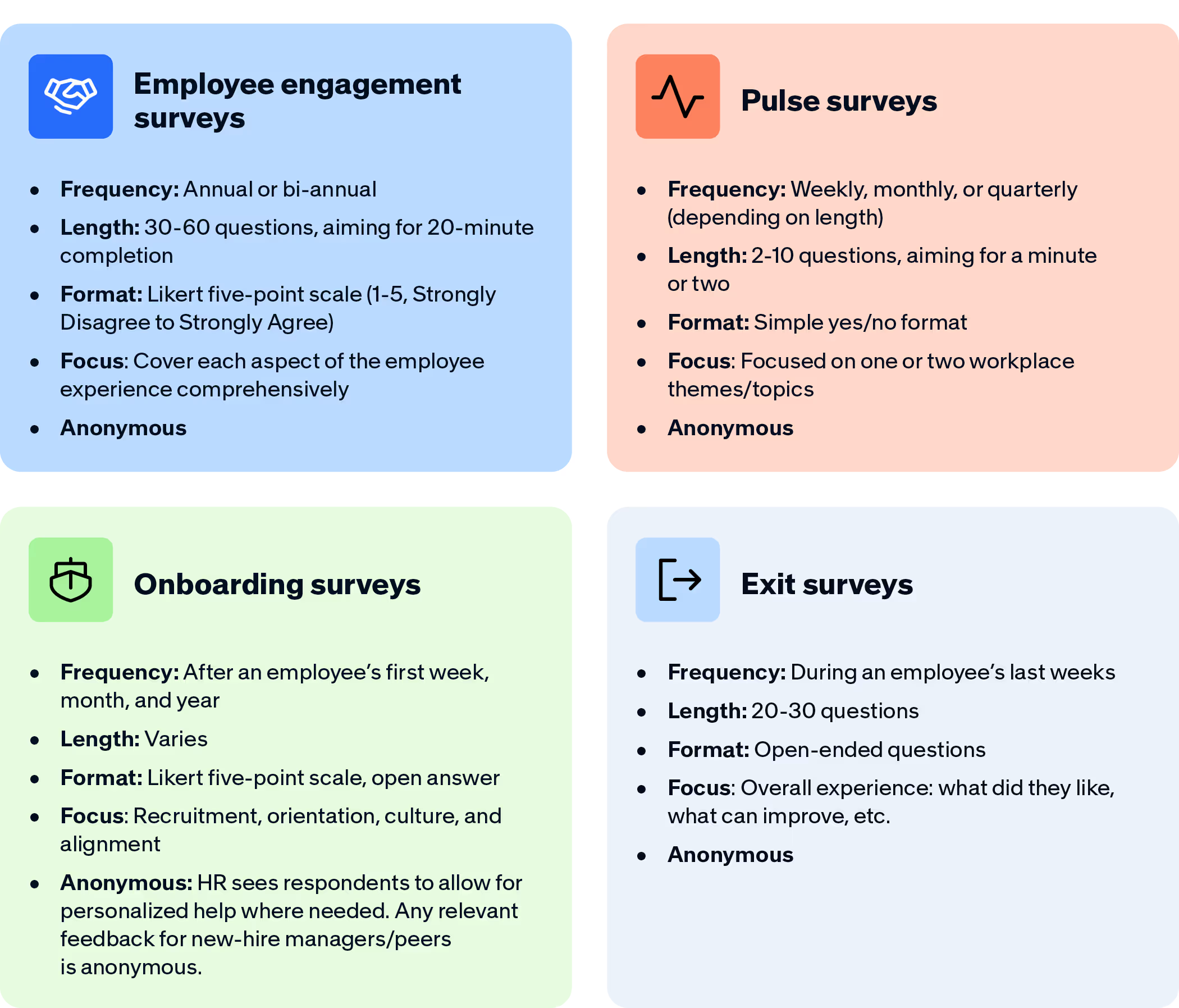
There are a multitude of survey types that organizations can use to obtain the data they need to improve their employee experience, and we recommend a mix of all of them to get the right feedback at the right time. These survey types include:
Employee survey best practices
Regardless of the type of survey planned, these best practices should shape your strategy to maximize the effectiveness of your employee listening:
Communicate the reason for, and importance of, the survey
Employees need to know what to expect before the survey goes out. What is it about? What is the company’s goal? What will the information be used for? Is it anonymous? How long will it take?
Communicate these answers and anything else that will help employees buy-in to the survey process.
Ensure anonymity
Nearly every survey use case needs to be anonymous so that employees feel safe offering honest feedback—without fear of any kind of consequence.
For example, if they need to share negative experiences about their manager or coworkers, they should know that their responses will stay anonymous and that any feedback given to the concerned parties stays anonymous as well.
Keep the survey focused
For any type of survey, even longer engagement surveys, it’s important to choose a few themes to focus on. Examples of potential foci include culture, professional development, work-life balance, work satisfaction, manager approval, and employee recognition.
Keep each survey concise, but don’t sacrifice results for brevity. Research shows that employees respond well to surveys with up to 50-59 questions, as long as they’re thoughtfully prepared.
Analyze and segment received data
Feedback shouldn’t be accepted in a vacuum. Instead, analyze your data to uncover trends:
- How do certain teams, departments, or employee groups perceive topics?
- Which locations or roles have the lowest scores?
- How does tenure affect survey answers?
- How do trends change over time?
- Do different compensation levels affect responses?
- Do age, gender, ethnicity, or marital status affect responses?
By segmenting your data, you’ll see which employee groups and demographics are truly struggling or satisfied with which aspect of your employee experience. This gives you the most accurate data to act on.
Focus on key trends
Don’t attempt to address every piece of feedback you receive. Focus on the trends identified in the previous step and make plans to improve the few key items that will make the biggest difference for your people.
Communicate appreciation and plans
Thank employees for participating and reiterate the importance of their honest feedback. Then, have a strategy for responding to the key trends you found. How will leadership respond? What will HR do to make improvements?
To build trust and increase the effectiveness of future surveys, executive leadership MUST make changes that satisfy employees based on survey responses.
Plan a follow-up survey
How did the company response to the first survey measure up to employee expectations? Did employees notice any improvements? These types of questions are perfect for a follow-up survey a few months after the first one is completed.
How Awardco Engage™ can help
For decades, HR has been promised that “engagement software” would close the gap between employees and employers. And yet in 2025 only one in five employees worldwide are engaged, a declining number that costs the global economy hundreds of billions of dollars in lost productivity.
The missing link isn’t more surveys, more dashboards, or more reward solutions.
What’s been missing is the single most human signal in the system: recognition. Proprietary Awardco research shows that meaningful recognition increases employees’ chances of being engaged by 2.3x! It’s time to close the gap—and we’re doing that with Awardco Engage™.
Awardco Engage is an in-platform tool that ties employee listening, communication, rewards, and recognition together in one seamless package, allowing leaders to activate meaningful change in their organization.
In addition to Awardco’s suite of award-winning recognition and reward tools, Engage allows organization to:
- Use customizable templates for annual, pulse, onboarding, and exit surveys
- Boost participation rates through award-enabled tools like incentives
- Gather anonymous feedback from every employee through multi-channel delivery
- View real-time dashboards showing results, analyses, and reporting
Engage has planned future enhancements as well, including guided action planning based on employee feedback, machine-learning-powered recommendations, and integrated outcome tracking.
By leveling the full strength of Awardco’s infrastructure, Awardco Engage closes the gap between employers and employees, connecting the employee experience through listening, communication, recognition, and rewards.
See how Awardco Engage closes the loop.
Engagement leads to results—not the other way around
By using employee feedback to build a meaningful culture of engagement, businesses will find the success they’re striving for in the stressful, hectic work environment we’re all a part of today.
Awardco provides the modern, all-in-one engagement platform HR teams need to offer rewards, recognition, listening, insights, and communication in a single, easy-to-use tool.
Contact the Awardco team to see how to make work more engaging for your people.

