

An employee incentive is a promise: do this, earn that. It’s simple in theory, but often difficult to pull off in practice. The goal has to be the right one, the rules have to be clear, the reward has to be motivating, and the whole thing must feel measured and fair.
Incentives are increasingly important—global employee engagement has dropped to 20%, its lowest level since 2020, and the second consecutive year of decline. An employee incentive program is one of the most effective ways to move that number—as long as it’s set up and managed just right.
This guide offers a complete framework for building such a program: what incentive programs are, how they work, and which structures produce results in the modern workplace.
What is an employee incentive?
Employee incentives are rewards that are directly tied to a specific, measurable action or outcome. Incentives are set up in advance to drive those actions and outcomes. They are proactive—structured specifically to motivate behavior and not just acknowledge it.
To create an incentive, a company has to:
- Decide which action or behavior it wants to see.
- Set a goal that will drive that behavior.
- Establish a reward for accomplishing that goal.
- Clearly communicate this program to the relevant employees.
Employee incentives vs. recognition vs. rewards
Employee incentives, recognitions, and rewards are often considered interchangeable, but they serve different purposes.
- Employee incentives are set up beforehand as motivators for an action. Employees know what they need to do and what to expect for doing it.
- Recognition is showing appreciation after an action or event. It is reactive and relational.
- Employee rewards are the tangible, experiential value delivered through both recognition and incentive programs. They’re the “what” behind the “why” and “when.”
Keep in mind that incentives and recognition can work together, but recognition is unique in that it can be triggered by specific milestones or personal tenure—events outside of specific actions. Rewards for service, birthday gifts, and holiday bonuses are moments of recognition given regardless of performance.
Why employee incentives matter
Low engagement cost the world economy approximately $10 trillion in lost productivity last year, an incredible 9% of global GDP.
Studies show that incentives reinforce the conditions that make meaningful engagement possible, yet there are major opportunities to implement high-quality incentives to support employees’ sense of being valued.
The best employee incentive programs:
- Make effort visible: When employees know specific behaviors are rewarded, they’re more likely to feel seen and valued.
- Provide clarity: Programs define what good looks like and make the connection between effort and result explicit.
- Reinforce culture: By rewarding those who develop or embody those values in their work, you can create the culture you want for your organization.
- Create momentum: Achieving a goal and earning a reward generates positive experience at work, which reinforces motivation to keep performing.
According to Gallup’s 2024 State of the Global Workplace report, high employee engagement is associated with a 23% increase in productivity and a 51% reduction in turnover. Put simply, corporate incentive programs are one of the best ways to reward your workforce for their efforts in a fair and quantifiable way—because every employee can attain them, no matter their role.
Types of employee incentives
Not every incentive program serves every goal. The right structure depends on the desired behavior, who you’re trying to reach, and what your workforce finds meaningful.
Employee incentive program examples
The best employee incentive programs are specific. Here’s how common employee incentive ideas look in practice and what makes them work.
Team productivity challenges
These are department-level goals with a shared reward when the team hits a milestone together. The research on social loafing supports this structure: team accountability tends to increase individual effort.
Sales goal incentives
These are tiered bonus structures that reward reps at 100%, 110%, and 120% of quota. The tiering keeps top performers motivated past the initial threshold rather than coasting once they’ve hit target.
Referral programs
Referrals are cash or points-based rewards paid when a referred candidate is hired and reaches a tenure milestone, often 90 days. Splitting the payout between hire and tenure milestone aligns the incentive with quality, not just volume.
Wellness challenges
These are points-based programs that reward participation in tracked fitness activities, preventive screenings, or wellness education. Employees accumulate points toward a reward catalog. They’re effective when participation is voluntary, and reward options are varied.
Safety streaks
Recognition for safety streaks happens when departments or teams are recognized for consecutive days without recordable incidents. It works best when combined with proactive safety behavior incentives, so the program drives positive habits rather than just underreporting.
Training completion
These are points or bonuses awarded when employees complete required or elective learning modules. They’re especially effective when tied to career pathing, as employees see a direct line between development and advancement.
Customer satisfaction scores
Recognition for customer satisfaction scores occurs when support and success teams are rewarded for meeting CSAT or NPS thresholds over a rolling period. It’s best designed at the team level, not the individual level, to avoid gaming and encourage collaboration.
Values-based incentives
These are peer-nominated awards tied to demonstrated company values. These work differently than performance incentives. They reinforce culture rather than output, and should be treated as a recognition tool more than a behavior-change mechanism.
Attendance or shift coverage incentives
These are streak-based rewards for consistent attendance in roles where absenteeism has a direct operational cost. Use carefully, as programs that feel punitive for legitimate absences are likely to backfire.
Innovation or process improvement incentives
These are rewards for submitted ideas that are implemented and tracked for impact. It requires a clear submission and evaluation process; without one, employees aren’t likely to bother.
How to build an employee incentive program
Building a program that holds up over time means getting the design right before launch.
1. Choose the business goal. Every other decision flows from this. The first activity in any incentive system is a gap analysis to assess variations between organizational goals and current performance. If the analysis indicates that people know how to achieve a goal but are not doing so, an incentive system can be a powerful solution.
2. Define the behavior or action. Translate the goal into a specific, measurable behavior. "Improve performance" is not a goal. “Achieve 105% of quarterly quota” or “complete all required safety certifications by Q3” is a goal.
3. Set clear rules and eligibility. Ambiguity here is a program killer. Goals that are both specific and challenging lead to performance gains greater than those realized with goals that are vague or easy. Very general “do your best” goals have no metric attached to them, and thus leave employees guessing whether they met objectives.
4. Choose rewards employees actually want. There is evidence that employee participation in the design of incentive systems leads to greater performance gains than would be realized if the incentive systems are simply assigned to employees. Survey your workforce, offer choice, and avoid assuming one reward type fits everyone.
5. Communicate the program. Launch with clear, specific communication across relevant channels. Employees can’t work toward a goal they don’t know exists. Repeat communications throughout the program. Don’t assume one announcement is enough.
6. Track participation and results. Monitor who’s engaging, who isn’t, and whether early indicators suggest the program is on track toward its goal.
7. Adjust based on feedback and ROI. Long-term programs allow more time to troubleshoot and ensure fairness. Employees who initially did not participate have more time to be won over after seeing colleagues succeed. Build in a review cycle and be willing to adjust.
Potential pitfalls (and solutions) of employee incentive programs
Setting up employee incentive programs requires careful handling. Below are common pitfalls businesses encounter, with solutions to maximize the impact.
1. Misaligned goals
- Pitfall: Employees might be working hard, but if they're focused on the wrong things, they may work in the wrong direction.
- Solution: Ensure all incentives are closely tied to the company’s strategic goals. Regularly review and adjust the incentive criteria to align with evolving business objectives and desired outcomes.
2. Unclear rules
- Pitfall: If employees have to ask when something counts, the program isn’t designed well.
- Solution: The best incentive programs have clear and fair rules—specific enough that eligibility and measurement are unambiguous from day one.
3. One-size-fits-all rewards
- Pitfall: A reward catalog with one option will only motivate the slice of your workforce that happens to want that thing.
- Solution: The more choice you offer, the more employees you reach. It’s helpful to offer programs that utilize points, gift cards, and varied reward options to meet the need for frequent feedback and rewards.
4. Inequity and inconsistency
- Pitfall: If incentive programs are perceived as unfair or biased, they can lead to resentment and decreased morale among employees who feel overlooked or undervalued.
- Solution: Communicate criteria openly and regularly so there’s no guessing about how to earn those rewards. Implement ethical guidelines and conduct regular training to reinforce the importance of achieving targets fairly.
5. Complexity and manual burden
- Pitfall: Overly complex incentive programs can be a recipe for confusion and low impact. They can also impose a significant administrative burden on HR departments.
- Solution: Keep it simple. Use technology and automated systems to track and manage incentive metrics, reducing the administrative burden and minimizing errors.

How to measure employee incentive program success
Measuring program impact requires establishing the right KPIs before, not after.
Financial metrics offer direct ROI visibility:
- Sales: Evaluate sales numbers before and after implementing the program.
- Revenue: Track how your incentives contribute to the organization’s overall performance.
- Cost savings: Measure decreased absenteeism, reduced turnover, better workflow processes, and more.
Non-financial metrics tell you whether your program is contributing to the right culture:
- Engagement: Circulate surveys (e.g., employee Net Promoter Score) or measure absenteeism.
- Performance: Think output, quality, efficiency, and so on.
- Participation rate: View how many are using the program and how often.
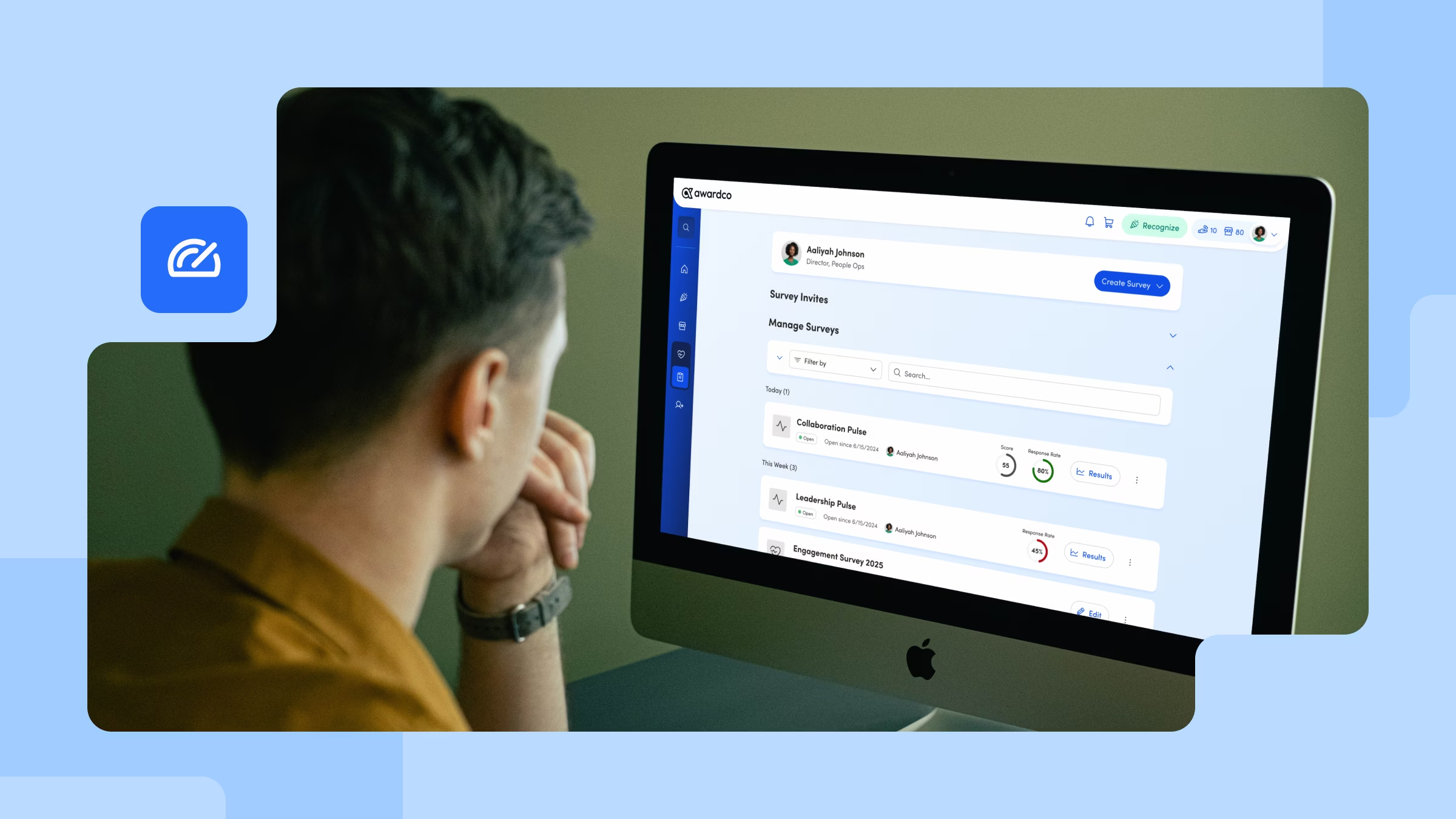
Use Awardco’s helpful tool to calculate your ROI to model the expected return on investment before you build.
How Awardco supports employee incentive programs
The distance between a well-designed employee incentive program and one that actually gets executed well is often an administrative one. Tracking participation, managing budgets, processing rewards, and reporting on outcomes become unsustainable at scale without the right platform.
Awardco connects recognition, incentives, rewards, budgets, automation, and reporting in one place, so HR teams can run programs that are truly visible and tied to real business outcomes.
Find out why Awardco is the platform of choice for companies that want incentive programs that actually work.
Employee incentive FAQs
What is an employee incentive program?
An employee incentive program is a structured system that offers rewards in exchange for specific, measurable actions or outcomes. Unlike recognition or general compensation, incentive programs are designed in advance to motivate particular behaviors.
What are the best employee incentive programs?
The best programs are the ones matched to specific business goals, designed with employees in mind, and administered consistently. Beyond structure, the best corporate incentive programs offer choice in rewards, apply fairly across eligible employees, run long enough to build momentum, and are tracked against measurable outcomes.
Are employee incentives the same as employee rewards?
Employee rewards are the tangible or experiential value delivered to employees, like prizes or points. Employee incentives are the broader system: the goal, the rules, the timeline, and the reward attached to achieving a specific outcome. All incentives involve rewards, but not all rewards are incentives.
How do you measure employee incentive program success?
Start with the KPIs you defined when the program launched. Financial metrics tell you about direct business impact. Non-financial metrics tell you whether the program is building the right behaviors. The most useful measurement compares pre- and post-program data for the specific outcome you targeted, and weighs that improvement against total program cost.






.svg)