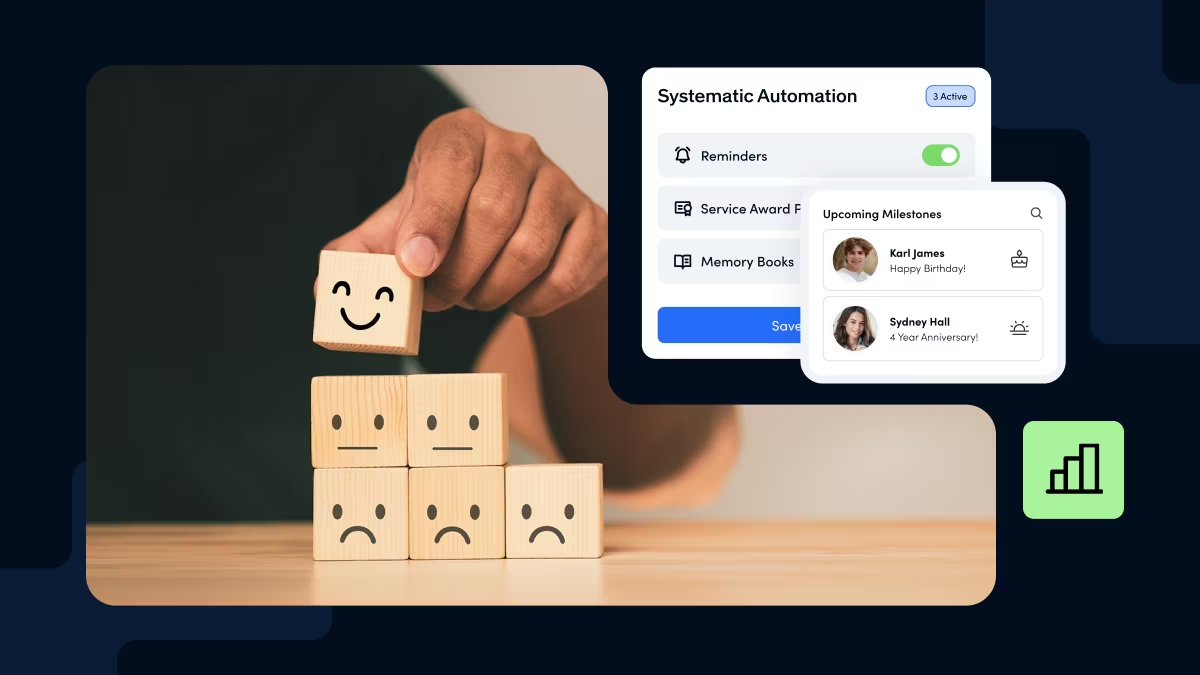
Quality employee recognition is a measurable driver of business performance. When applied strategically, employee engagement metrics can improve, including those for turnover, engagement, productivity, and absenteeism.
The following framework outlines how recognition impacts metrics for turnover, engagement, and productivity—supported by research-backed formulas and methodologies. We encourage you to use these to help assess your company's current standing and identify any specific enhancements it may need to achieve its objectives.
1. Reduces turnover
Context
Voluntary turnover is costly. Replacing a departing employee often costs one to two times their annual salary, including recruiting, onboarding, and lost productivity.
Evidence
Companies with recognition programs experience “31% lower voluntary turnover” and are 12 times more likely to drive strong business results. Moreover, Deloitte notes recognition is one of the most impactful non-financial components for retention.
Let’s work out the financial impact for further context.
Methodology
Step 1: Calculate baseline turnover cost
To calculate the annual cost of turnover, multiply your baseline voluntary turnover rate by the average fully loaded replacement cost (which typically ranges from one to two times an employee's salary per the data presented earlier).
Annual turnover cost = Baseline voluntary turnover X Average fully loaded replacement cost (1–2 X salary)
Step 2: Apply recognition program impact
Research from Deloitte suggests recognition programs can reduce turnover by 31%.
Multiply your baseline turnover cost by this reduction rate to estimate avoided costs:
Avoided turnover cost = Annual turnover cost X 0.31
This provides a direct, dollar-figure ROI for recognition programs, turning what often feels like a soft initiative into a tangible business outcome.
Takeaway
Recognition isn’t simply a feel-good tool; it directly reduces avoidable costs by retaining top talent.

2. Increase engagement
Context
Recognition also betters your employee engagement metrics, which drives measurable improvements in performance. It’s a lucrative trickle effect that serves as a powerful tool.
Evidence
Studies demonstrate the positive impact that recognition has on employee engagement, encouraging organizational leaders to prioritize recognition programs.
In addition, Gallup research found that business units and teams in the top quartile of employee engagement significantly outperformed those in the bottom quartile across key outcomes, including:
- 81% lower absenteeism
- 58% fewer patient safety incidents (mortality and falls)
- 18% lower turnover in high-turnover organizations
- 43% lower turnover in low-turnover organizations
- 28% less shrinkage (theft)
- 64% fewer safety incidents (accidents)
- 41% fewer quality defects
- 10% higher customer loyalty and engagement
- 18% higher productivity (sales)
- 23% higher profitability
Methodology
Step 1: Identify engagement drivers tied to recognition
Use your engagement survey or pulse items specifically linked to recognition (e.g., “I feel valued by my manager,” “Peers frequently acknowledge my contributions”).
Step 2: Quantify impact
Link engagement gains to measurable business outcomes. Even a modest 5–10 point lift in engagement scores can be mapped to Gallup’s meta-analyses on business outcomes.
By applying these benchmarks to your organization’s metrics, you can model the tangible financial impact of recognition-driven engagement.
Takeaway
When employees feel valued and recognized, they are more motivated, collaborative, and attentive—leading to higher output and fewer costly errors.
3. Productivity
Context
Productivity is one of the most direct ways recognition impacts organizational performance. When employees feel valued for their efforts, they’re more engaged, focused, and willing to go above and beyond—leading to measurable gains in output and efficiency.
Evidence
Gallup’s research shows that teams in the top quartile of engagement (driven in part by strong recognition cultures) see 18% higher productivity and 23% higher profitability compared to those in the bottom quartile. Likewise, organizations that integrate recognition into daily workflows report stronger collaboration, higher discretionary effort, and faster project completion rates.
Methodology
Step 1: Establish productivity baselines
Identify the key productivity metrics relevant to your organization—such as revenue per employee, sales per FTE, project completion rates, or output per labor hour.
Step 2: Apply engagement-productivity benchmarks
Apply Gallup’s benchmark of an 18% productivity increase for top-quartile engagement to your baseline metric. For example:
Productivity gain = Baseline productivity metric × 0.18
This helps estimate the potential productivity gains that could be achieved through recognition-driven engagement improvements.
Takeaway
Recognition fuels the discretionary effort that drives real business performance. When people feel seen and appreciated, they don’t just work harder, they work smarter, producing measurable gains in efficiency, output, and profitability.

4. Absenteeism & safety
Context
Recognition programs can reduce absenteeism and workplace incidents.
Evidence
Meta-analyses show that employees who are engaged (and supported by frequent recognition) take fewer sick days and experience fewer workplace accidents, making recognition a measurable risk and cost management tool.
Methodology
Step 1: Track pre/post program metrics
Monitor absenteeism and safety incidents before and after the program rollout.
Calculate the absenteeism rate by dividing the total number of unexcused absences by the total possible workdays (number of employees × number of workdays in the period), then multiplying by 100.
For example, if a 300-person team recorded 20 unexcused absences over 20 workdays, the formula would be:
(20 ÷ (300 × 20)) × 100 = 5%.
Step 2: Attach cost per incident
Multiply reductions in absenteeism or safety incidents by your organization’s standard cost per event to estimate savings.
Include both direct costs (lost time, wages, insurance claims) and indirect costs (replacement labor and productivity losses) for a complete financial picture.
Takeaway
Recognition doesn’t just boost morale; it directly reduces absenteeism and safety incidents. By tracking and quantifying these improvements, organizations can demonstrate how recognition contributes to lower risk exposure and measurable cost savings.
Track Intentionally
When tracked intentionally, employee recognition metrics turn appreciation into proof—showing exactly how recognition drives lower turnover, stronger engagement, higher productivity, and measurable business value.







.svg)