

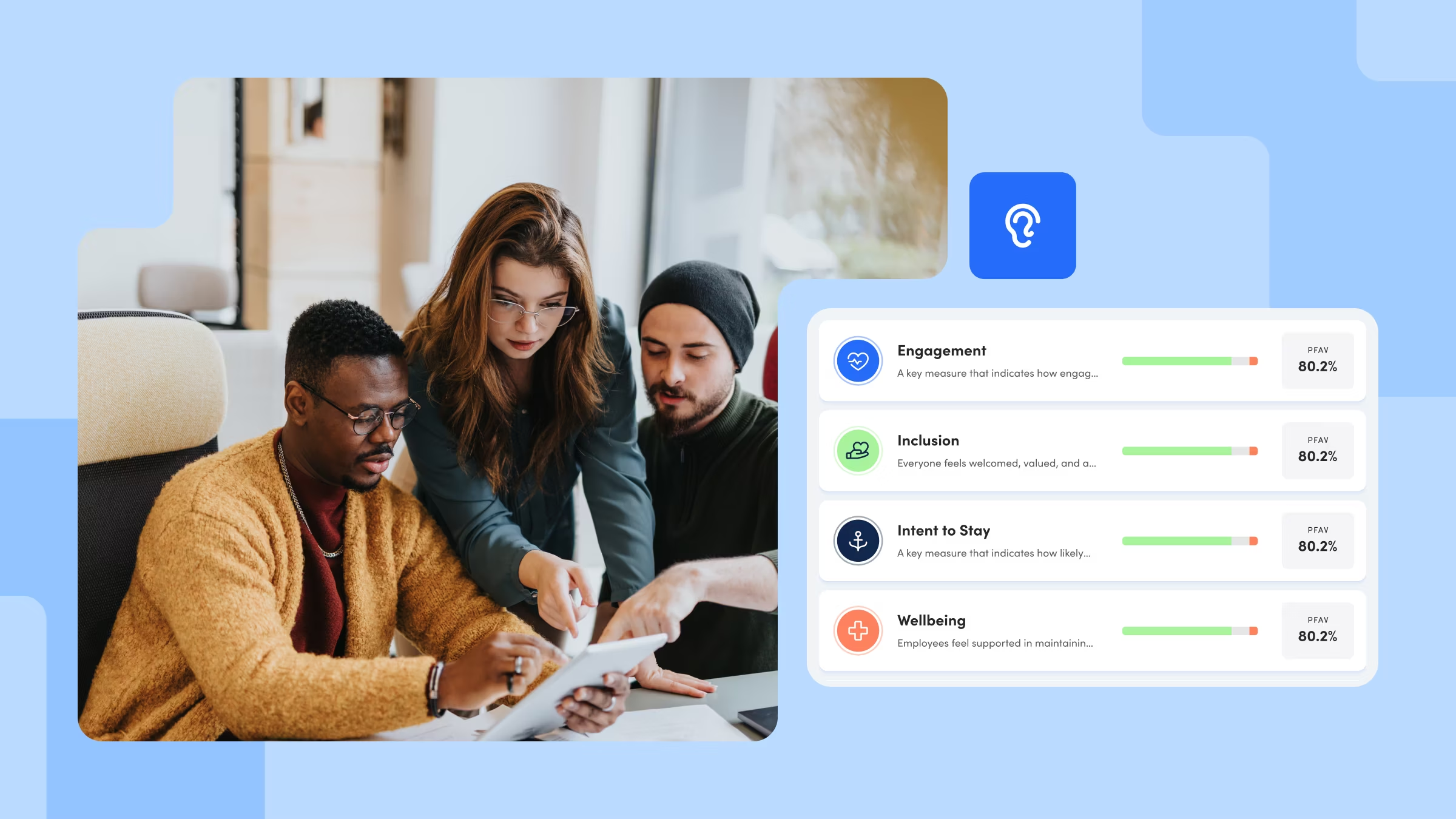

Employee listening and survey tools help organizations collect employee feedback, measure engagement, identify themes, and act on what employees share. The best platform depends on survey flexibility, participation, reporting, confidentiality, integrations, workforce access, and the path from insight to visible action. Awardco is a strong fit for organizations that want employee listening and recognition connected in one system.
But we recognize we’re not the only tool around. Here’s a list of the best employee listening and survey tools available:
We get it—it’s a lot to digest. So before choosing a tool, ask yourself two questions: Can the survey tool help us understand what employees need? And, can it help us show employees what we did with that insight?
Not sure which tool is right for you yet? Not to worry. In this guide to employee listening and survey tools, you’ll gain a deeper understanding of what employee listening software is and what to look for in an employee survey platform.
You’ll also uncover the differences between employee listening software and employee survey software, as well as an in-depth look at the seven best employee listening and survey tools available. Finally, you’ll find out why employee listening works better when it connects to recognition, and walk away with a checklist to help you choose the right employee listening tool.
Best employee listening and survey tools: the quick answer
The best employee listening and survey tools do more than collect feedback. They help organizations understand what matters, act visibly, and close the loop between employee insight and recognition.
When we look across survey capability, participation, insight quality, trust, action support, integrations, workforce reach, and platform fit, there are seven tools that rise above the rest:
- Awardco is a strong fit for organizations that want employee listening and recognition all in one place.
- Culture Amp connects employee engagement and people analytics.
- Qualtrics Employee Experience is an enterprise experience management solution.
- WorkTango focuses on employee experience, listening, and recognition.
- Lattice is a reliable choice for performance management, engagement, and manager effectiveness.
- 15Five focuses on engagement, performance, and manager effectiveness.
- Workhuman connects recognition and employee experience.
What is employee listening software?
Employee listening software is a platform that helps organizations gather, analyze, and act on employee feedback. It can capture input across multiple surveys and listening moments (like annual engagement surveys or pulse checks) and give leaders a clearer picture of what employees are experiencing and where improvements are needed.
Unlike a basic survey form or one-time questionnaire, employee listening software is designed to support an ongoing listening strategy. It typically brings feedback together in one place, allows teams to identify trends and recurring themes, provides insights that can inform decisions and action plans, and helps build a culture of listening and trust.
However, technology alone can't build employee trust. Trust grows when employees see that their feedback leads to thoughtful action. To do this, leaders must communicate back what they heard, what they're doing in response, and where change may take time. The software can make that process easier to manage, but following through is what makes employees feel heard.
What should you look for in an employee survey platform?
The best employee survey platform for your organization depends on how, when, and why you plan to collect feedback. As you compare options, look beyond the ability to send surveys and consider how well each platform supports participation, analysis, action, and ongoing listening across your workforce.
Here are eight components of a great survey platform:
1. Survey flexibility and cadence
Look for a platform that supports the types of surveys you plan to run, such as annual engagement surveys, pulse surveys, onboarding and exit surveys, lifecycle listening, custom surveys, and quick polls. If you're using multiple listening methods, the platform should make it easy to manage different cadences as part of a cohesive program rather than creating disconnected surveys and datasets.
Depending on your needs, also consider features such as question libraries, templates, branching logic, multilingual surveys, and configurable response scales. Be sure to verify specific capabilities with each provider.
2. Participation and employee access
Employees need a practical way to participate in your surveys, regardless of where or how they work. Depending on your workforce, that could mean mobile access, Slack or Microsoft Teams delivery, shared kiosks, email, reminders, incentives, or other in-the-flow options. This is especially important for deskless and shift-based employees, remote teams, and global workforces that may not have consistent access to a desktop or company email.
Nailing employee participation? Great! But don't treat a high response rate as proof of high employee trust. Participation is an important signal, but survey quality, candor, follow-through, and subsequent improvements matter, too.
3. Insight quality and reporting
Collecting more feedback isn't necessarily the same as generating better insight. Look for reporting capabilities that help leaders understand what the data means and where they should focus, such as dashboards, trends, benchmarks, driver analysis, sentiment themes, open-text analysis, segmentation, and manager-level reporting.
Make sure the platform also provides clear definitions for its scores, benchmarks, thresholds, and comparison groups. Leaders should be able to understand where an insight comes from and what it represents before using it to make decisions.
4. Confidentiality, privacy, and trust
Employees need confidence that sharing candid feedback won't expose them to unnecessary risk. To ensure privacy—and earn employees’ trust—evaluate how each platform handles anonymous or confidential responses, minimum group-size thresholds, data aggregation, role-based access, retention, security, and applicable regulatory requirements.
Pay particular attention to segmentation. Breaking results down by team, location, demographic, or another characteristic can produce valuable insights, but small groups can also make individual employees easier to identify. Privacy, security, and compliance capabilities can change, so verify any provider claims against its current documentation before making a decision.
5. Action planning and follow-through
A survey should be the beginning of the feedback process, not the end. Look for capabilities that help leaders turn insights into action, such as manager action plans, task assignments, recommendations, communication workflows, issue tracking, and outcome measurement. A platform helps leaders decide and track what happens after the survey, not produce another report.
Recognition can be one way to make follow-through visible. For example, organizations can use recognition to reinforce the employees, managers, or behaviors contributing to a desired improvement. But, as our Better Together campaign emphasizes, recognition is one avenue to support meaningful action; it’s not a substitute for addressing the issues employees raised.
6. Integrations and data management
Consider how the platform fits into your existing technology stack, including your HRIS, identity systems, organizational hierarchy, Slack, Microsoft Teams, email, mobile tools, and analytics and reporting systems. Check whether important integrations are native, partner-supported, available at an additional cost, or dependent on implementation services.
Data quality matters, too. Accurate employee and organizational data makes it easier to segment results correctly, route insights to the right managers, and provide leaders with relevant reporting. Poor or outdated data can undermine those capabilities regardless of how sophisticated the platform is.
7. Workforce coverage and scalability
Evaluate whether the platform can support the full range of people you want to hear from—not just employees who sit at a desk or in HQ. Consider global languages and locations, frontline and shift workers, remote teams, multiple business units, and enterprise-wide reporting.
The experience should also be reasonably consistent across roles and channels. If some employees can participate seamlessly while others face significant barriers, your listening program may capture an incomplete picture of the workforce.
8. Administration and implementation
Consider what it will take to launch and maintain the platform. Relevant capabilities may include survey design support, templates, rollout services, manager enablement, governance tools, and ongoing program administration.
Ask providers to outline the implementation effort required for your specific organization, including internal resources, integrations, data preparation, training, and ongoing administration. Rather than assuming a platform will be quick or easy to implement, evaluate the work involved against your team's available capacity.
Employee listening software vs. employee survey software
Wondering about the differences between the available tools? We’ve got you.
Employee survey software generally focuses on creating surveys, collecting responses, and reporting results. Employee listening platforms typically take a broader approach, potentially adding capabilities such as pulse and lifecycle listening, benchmarks, manager insights, sentiment analysis, action planning, and ongoing measurement. An employee experience platform can be broader still, combining listening with capabilities such as employee recognition, rewards, communication, performance, or other workforce workflows.
Keep in mind that more functionality isn't automatically better. The right category depends on your goals, workforce, existing technology, budget, and capacity to manage change.

7 employee listening and survey tools to compare
1. Awardco
Primary focus: Awardco combines employee recognition and rewards with employee listening through Awardco Engage, connecting feedback with opportunities for visible action.
What to evaluate: Awardco Engage supports engagement, pulse, onboarding, exit, and other employee surveys, along with survey templates, automated cadences, anonymous feedback, reporting, key-driver analysis, and action planning. Its Better Together model connects listening and recognition: feedback helps leaders identify what matters, recognition can reinforce behaviors or contributions that support change, and follow-up listening can help determine whether the broader response is working. HR and People leaders should also evaluate participation options, manager insights, HRIS integrations, and how survey findings can inform recognition and other action workflows.
Potential fit: Awardco may be relevant for organizations that want listening and recognition within a more connected employee experience strategy, particularly those looking to consolidate separate tools or complement an existing HR tech stack.
Questions to verify: Confirm which Awardco Engage capabilities are included in each package, available integrations, privacy and anonymity controls, segmentation options, mobile and frontline access, implementation requirements, and pricing. Also verify how specific survey insights can connect with recognition workflows. Recognition is one possible response to feedback—not a substitute for manager follow-through, communication, process improvements, or resource investment.
2. Culture Amp
Primary focus: Culture Amp is an employee experience platform centered on employee engagement, people analytics, performance, and development.
What to evaluate: Culture Amp includes engagement and pulse surveys, customizable templates, lifecycle feedback, benchmarks, analytics, comment analysis, retention insights, and tools for identifying focus areas. Its platform also gives managers access to relevant results and supports action planning after surveys. HR and People leaders should evaluate how easily teams can move from organization-wide findings to manager-level priorities, how benchmarks and comparison groups are defined, and how employees are kept informed about resulting actions.
Potential fit: Culture Amp may suit organizations seeking an established employee listening and people analytics program that operates alongside performance management, employee development, and manager-effectiveness initiatives.
Questions to verify: Confirm current package scope, pricing, implementation support, integrations, confidentiality thresholds, segmentation, lifecycle survey functionality, and access for deskless or frontline employees. HR and People leaders should also verify the current depth of recognition functionality and whether recognition is designed to connect directly with engagement findings. Culture Amp provides action-planning capabilities, but organizations should examine how those plans become visible to employees and how progress is communicated and measured after a survey closes.
3. Qualtrics Employee Experience
Primary focus: Qualtrics Employee Experience is an enterprise experience-management platform designed to collect and analyze employee signals across multiple stages of the employee journey.
What to evaluate: Qualtrics supports engagement and pulse surveys, lifecycle listening, always-on feedback, dashboards, benchmarks, open-text analysis, driver insights, and action planning. Organizations can evaluate how the platform combines employee signals with other experience and operational data, distributes relevant insights to managers, and supports action based on findings. HR and People leaders with complex programs should also assess experience orchestration, role-based reporting, survey distribution, organizational hierarchies, and the level of configuration required to support different employee populations and listening programs.
Potential fit: Qualtrics may fit enterprises that need sophisticated analytics, multiple listening channels, lifecycle measurement, complex organizational structures, or employee experience capabilities connected to a broader experience-management strategy.
Questions to verify: Confirm licensing and package scope, pricing model, implementation resources, integration and data requirements, confidentiality controls, manager permissions, survey distribution methods, and workforce coverage. Enterprise depth can also introduce configuration and implementation considerations, so determine what internal or external resources will be required. HR and People leaders seeking a listening-to-recognition workflow should verify whether recognition is native, integrated through another platform, or managed separately—and how managers communicate resulting actions back to employees.
4. WorkTango
Primary focus: WorkTango positions itself as an employee experience platform spanning employee surveys and insights as well as recognition and rewards.
What to evaluate: WorkTango’s listening capabilities include employee surveys, pulse feedback, customizable and research-based templates, lifecycle listening, dashboards, benchmarks, heat maps, sentiment analysis, comment themes, anonymous conversations, and action planning. Its Recognition & Rewards offering adds peer and manager recognition, incentives, milestones, points, rewards, and related reporting. HR and People leaders should evaluate how these capabilities work together, including whether leaders can use survey findings alongside recognition data and action-plan progress to understand employee experience and determine where intervention is needed.
Potential fit: WorkTango may suit organizations that want formal employee listening and recognition and rewards capabilities and are considering whether bringing them into the same employee experience platform could simplify their technology and workflows.
Questions to verify: Confirm current packaging and whether Surveys & Insights and Recognition & Rewards are licensed separately or together. Also verify pricing, implementation requirements, HR and workplace integrations, privacy thresholds, segmentation, global survey and reward coverage, and participation options for different workforce groups. Because listening and recognition are available within the broader platform, HR and People leaders should examine exactly how survey findings connect to recognition or other action workflows rather than assuming that having both capabilities automatically creates a closed feedback loop.
5. Lattice
Primary focus: Lattice combines employee engagement with performance management, goals, employee development, analytics, and manager-effectiveness workflows.
What to evaluate: Lattice supports engagement and pulse surveys, survey analytics, heat maps, sentiment tracking, organizational and demographic filtering, and post-survey action planning. Managers can use results to identify priorities and create action plans, while engagement data can sit alongside performance reviews, goals, feedback, and other people-management workflows. HR and People leaders should assess the depth and flexibility of survey functionality, manager reporting, benchmarks, action planning, and the usefulness of connecting engagement insights with ongoing performance and development processes.
Potential fit: Lattice may fit organizations that want employee listening to be part of a broader performance-management strategy, especially when manager effectiveness, continuous feedback, goals, and employee development are also important buying requirements.
Questions to verify: Confirm survey flexibility, lifecycle-listening capabilities, benchmarks, package scope, pricing, integrations, confidentiality settings, segmentation, implementation, global support, and mobile or frontline access. Lattice also offers praise and feedback capabilities, but HR and People leaders seeking a robust recognition program should verify their current scope. Determine whether engagement findings can connect systematically with recognition or whether action happens primarily through managers, performance processes, and action plans. Also verify how employees can see progress after providing feedback.
6. 15Five
Primary focus: 15Five combines employee engagement, performance management, ongoing manager-employee feedback, and tools designed to support manager effectiveness.
What to evaluate: 15Five includes employee engagement surveys, benchmarks, eNPS, team-sentiment and manager-effectiveness measurement, dashboards, demographic filtering, and action planning. Its broader platform includes check-ins, 1-on-1s, performance reviews, feedback, goals, manager enablement, and High Fives for employee recognition. HR and People leaders should evaluate how engagement insights flow into recurring manager workflows, whether reporting provides sufficient detail for different organizational levels, and how effectively action planning helps teams respond to identified engagement priorities.
Potential fit: 15Five may suit organizations that want employee listening closely connected with recurring manager conversations and performance processes rather than operating as an isolated survey program.
Questions to verify: Confirm which survey types and lifecycle workflows are currently available, survey customization, benchmarks, confidentiality controls, integrations, implementation requirements, mobile and frontline access, global support, package scope, and pricing. HR and People leaders should also distinguish High Fives from a comprehensive recognition-and-rewards platform by verifying current recognition functionality and whether rewards are supported. Determine how engagement findings connect to recognition or other employee-facing actions and how progress is communicated after surveys.
7. Workhuman
Primary focus: Workhuman is primarily oriented around employee recognition and rewards, with employee-experience insights derived from recognition and other workforce data.
What to evaluate: Workhuman’s platform emphasizes Social Recognition and Human Intelligence, which uses recognition data and AI to surface insights related to skills, collaboration, culture, performance, and workforce patterns. Its analytics capabilities can help leaders examine recognition activity and identify trends or opportunities for action. HR and People leaders evaluating Workhuman specifically for employee listening should look closely at current survey and feedback functionality, including the types of listening supported, survey depth, reporting, segmentation, and how listening data works alongside the platform’s established recognition capabilities.
Potential fit: Workhuman may fit organizations where enterprise recognition, global rewards, program configuration, and recognition-linked workforce insights are major requirements, particularly when recognition itself is a central component of the employee experience strategy.
Questions to verify: Confirm Workhuman’s current employee listening and survey capabilities rather than relying on older product materials. Verify survey types and cadence, anonymity controls, segmentation, package scope, integrations, implementation requirements, workforce access, global coverage, and pricing. Most importantly, determine whether listening is native, integrated, or separate from recognition workflows and whether that model meets the organization’s requirements for a unified survey-to-action system.
Why employee listening works better when it connects to recognition
Employee listening is only the beginning. Surveys and pulse feedback can tell leaders what matters to employees, where friction exists, and what needs attention, but collecting feedback alone doesn’t create change. The real value comes from what organizations do with those insights and whether employees can see that their input led to meaningful action.
That’s where employee listening and recognition can work better together: feedback helps leaders understand what matters. Recognition is one visible way to act on it. For example, if employees say cross-functional collaboration needs improvement, leaders might change processes or provide additional resources while using recognition to reward employees who help teams collaborate more effectively.
To integrate the feedback-to-action loop in your team:
- Listen: Gather employee perspectives through engagement surveys, pulse surveys, or other feedback channels.
- Understand: Analyze themes, drivers, and workforce context to identify where action could have the greatest impact.
- Act: Respond appropriately—whether that means recognition, manager follow-through, clearer communication, process changes, resource investment, or a combination of approaches.
- Show: Communicate what changed, why it changed, and how employee feedback informed the response.
- Measure again: Listen again to understand whether the actions are making a difference and where further attention is needed.
Connecting listening and recognition workflows can also make this loop easier to manage. Instead of insights moving manually between separate teams, tools, and processes, connected workflows can reduce handoffs and help leaders turn relevant feedback into visible action more efficiently.
Recognition, however, isn’t the answer to every issue employees raise. Feedback about workload, compensation, inadequate resources, or broken processes may require very different interventions. The goal is to make it easier for organizations to move from hearing employees to taking appropriate, visible action—and to continue listening to understand whether that action worked.
Ready to move from feedback to insight to visible action? See Awardco Engage in Action.
How to choose the right employee listening tool
Remember, the right employee listening tool helps you do two things: understand what employees need, and show employees what you did with that insight.
Use this checklist to clarify what employee listening tool fits your needs best:
- Define the listening moments and survey cadence you need.
- Map your workforce: office, remote, frontline, deskless, global, multilingual, and shift-based employees.
- Decide how much action planning and manager workflow you need.
- Confirm confidentiality, segmentation, privacy, and data-governance requirements.
- Verify HRIS, identity, collaboration, mobile, and analytics integrations.
- Estimate implementation and administration capacity.
- Compare total cost, including services, modules, integrations, and incentives.
- Run a realistic pilot with representative employee groups.
- Decide how employees will see that feedback led to action.
Frequently asked questions about employee listening software and survey tools
Q: What are the best employee listening and survey tools?
A: Some of the top employee listening and survey tools to compare include Awardco, Culture Amp, Qualtrics Employee Experience, WorkTango, Lattice, 15Five, and Workhuman. The right choice depends on your priorities, such as survey flexibility, analytics, workforce access, action planning, integrations, and recognition. Awardco is a strong fit for organizations that want employee listening and recognition connected in one platform.
Q: What is the difference between employee listening software and employee survey software?
A: Employee survey software primarily helps organizations create surveys, collect responses, and analyze results. Employee listening software typically goes further by supporting ongoing feedback through pulse and lifecycle surveys, deeper analytics, manager insights, action planning, and repeated measurement. Employee experience platforms can be broader still, combining listening with recognition, rewards, performance, communication, or other workforce workflows.
Q: What features should an employee survey platform include?
A: Look for survey flexibility, multiple survey types and cadences, accessible participation options, analytics and reporting, confidentiality and privacy controls, action-planning capabilities, integrations, and support for different workforce populations. Organizations should also evaluate implementation requirements and whether the platform makes it easy to turn survey findings into visible follow-through.
Q: Which tools support pulse surveys and ongoing listening?
A: Several platforms in this comparison support pulse surveys or ongoing listening, including Awardco, Culture Amp, Qualtrics Employee Experience, WorkTango, and Lattice. Capabilities vary by provider, so verify supported survey types, cadence, automation, lifecycle listening, package requirements, and whether the platform can bring different listening moments into a cohesive program.
Q: How do employee survey tools help leaders act on feedback?
A: Employee survey tools can help leaders identify themes, drivers, and priority areas and then support follow-through through capabilities such as action plans, task assignments, recommendations, communication workflows, and outcome measurement. The goal is to move beyond collecting feedback by showing employees what leaders heard, what they're doing in response, and whether those actions are making a difference.
Q: Which employee listening platforms work for frontline and global teams?
A: The right platform for frontline or global teams depends on how employees access surveys and where they work. Evaluate mobile and in-the-flow participation, multilingual capabilities, support for deskless and shift-based workers, global locations, and enterprise-wide reporting. Because workforce coverage varies by provider and package, verify these capabilities directly before choosing a platform.
Q: Should employee listening and recognition live in the same platform?
A: Connecting employee listening and recognition can make it easier to turn relevant feedback into visible action and reduce manual handoffs between separate tools and teams. Recognition can reinforce behaviors or contributions that support a desired change, while follow-up listening can help measure whether the broader response worked. However, recognition isn't the right response to every issue employees raise, so organizations should still use manager follow-through, communication, process changes, or resource investment when appropriate.
Want to see employee listening and recognition in action? Book an Awardco Demo.



.avif)






.svg)





.svg)


