

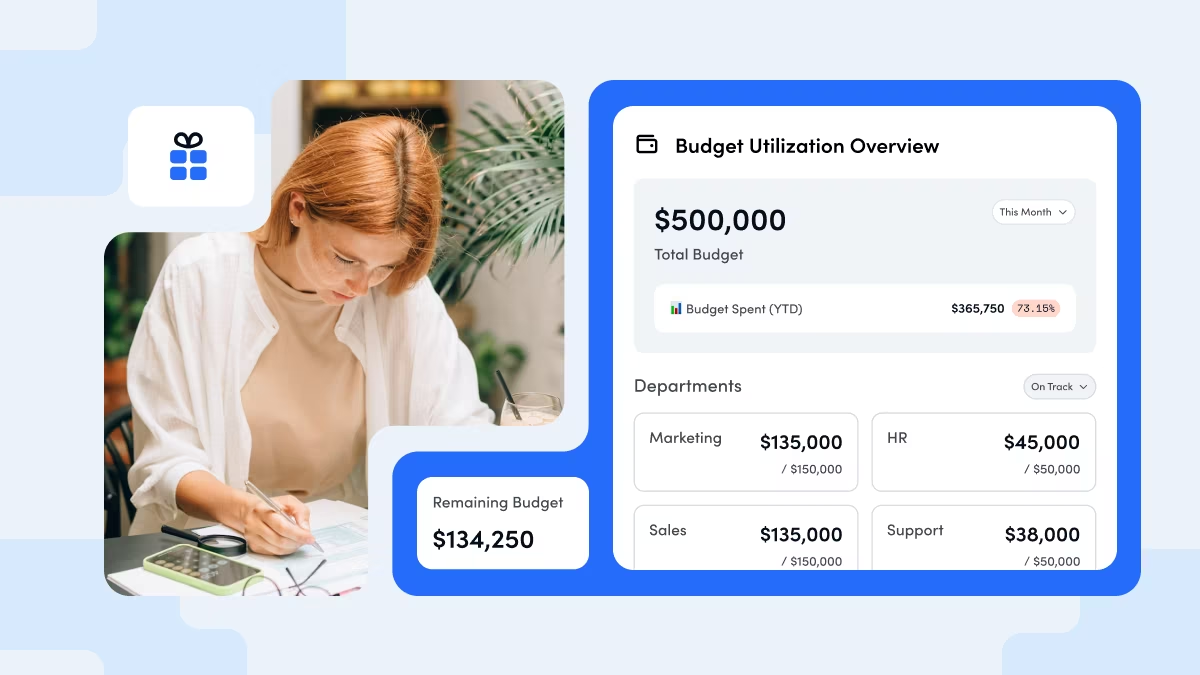
Ask three recognition vendors for a quote and you'll likely get three numbers that look comparable on paper and mean three different things in practice. One bundles implementation into the subscription. Another prices reward funding separately. A third charges per eligible employee while a competitor charges per active user, which can be a very different number at enterprise scale.
Enterprise rewards and recognition software is commonly priced through a per-employee, platform-tier, program-based, usage-based, or hybrid model, and the real cost depends on your eligible employee count, countries, program types, reward funding, integrations, implementation, reporting, and support. Sounds a little more complicated than a single number can convey, right?
The right way to compare vendors isn't to ask "what's your price," it's to ask what's included in that price, then build a total cost of ownership model around your actual workforce and program design.
Why enterprise recognition pricing is hard to compare
Two vendors can quote similar-looking annual numbers while including very different things. A credible comparison separates:
- Platform or subscription fees: what you pay for software access itself.
- Reward and recognition funding: the money employees actually redeem, which is separate from the software license.
- Implementation and integration work: what it costs to get your data, systems, and workflows connected.
- Fulfillment, shipping, taxes, and currency effects: costs tied to actually delivering rewards globally.
- Optional modules, catalogs, or payment products: features that may or may not be bundled into a base price.
- Reporting, support, and professional services: the ongoing relationship, not just the initial sale.
- Internal administration and program management: the time your own team spends running the program.
It's also worth remembering that a rewards marketplace is only one piece of a recognition platform. Catalog breadth matters, but so do program rules, eligibility, budgets, approvals, integrations, fulfillment, and reporting.
A vendor with an impressive catalog and a thin administrative layer can end up costing more in internal labor than a vendor with a smaller catalog and better controls. Awardco's rewards marketplace evaluation guide walks through how to evaluate catalog quality specifically, which is a useful companion to the cost conversation here.
Common pricing models for enterprise rewards and recognition software
These are the models you'll typically encounter in the market. Not every vendor uses every model, and some blend several together.
Awardco's plan structure
Awardco publishes Standard, Scale, and Enterprise plan structures rather than a single flat price. Standard and Scale are differentiated by the number of program types available, while Enterprise is built to support unlimited programs across program types and the platform's full capability set.
What the public plans page doesn't do, by design, is publish a universal enterprise dollar figure, because enterprise pricing depends on too many organization-specific variables to represent honestly as a single number. The more useful exercise is requesting a quote modeled on your workforce, programs, countries, reward mix, integrations, and support requirements, which is true whether you're evaluating Awardco or anyone else.
The enterprise cost model: seven categories to include
1. Platform subscription
Ask what the subscription actually covers: eligible population or user count, program types and modules, admin seats and roles, reporting and analytics, integrations and data feeds, SSO and security requirements, support and customer success, and the contract term and renewal structure.
2. Recognition and reward funding
This is the money allocated for employees, separate from the software fee. Model your average award value, recognition frequency, service-award and milestone schedules, manager or team budgets, incentive pools, expected participation and redemption rates, and your policy on unused balances, expiration, and rollover.
A platform's subscription price doesn't tell you what the right employee reward budget should be. That's a separate decision based on your goals and workforce size.
3. Global and regional requirements
For a global program, model eligible employees by country and entity, local currencies and exchange-rate treatment, language requirements, local reward availability, fulfillment logistics, shipping and customs responsibility, and country-specific tax, payroll, and labor requirements.
Awardco's global recognition capabilities are built around international program management and multi-currency reporting, but you should still validate country coverage and implementation specifics against your own footprint before assuming parity everywhere you operate.
4. Implementation and integration
Ask whether the quote includes discovery and program design, HRIS or employee-data integration, SSO and communication-tool connections, data mapping and testing, historical data migration, admin training and change management, pilot support, and launch communications. Implementation scope depends heavily on your existing systems, so be wary of any vendor presenting it as a flat or universal cost.
5. Reward delivery and fulfillment
Compare the full delivery model: digital versus physical rewards, catalog access, custom products or company stores, shipping and handling, international delivery, returns and support, gift-card or prepaid-card costs, and fulfillment timing. Ask vendors to model this against realistic redemption patterns rather than quoting only the platform subscription in isolation.
6. Finance, tax, and reporting requirements
This category includes budget and cost-center reporting, payroll-ready data feeds, taxable-status fields and earning codes, invoice and funding workflows, currency conversion and reconciliation, audit trails, and scheduled reporting exports.
Reward value and tax treatment vary by reward type, country, employee group, and program design, so route exact claims through your Finance, Payroll, Tax, and Legal teams rather than relying on a vendor's general marketing language.
Awardco's finance and procurement resources outline the budget visibility and reporting structure to expect, as a starting point for that internal conversation.
7. Internal administration and total cost of ownership
A lower subscription price isn't necessarily lower total cost if your team has to manage significantly more manual work. Estimate the internal effort required for employee data maintenance, program changes, budget reconciliation, manual fulfillment, reporting, support escalations, regional coordination, and compliance administration. If a vendor shares customer-reported time savings, ask for the source, timeframe, and methodology before treating it as a benchmark for your own organization.
What to request in a pricing quote
A thorough quote request should specify:
- Total and eligible employee population by country
- The number and type of recognition programs
- Estimated annual reward funding
- Expected participation and redemption rates
- Reward categories and regional availability
- Required HRIS, SSO, communication, payroll, and finance integrations
- Implementation timeline and rollout phases
- Admin and reporting requirements
- Contract term and renewal assumptions
- A clear list of what's included versus excluded, down to every fee tied to rewards, fulfillment, shipping, taxes, payments, and changes
Comparing two enterprise proposals fairly
A side-by-side comparison only works if you're comparing equivalent scope. Use a simple table with your own assumptions noted alongside each line:
If two vendors quote wildly different totals, the first thing to check isn't which one is cheaper. It's whether they modeled the same workforce, countries, programs, redemption behavior, and contract terms.
Questions worth asking Awardco specifically
If you're evaluating Awardco, useful questions include:
- which plan and program types fit your recognition strategy
- Whether pricing is based on total employees, eligible employees, or active users
- Which capabilities are included in the quoted price
- How global rewards and fulfillment are handled for your specific countries
- How budgets and cost centers are reported
- Which integrations and implementation services are included
- Which capabilities would require an upgrade
- How reward funding should be modeled separately from software cost, an
- Whether Awardco can build a line-item total-cost model based on your actual workforce and program design.
The platform overview is a reasonable starting point before that conversation, since it shows how recognition, rewards, incentives, and reporting fit together as one system rather than separate add-ons.
The bottom line
Enterprise pricing for recognition and rewards software was never going to be a single number, and any vendor presenting it that way is leaving out the categories that actually drive your total cost.
The right comparison combines subscription cost, reward funding, global delivery, implementation, integrations, administration, reporting, taxes, and support. Before you sign anything, request a modeled proposal and validate the assumptions with HR, Finance, Procurement, Payroll, Tax, Legal, and IT as appropriate for your organization.
Request a modeled Awardco pricing consultation →
Explore Awardco's global recognition and rewards capabilities →









.svg)


.svg)