
Most enterprise recognition programs don't fail because the software was wrong. They fail because the organization treated the launch as a software rollout instead of a change in how people work.
You turn on a platform, send one company-wide email, and wait for participation to show up. Six months later, usage is concentrated in a handful of departments, managers haven't touched their budgets, and frontline teams never logged in at all. The technology worked exactly as configured, but the behavior never changed.
Launching an enterprise rewards and recognition program is a change-management initiative that happens to run on software. It asks leaders to sponsor something new, managers to build a habit, employees to trust that appreciation is genuine, and HR and finance to govern the whole thing responsibly.
Awardco supports enterprise rewards and recognition programs from planning and implementation through launch, adoption, reporting, and ongoing optimization. Organizations can:
- Configure custom recognition, milestone, incentive, and reward experiences
- Connect to HR systems like Workday, UKG, and BambooHR
- Set role-based access and budget controls
- Reach global, frontline, deskless, hybrid, and office-based employees
The specific services, integrations, and support included depend on your plan and implementation agreement, so it's worth validating your configuration with your Awardco contact before you build a rollout plan around it.
Start with the outcome, not the feature list
Before anyone touches a reward catalog or a workflow builder, define what the program needs to change. Is the goal reinforcing company values? Making appreciation more consistent and timely? Connecting recognition to onboarding, safety, or quality goals? Reaching the frontline employees that most office-centric programs quietly leave out? Giving HR and finance visibility into spend they currently can't see?
That answer shapes every decision that follows, including which programs you build first, how you configure budgets, and how you measure success. Awardco's platform centralizes recognition, rewards, incentives, engagement, and reporting in one place, but the platform is only as useful as the goals it's built around.
This matters because recognition, done well, has a measurable relationship with engagement. McKinsey research has found that non-cash motivators like manager praise and leadership attention can be just as effective as top-tier financial incentives in building long-term engagement (see McKinsey's research on motivating people).
That's the kind of outcome worth designing toward, rather than an afterthought you measure once and forget.
Align stakeholders and set governance early
A handful of roles need to agree on how the program will work before anyone starts building it:
- Executive sponsor: Explains why recognition matters to the business and models the behavior publicly
- Program owner: Makes day-to-day decisions and keeps the rollout on schedule
- HR and total rewards: Defines employee experience, eligibility, and program goals
- Finance and procurement: Sets budgets, approval thresholds, and reporting requirements
- IT and security: Reviews identity, integrations, and data access
- Regional and business-unit leaders: Adapts the program locally without fragmenting it
- Managers and recognition champions: Turns the strategy into everyday behavior
Skip this step and you end up with a program that's either too centralized to feel relevant anywhere or too decentralized to manage anywhere.
Awardco's Center of Excellence works with organizations on exactly this kind of alignment, business-case development, program design, and change planning, alongside the implementation guidance that gets the platform built, tested, and ready to launch.
Depending on your agreement, that support may also include a dedicated implementation consultant, customer support manager, or technical account manager, as outlined on Why Awardco.
Design around real employee moments, not one feed
Enterprise organizations rarely need a single recognition feed. They need several connected experiences, such as:
- Peer-to-peer appreciation
- Manager-led recognition
- Service anniversaries
- Values-based nominations
- Onboarding moments
- Safety and quality incentives
- External Recognition™ from customers or partners
Awardco's recognition platform is built to support that range without forcing every use case into the same format. A service anniversary, a safety milestone, and a quick peer thank-you can all live in one governed system instead of three disconnected tools that HR has to manage separately.
Employees also get real choice in what they redeem, through the global rewards marketplace, which matters because recognition that comes with a generic, one-size-fits-all reward tends to land flat.

Build for enterprise scale: security, integrations, access, and budget
This is where a lot of the real implementation work happens, and it's worth treating as its own workstream rather than an afterthought to program design.
Security and compliance
Enterprise procurement teams should include platform certifications as part of their diligence checklist. Awardco maintains SOC 2 Type II certification along with GDPR, HIPAA, and CCPA alignment. That certification supports your review, but it doesn't replace your organization's own security and privacy assessment.
HRIS integrations
Awardco is a Workday Certified partner with a native, self-service Workday integration that syncs employee data automatically, along with supported connections for UKG, BambooHR, and other HRIS providers through HRIS Sync. Confirm your specific environment and setup model with your implementation team, since the right approach depends on your systems and account structure.
Role-based access
Administrators can define who sees what: a program administrator might manage one recognition program, a regional admin might see one country, and finance might get broader reporting access without full administrative control. This is described in more detail on Awardco's HR admin solutions page.
Budget governance
Teams can assign budget owners, restrict access by user, group, or metadata, set reload schedules, and review utilization in real time, rather than reconciling spend after the fact. Awardco's budget management resources walk through how that access is structured.
Scale
Awardco has supported rollouts well beyond 50,000 employees, using phased, region-by-region approaches that keep governance centralized while letting local teams adapt the experience. Awardco's own guidance on scaling recognition from 50 to 50,000 employees is a useful reference if you're planning a rollout at that size. There's no universal capacity number to promise here. The right architecture depends on your data, integrations, and rollout plan.
Treat change management as part of the implementation plan, not an afterthought
This is where most enterprise programs actually succeed or stall, and it deserves more attention than a single communications email.
- Build the case for why. Employees need to understand why recognition is changing, not just that it is. Connect it to company values and to what employees will actually experience, not just to a new login.
- Create visible sponsorship. Executives who explain the program's purpose and use it themselves give managers and employees permission to take it seriously.
- Prepare managers. Managers largely determine whether recognition becomes a habit or a novelty. Give them short, practical training, budget guidance, and real examples of what meaningful recognition looks like.
- Activate local champions. Champions across regions, shifts, and departments can answer questions, demonstrate the platform, and make the program feel relevant to employees who never interact with corporate HR.
- Communicate where employees actually are. One email will not reach a distributed workforce. Plan for team meetings, collaboration tools, onboarding, breakrooms, and manager conversations.
- Pilot before you scale. A focused pilot surfaces data, workflow, and communication issues before they multiply across a global rollout.
Lineage, a global cold storage and logistics company operating more than 400 facilities across 20 countries, piloted its Awardco rollout in a single location using a leadership-led approach that included lunch-and-learns, printed walkthroughs for deskless employees, and onboarding integration. The pilot achieved a 100% login rate at launch and a 133% year-over-year increase in recognitions before expanding across the U.S., Canada, and Australia (see the Lineage customer story).
Launch for the whole workforce, not just the office
A program isn't enterprise-wide if it only works for employees sitting at a desk. Roughly 80% of the world's workforce doesn't work at a computer regularly, which makes mobile access, offline options, and localized design a launch requirement rather than a nice-to-have.
Awardco supports this through mobile access, AwardCodes™ for on-the-spot physical recognition, kiosks, and localized catalogs, currencies, and languages for global teams.
NIBCO, a global manufacturer, used kiosks, breakroom displays, and AwardCodes to make sure associates on the plant floor had the same access to recognition as office teams, part of a rollout that included executive sponsorship and automated milestone workflows.
The company reported an 8% reduction in turnover in its first year, roughly $5.79 million in estimated turnover-cost savings, and an 80% recognition receipt rate (see the NIBCO customer story). These are NIBCO-reported, program-specific results, not a guaranteed outcome for every organization, but they illustrate what's possible when frontline access is designed in from the start rather than added later.
Run the program like an operating system, not a one-time project
Launch is the beginning of the work, not the end of it. A healthy operating rhythm includes reviewing participation and budget utilization, spotting locations or teams with low adoption, refreshing campaigns before they go stale, coaching managers who've gone quiet, and reporting progress to leadership on a regular cadence.
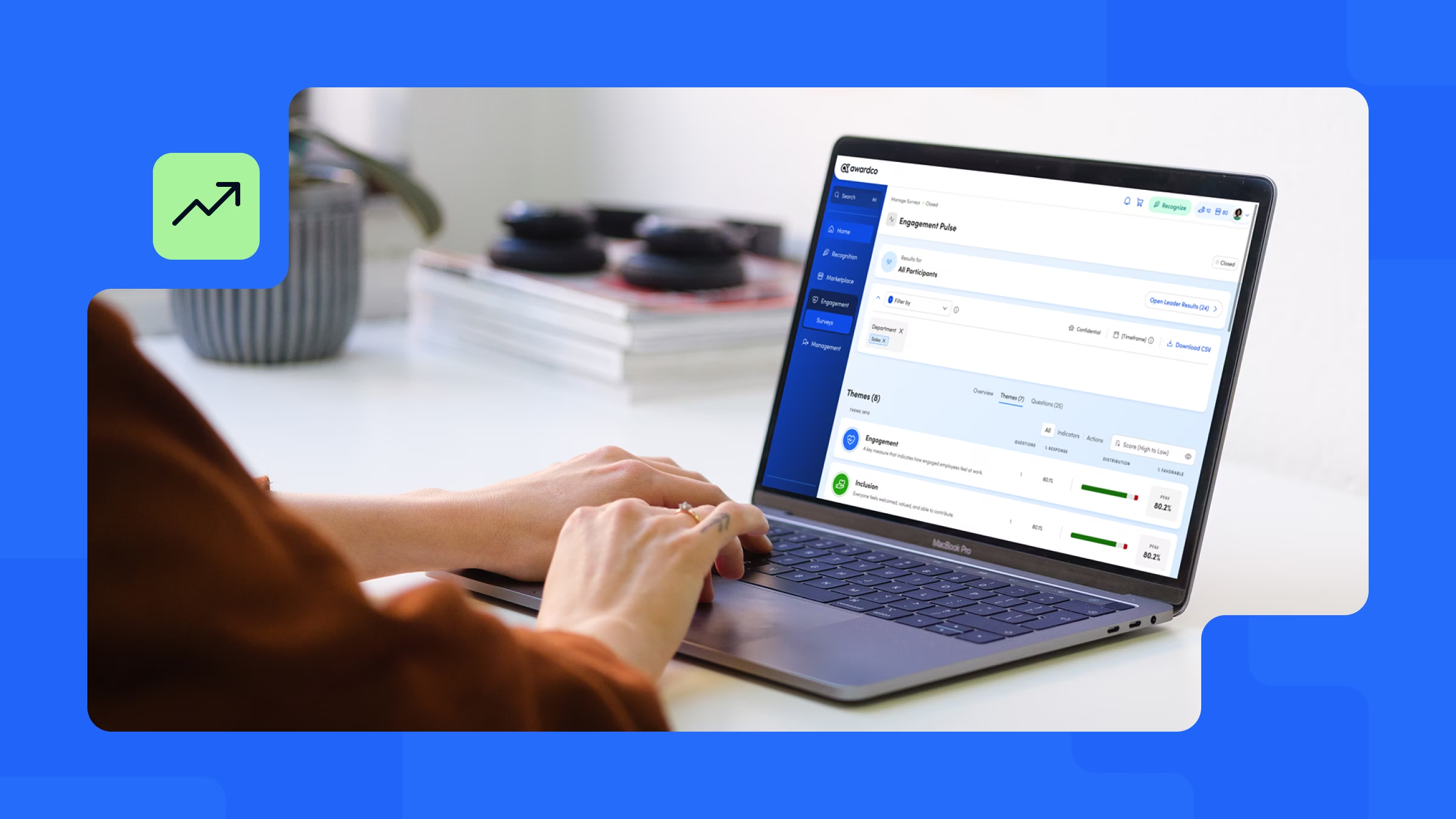
Awardco's reporting and analytics tools give administrators visibility into login activity, recognition volume, budget health, and redemption patterns, filterable by department, region, manager, or program. Depending on your plan, ongoing technical guidance and quarterly business reviews may also be available through Awardco's platform support resources.
Measure adoption, experience, and business relevance
Resist the urge to chase a single ROI number in year one. A more useful framework looks at three layers:
- Adoption metrics: login and activation rates, participation by location and manager, repeat participation, and manager involvement.
- Program health metrics: budget utilization, approval time, redemption rate, and how recognition is distributed across the workforce.
- Business-outcome indicators: employee sentiment, retention patterns, onboarding completion, and administrative time saved.
Customer results like Lineage's and NIBCO's are useful benchmarks, but correlation isn't causation. Define your own baseline, comparison group, and timeframe before you call a result an ROI figure.
Choose a partner for the whole lifecycle, not just the launch
The best enterprise recognition program isn't the one with the longest feature list. It's the one employees actually use, managers reinforce, administrators can govern, and leaders can see improving quarter over quarter. That takes a platform built for enterprise scale and a partner willing to stay involved well past the kickoff call.
If you're planning a launch or rethinking one that's stalled, see Awardco in action or explore the global recognition platform to see how the pieces fit together for organizations your size.






.svg)


.svg)