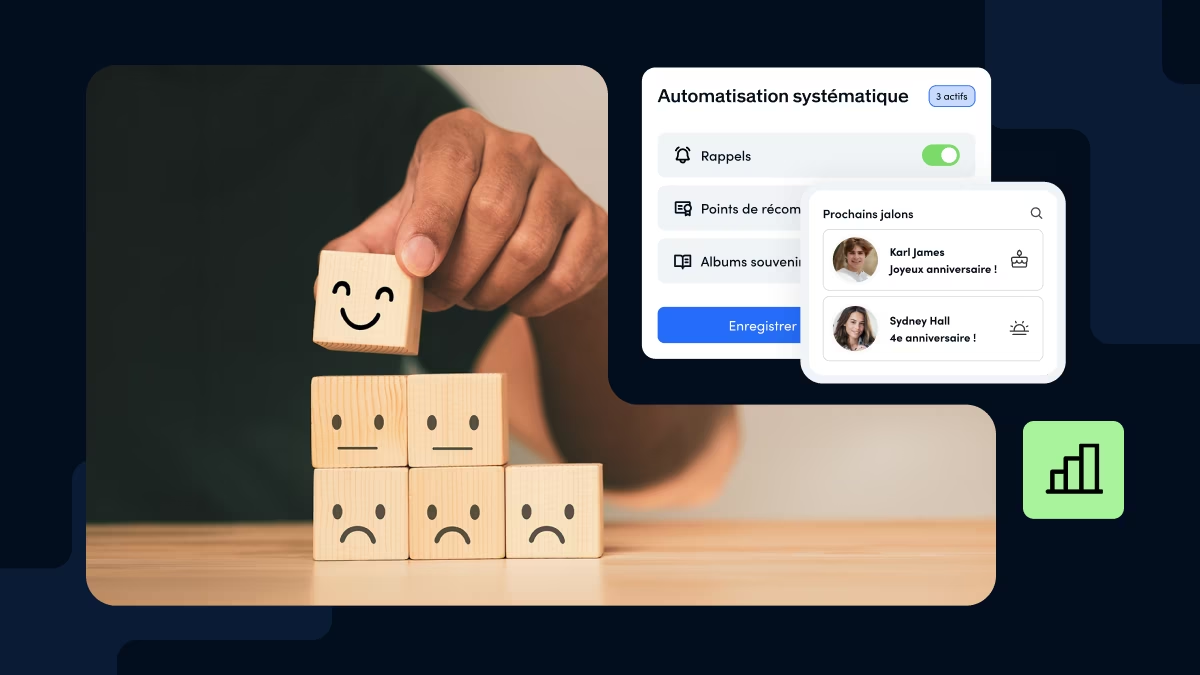

There is no single type of motivation that works for everyone. We are each a complicated mix of experiences and preferences. Most employees stay energized when they have meaningful work, clear expectations, some autonomy, room to grow, supportive managers, and visible recognition for the impact they create. Adding rewards can reinforce specific behaviors or give employees useful choices, but they work best when layered on fair pay, manageable workloads, purpose, and genuine appreciation.
That is the short answer. The longer answer is one I have been chasing for most of my career, and it started with a breakfast, and before that, a washing machine.
The breakfast that taught me what motivation actually looks like
Years ago, I led a massive employee event at a tech company: a global soccer tournament that flew employee athletes in from offices around the world. I ended up managing the laundry logistics for 40-plus players, which is its own story involving mesh bags, an industrial dryer, and my 11-year-old daughter asking me at midnight why my "new job" required this much sorting of jerseys.
The event went off beautifully. And shortly after, I was invited to a small breakfast with the company's CEO, who thanked the event team personally and talked about culture, teamwork, and the kind of cooperation that actually drives innovation.
That combination stuck with me. It was personal. It came from the top. It was close in time to the effort. And it was followed by something tangible I could choose for myself. I have spent the years since trying to understand why that moment worked so well, and it turns out the research backs up exactly what I felt that morning.
Gallup has found that the most memorable recognition employees receive most often comes from their manager (28 percent), followed by a high-level leader or CEO (24 percent). A few minutes of a senior leader's attention can become a career highlight. That single breakfast confirmed something I now build entire programs around: who delivers recognition matters almost as much as the recognition itself.
What is employee motivation, really?
Motivation is the internal and external force that shapes how much effort someone puts in, in what direction, and for how long. It is not a personality trait some employees have and others lack. It is closely related to two other ideas that get used interchangeably, even though they answer different questions.
- Motivation is why someone directs effort toward a goal or behavior.
- Morale is how someone feels about their work, their workplace, and their relationship with the organization.
- Engagement is how connected someone feels to their work, their team, and the organization as a whole.
These three overlap, but they are not the same thing. An employee can feel engaged with and supported by their team while still being demotivated by an unmanageable workload. Someone can push hard to hit a short-term deadline while their overall morale is low. Understanding which lever you are actually pulling matters more than most engagement strategies acknowledge.
Intrinsic and extrinsic motivation need each other—and neither is better
Intrinsic motivation comes from enjoyment, curiosity, mastery, autonomy, purpose, and pride in the work itself. Extrinsic motivation comes from outside conditions: pay, rewards, recognition, status, incentives, and career opportunity.
These are not opposing forces competing for the heart of the same employee; they compliment each other. And recognition is one of the few tools that bridges both. A specific, well-timed acknowledgment makes an employee's internal sense of accomplishment visible, and ties the accomplishment back to team and company goals.
Rewards can reinforce a behavior, surprise and delight, or give an employee a meaningful gift, but they were never meant to replace fair compensation or reasonable working conditions. No short term gift card fixes a deeper burnout problem.
What actually motivates employees
Our team at the Awardco Center of Excellence (COE) has studied this question directly, and the honest answer is that no one is driven by a single motivator. Depending on the moment and the task, employees are impacted by their own unique mix of :
- Material reward
- Expectations from colleagues
- Expectations from personal life
- Contribution to something larger than themselves
- Ideology, including mission, values, learning, and growth
- Achievement
- Enjoyment of the work itself
The same person might be driven by achievement on one project, contribution on another, and a practical reward on a third. Programs that offer only a blanket solution or assume one motivator fits an entire workforce will always underperform.

Five motivation profiles worth understanding, not labeling
Our research also surfaced five patterns that show up across teams based on a factor analysis of motivation styles. These are useful as a diagnostic lens, a moment in time, not as permanent boxes to put people in.
- Actively demotivated: low enjoyment, purpose, and connection. Start with listening, workload, and consistent acknowledgment from leadership.
- Disconnected: getting work done competently but with a weak sense of how it connects to the bigger picture. Tie individual contributions to customer, team, and company outcomes.
- Obligated: effort driven mostly by pressure or external structure. Build in more autonomy, progress markers, and meaningful feedback.
- Bought in: strong internal drivers like purpose and enjoyment already exist. Sustain that with visible appreciation and room to grow.
- Firing on all cylinders: internal motivation and external reinforcement are working together. Protect those conditions, and resist the temptation to quietly load more work onto your best people.
The goal is never to assume we can move every employee from the first into the last category. It is to add channels and opportunities for recognition that move people into a more consistently engaged state.
Why engagement and recognition work better together
Let’s put it all together. Engagement without recognition becomes invisible effort: people are connected to the mission, but no one ever tells them their specific contribution matters. Recognition without engagement becomes a string of disconnected transactions, points and prizes with no thread of meaning behind them. The latter can also create a culture of entitlement if it is always connected to a monetary reward (e.g. everytime I do X, I get $Y)
The system works better when the pieces are connected:
- Listening identifies what employees actually need and where the barriers are.
- Consistent, meaningful recognition reinforces contribution, progress, values, and belonging.
- Rewards add flexibility and create an occasion by offering something tangible or experiential the employee values
- Reporting creates a feedback loop that shows leaders whether recognition is reaching everyone or just the loudest voices in the room.
This is exactly the gap tools like Awardco Engage are built to close, connecting feedback, recognition, and rewards inside one experience so leaders are not managing three disconnected systems and hoping they add up to a culture.
Eight practical ways to motivate employees
Recognition is strongest when it is timely, specific, performance based, and connected to emotion. Here are ways to make the effort sustainable:
- Give employees meaningful autonomy and choice. Real agency in decisions, project ownership, and reward selection motivates far more than a superficial menu of pre-approved options.
- Connect daily work to purpose and impact. Show people how their work touches customers, teammates, and company goals. Recognize the "how," not just the "what."
- Make recognition timely, genuine, and specific. Describe the behavior, explain the impact, and connect it to a value or goal. Recognition that arrives months later loses most of its power.
- Distribute recognition across leaders, managers, and peers. Senior-leader recognition carries weight for visible impact. Manager recognition supports day-to-day progress. Peer recognition reinforces collaboration. Watch for proximity bias so remote, frontline, and less visible employees are not left out.
- Create room to learn, grow, and achieve. Development plans, mentorship, stretch assignments, and recognition for progress, not only final outcomes.
- Listen, act, and close the loop. Surveys and pulse checks only build trust if employees see what changed because of what they said.
- Address workload and burnout directly. Burnout is not a motivation deficit, and no amount of recognition should be asked to compensate for chronic overwork or understaffing.
- Match rewards to the employee and the moment. Some people want a gift card. Others want an experience, a charitable donation, or simply public acknowledgment. Offer real choice.
Employees notice which of these are missing faster than leaders expect. According to Gallup, only about one in three U.S. workers strongly agree they received recognition or praise for good work in the past seven days, and employees who do not feel adequately recognized are twice as likely to say they will leave within the year. That is not a small gap to close.
How managers can motivate employees every day
Managers carry more of this weight than most job descriptions admit. A short checklist worth keeping visible:
- Set clear expectations and explain why the work matters.
- Ask employees what kind of feedback and recognition actually feels meaningful to them.
- Recognize progress and collaboration, not only final results.
- Use specific, real examples in one-on-ones and team meetings.
- Respect whether someone prefers public or private acknowledgment.
- Check workload before handing more to your highest performers.
- Talk about growth and career goals on a regular cadence.
- Escalate barriers that are outside your control instead of absorbing them silently.
One caution worth repeating: manager recognition is not a substitute for fair pay reviews, promotions, or adequate staffing. It should sit alongside those decisions, not be a stand in for the absence of them.
How to measure employee motivation and morale
No single number proves motivation is improving. It’s often a combination of sentiment, behavior, and outcome signals.
Listening and sentiment signals:
- Survey items on purpose, belonging, recognition, manager support, and workload
- Open-text themes from qualitative feedback
- Trends by team, tenure, and work arrangement
Recognition and participation signals:
- Recognition reach and participation rates
- Frequency by manager, team, and employee population
- Distribution across leaders, managers, and peers
- Time between contribution and recognition
Business and workforce signals:
- Retention and regrettable attrition
- Internal mobility and development participation
- Productivity or quality measures appropriate to the role
This measurement matters because the cost of getting it wrong is real. Gallup estimates that declining engagement cost the global economy 438 billion dollars in lost productivity in a single year, and global engagement has slipped to around 21 percent, among the lowest levels recorded since the pandemic. Meanwhile, 89 percent of organizations in North America already have a recognition program in place, which tells me the gap is rarely about whether a program exists. It is about whether the program is actually working.
Build a motivation strategy that lasts
A phased approach keeps this from becoming another one-time initiative that fades by the next fiscal year.
- Diagnose using listening data, recognition data, manager input, and workforce context.
- Prioritize one or two motivation barriers instead of trying to fix everything at once.
- Design the recognition moments, sources, frequency, and reward options that fit your culture.
- Enable managers with training and make participation simple.
- Measure adoption, reach, sentiment, and outcomes.
- Improve by telling employees what changed and refining from there.
Frequently asked questions
What motivates employees at work? Employees are motivated by a mix of meaningful work, autonomy, achievement, growth, contribution, fair compensation, recognition, and practical rewards. The right mix varies by person, so leaders should rely on listening and participation data rather than assuming one motivator fits everyone.
How do you motivate employees? Start by understanding what is helping or blocking motivation. Set clear expectations, connect work to purpose, offer appropriate autonomy, create growth opportunities, address workload and burnout, and make recognition timely and specific. Rewards reinforce progress, but they work best as part of a broader employee experience.
Does employee recognition motivate employees? Yes, when it is genuine, specific, timely, and distributed across leaders, managers, and peers. Recognition should complement, not replace, fair pay, manageable workloads, strong management, and development.
What is the difference between employee motivation, morale, and engagement? Motivation is the force behind effort and persistence. Morale is how employees feel about their work and workplace. Engagement is how connected they feel to their work, team, and organization. The three overlap but point to different questions.
How can managers motivate employees? By clarifying expectations, explaining impact, offering autonomy, recognizing specific contributions, supporting growth, listening to concerns, managing workload fairly, and following through on what they say they will do.
How do you measure employee motivation? Combine multiple signals: survey items on purpose and recognition, open-text feedback, recognition participation and frequency, retention, and role-appropriate performance measures. No single metric proves motivation on its own.
What rewards motivate employees the most? There is no universal answer. Some employees prefer practical gift cards, others value experiences, learning, wellness, or charitable giving. The best approach offers meaningful choice and local relevance.
How can companies motivate remote and frontline employees? Make recognition and feedback accessible through the tools employees actually use, including mobile and shift-friendly options, and track recognition reach by work arrangement so no group is quietly left out.
The washer and dryer moment
I still think about that recognition catalog from years ago, the one that generously included a washer and dryer set alongside gift cards and experiences. I did not choose the appliances. I chose the gift card, because I was renting at the time and needed something flexible. But the fact that the choice existed, paired with a genuine thank you from someone at the top, is what made the moment land.
That is the whole idea behind building recognition and engagement together instead of treating them as separate line items. Listening tells you what your people need. Recognition tells them it was noticed. Rewards supercharge recognition and give them a way to actually experience that appreciation on their own terms.
See how Awardco can connect recognition, rewards, and employee feedback in one experience built around the way your people actually want to be motivated.





.svg)


.svg)