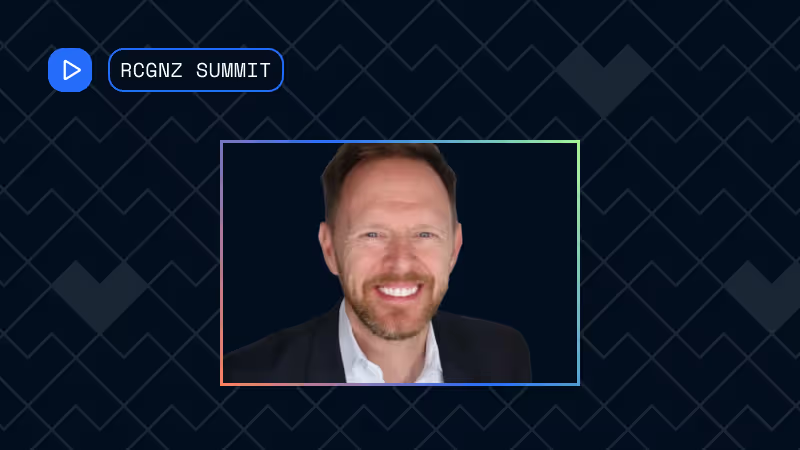


Points saillants de la conférence du futurologue Mike Bechtel au Recognize Summit :visionnez l'enregistrement complet ici.
Lorsqu'ils entendent le mot « futurologue », les gens réagissent généralement de deux façons : certains sont intrigués, d'autres se préparent à un discours exagéré. Mike Bechtel, futurologue en chef pour de nombreuses entreprises du Fortune 500, est venu au Recognize Summit avec une mission différente : aller à l'essentiel, démystifier les nouveautés et rappeler aux dirigeants qu'à l'ère de l'IA, l'humain est plus important que jamais.
Voici un résumé de ses grandes idées et des stratégies qu'il a partagées.
1. La technologie a toujours été un outil, pas un remplaçant
Bechtel aborde le sujet en anthropologue plutôt qu'en technologue, en partageant ces observations :
- Les premiers humains ont taillé des pierres pour manger plus rapidement.
- Les Sumériens utilisaient des tablettes d'argile comme ancêtres des disques durs externes.
- La presse de Gutenberg était le « copier-coller » avant l'heure.
Chaque étape était une astuce pour libérer du temps humain pour des tâches à plus grande valeur ajoutée.
Si l'on pense au « vélo pour l'esprit » de Steve Jobs et à ce que l'on appelle aujourd'hui la « fusée pour l'esprit », le modèle reste le même : l'informatique n'est pas une force étrangère. C'est simplement le dernier outil en date d'une lignée de deux millions d'années où l'humain cherche à se donner des leviers.
L'objectif n'est donc pas de chercher comment remplacer les humains par la technologie, mais de trouver comment appliquer les bons outils aux bons problèmes pour maximiser le travail humain.
2. La logique derrière les nouvelles technologies
L'équipe de Bechtel a collaboré avec le Forum économique mondial pour tester une idée simple : peut-être que l'avenir de la technologie est plus prévisible qu'il n'y paraît.
En remontant aux premiers ordinateurs, jusqu'aux mainframes, aux PC et aux téléphones, il observe les trois mêmes éléments qui reviennent constamment :
- Une interface (comment l'humain interagit)
- Une base de données (où les informations sont stockées)
- Un moteur de calcul (où le travail est effectué)
La forme change, mais trois tendances profondes se répètent :
- La simplicité gagne. Les interfaces évoluent des lignes de commande vers les interfaces graphiques, le tactile, la voix, et enfin vers le « montre-moi simplement ce dont j'ai besoin ».
- L'intelligence gagne. Nous passons des calculs de base à l'analytique, puis à la prédiction et à la simulation.
- L'abondance gagne. La puissance de traitement et le stockage deviennent de moins en moins chers et de plus en plus accessibles.
C'est la carte au trésor que les dirigeants peuvent utiliser pour distinguer les modes des fondations durables. Si une innovation ne rend pas les choses plus simples, plus intelligentes ou plus accessibles, elle ne durera probablement pas.
3. Informatique spatiale, blockchain et perspectives d'avenir
Bechtel a abordé plusieurs termes à la mode parfois intimidants pour les recadrer comme des évolutions plutôt que des révolutions :
- Informatique spatiale : Des casques encombrants aujourd'hui, des lunettes élégantes demain, et à terme, des interfaces qui s'affranchissent des écrans. L'important n'est pas le gadget, mais de dépasser le rectangle 16:9 pour permettre aux gens de visualiser l'information de manière plus naturelle et utile.
- Blockchain et plateformes décentralisées : Si l'on écarte le battage médiatique et les arnaques, il reste une chose simple : la vérité cryptographique. Dans un monde de « deepfakes » et de contenus générés par IA, la preuve par la chaîne devient un moyen puissant de valider ce qui est réel.
- Informatique quantique et interfaces cerveau-machine : Encore au stade embryonnaire et étrange, ce sont simplement de nouvelles façons de résoudre des problèmes complexes et d'étendre les capacités humaines, notamment en matière d'accessibilité et de santé.
Tout cela ne sont que des outils. Ce qui compte vraiment, c’est la façon dont nous choisissons de les utiliser.
4. L’IA n’est pas une pilule amaigrissante, c’est une fusée.
Les discours les plus courants sur l’IA ont tendance à être extrêmes : soit elle sauvera le monde, soit elle le détruira.
L’approche de Bechtel est plus pragmatique :
- L’IA n’est pas une case dans un tableau, c’est la ligne entière : toutes les façons dont les ordinateurs prennent en charge des tâches que nous faisions nous-mêmes auparavant.
- Les systèmes actuels ne sont pas aussi performants que vos meilleurs éléments, mais ils surpassent le reste de votre équipe sur bon nombre de tâches répétitives liées au savoir.
- Si les organisations n’utilisent l’IA que pour réduire les coûts, elles la traitent comme une pilule amaigrissante pour entreprise. Vous vous retrouvez avec votre plan de 2024, simplement plus mince.
On ne peut pas atteindre l’excellence en se contentant de réduire la voilure.
Bien utilisée, l’IA devient un moyen d’élever les gens, pas de les effacer. Elle prend en charge le travail répétitif afin que les humains puissent consacrer plus de temps aux éléments qui distinguent réellement votre culture, votre expérience client et votre marque.
5. Rehausser la barre du « ce n’est pas mon problème »
L’une des métaphores les plus utiles provient d’un cadre de chez LEGO :
- Les enfants ne sont pas là pour construire un ensemble. Ils sont là pour créer des souvenirs.
- Le problème ? La recherche interminable de minuscules pièces. Le temps passé à chercher la brique est du temps volé à la magie de la construction.
LEGO adore une application alimentée par l’IA qui scanne un tas de briques et vous montre ce que vous pouvez créer. Elle ne remplace pas le jeu. Elle rehausse la barre du « ce n’est pas mon problème » pour que les gens passent moins de temps sur les tâches ingrates et plus de temps sur la magie.
Appliquez cela à votre propre réalité :
- L’administration, les rapports, les approbations répétitives et la rédaction de base sont vos petites briques.
- L’IA et l’automatisation peuvent dégager cette voie.
- Vos employés peuvent alors consacrer leur énergie au coaching, à la stratégie, à la reconnaissance, à la résolution de problèmes et au renforcement des relations.
La technologie n’est pas la vedette. C’est l’expérience qui l’est.
6. Pourquoi les humains comptent plus que jamais
Bechtel conclut avec trois compétences très humaines qui deviennent plus précieuses dans un monde dominé par l’IA :
- Ingéniosité
- Poser de meilleures questions
- Essayer des invites inattendues
- Voir des possibilités que les autres manquent
- Empathie
- Entendre ce dont les clients et les employés ont réellement besoin
- Comprendre le contexte, la nuance et l’émotion
- Concevoir des expériences qui semblent humaines, et pas seulement efficaces
- Initiative
- Agir sans y être invité
- Repérer un besoin et intervenir
- Transformer des idées en expériences, et des expériences en résultats concrets
Ces trois éléments correspondent étroitement à ce que les programmes de reconnaissance efficaces sont conçus pour renforcer. Lorsque vous mettez en lumière les personnes qui font preuve d’ingéniosité, d’empathie et d’initiative, vous préparez votre culture pour l’avenir.
Selon les mots de Bechtel, ce n’est rien de moins que de l’intelligence, du cœur et du courage.
7. Ce que les leaders peuvent faire dès maintenant
Pas besoin d’un titre de futuriste pour passer à l’action. Vous pouvez :
- Éliminez le superflu
- Où votre équipe est-elle ensevelie sous des tâches répétitives à faible valeur ajoutée ?
- Où l’IA ou l’automatisation pourraient-elles raisonnablement prendre le relais ?
- Redéfinissez les rôles autour de la « magie »
- Protégez le temps consacré au coaching, à l’écoute, à la résolution de problèmes et au travail créatif.
- Clarifiez que c’est ce travail qui compte le plus.
- Valorisez les comportements tournés vers l’avenir
- Soulignez le travail des employés qui expérimentent intelligemment de nouveaux outils.
- Célébrez ceux qui font preuve d’empathie et d’initiative pour soutenir leurs collègues et clients.
- Utilisez votre plateforme de reconnaissance pour lier ces comportements à vos valeurs.
- Évitez les extrêmes
- Ne cédez ni à la panique ni à l’engouement aveugle.
- Posez-vous la question : cela simplifie-t-il le quotidien, rend-il les choses plus intelligentes ou plus accessibles pour nos gens ?
Pour découvrir l’ensemble des récits (incluant les spectacles de drones, les interfaces cerveau-ordinateur et pourquoi la blockchain pourrait être plus importante que vous ne le pensez), visionnez l’enregistrement complet de la conférence de Mike au sommet RCGNZ.










.svg)




.svg)